wildcat2030:
A team of neuroscientists has found a key to the reduction of forgetting. Their findings, which appear in the journal Neuron, show that the better the coordination between two regions of the brain, the less likely we are to forget newly obtained information. The study was conducted at New York University by Lila Davachi, an associate professor in NYU’s Department of Psychology and Center for Neural Science, and Kaia Vilberg, now a postdoctoral researcher at the University of Texas’ Center for Vital Longevity and School of Behavioral and Brain Sciences in Dallas. “When memories are supported by greater coordination between different parts of the brain, it’s a sign that they are going to last longer,” explained Davachi. It is commonly understood that the key to memory consolidation — the cementing of an experience or information in our brain — is signaling from the brain’s hippocampus across different cortical areas. Moreover, it has been hypothesized, but never proven, that the greater the distribution of signaling, the stronger the memory takes hold in our brain. In the Neuron study, Davachi and Vilberg sought to determine if there was scientific support for this theory. To do so, they examined how memories are formed at their earliest stages through a series of experiments over a three-day period.
Neuroscientists find a key to reducing forgetting: It’s about the network
Published by Cali Lili™ Cali Lili Indies™ Pictures Words Music In Motion™ feMt0™studi0*surFLoft*H20™VenusBeach™CuttingEdgeOfThePacific™
Informal Biography + Anecdotes :
"I'm still that teenage runaway with a scholarship ... lol, I got a Masters' Degree from NYU, but no high school diploma ... "
Actress * Director * Singer * Songwriter Cali Lili skipped several grades (having been tested as reading at college level in grade school) took her first college course in the entire works of Shakespeare, at age 13, never graduated high-school, never even went to a prom, was swooped up, landing at NYU, then completed her Masters' Degree on full scholarship with awards / stellar reviews for early works.
The Cali Lili ™ Band recorded a completely original stand-alone "Urban / World / Rock © " styled Singer-Songwriter Debut Album which forms the core of the soundtrack for her debut feature film :
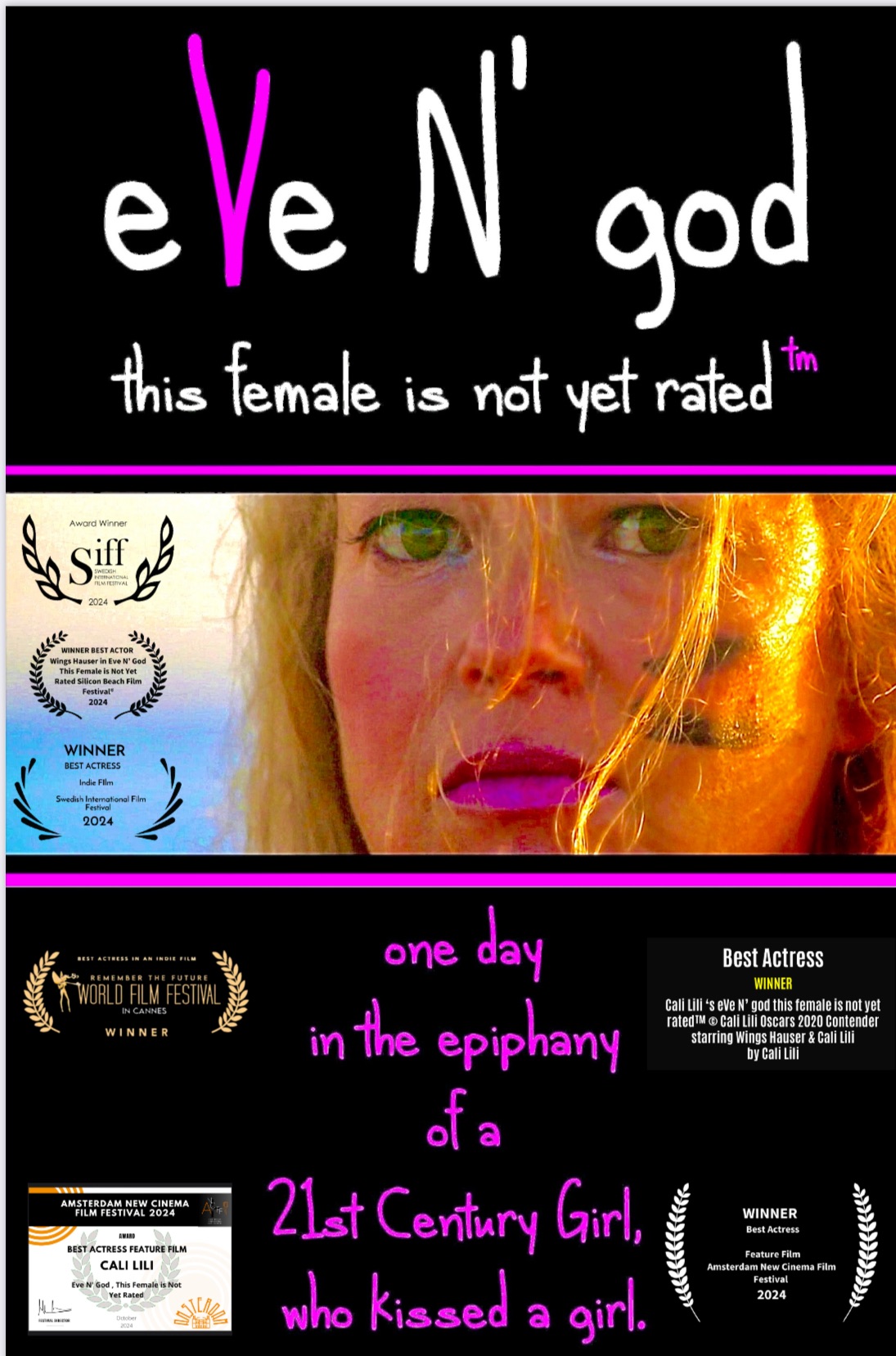
'eVe N'god ™ this female is not yet rated ™ ' now streaming on demand on iTunes 🍎Apple TV etc…
She made the feature length narrative motion picture with an ALL FEMALE production team.
'eVe N'god this female is not yet rated ™ ' is perhaps, the first ( or one of the first ) production of it's kind : a theatrical feature length motion picture, in which the technical production roles employed only women during principal photography. She began pre-pre-production on this "fempoword™" project in 2010, including rehearsal footage.
Cali is told that she was born "early" and "on the water." Having experienced an extremely difficult childhood, she does not revisit those days, and often speaks out against abuse.
Born of multi-cultural heritage, Cali is keenly aware and concerned with what she sees as a form of "tribalism" too often employed as "nationalism." Cali writes about these issues and acts accordingly when it comes to her public image.
Cali adores being an actor and takes that craft very seriously, but found herself turning down 3 acting offers, that she felt were disempowering to women, in order to "turn up" what she calls fempower (TM) by scraping together "half a shoestring budget" to build her "green" "off-grid," upcycled "surfshack" feMt0™studi0 in the "floating" neighborhood of Venice Beach in Los Angeles, California where she makes "Signature" auteur Motion Pictures, Albums and Books, "TinyMultiMedia™️ HandMade2MakeADifference™”©
Based on the quality of her work as an artist, and her uncompromising dedication to excellence, she then raised modest financing for her upcoming Slate of Motion Pictures, Albums, and Books.
She works from the Cutting Edge Of The Pacific ™" @ The Cali Lili Indies ™ " where she stays "afloat" connected with her love and devotion to "rippling waters of the world"
Cali's degree included extensive studies in anthropology as well as performance techniques from all over the globe. She holds an added background of intense New York studies in dance /choreography.
Cali is proud to share her deep connection with "Mother Africa." She is greatly inspired by African culture, the cultures of Oceania, and that of her other diverse intercultural studies.
Cali's quote :
"We all originate from one mother in Africa, the Ocean is our collective unconscious, so let us honor each other, our mutual mother, our waters, and our blue mothership, earth. In doing so, we save ourselves "©
Cali's films are inclusive of lgbtq characters and the authentic real lives of these characters. She also delves into the reality of "being female" and a "multi-cultural blend" who "appears to be white," in a biased world.
Cali's career in movies began as a teenager, flying back and forth from NY to LA, while working as an "au pair."
As a kid, she "raised herself" in spite of an abusive childhood and vowed she would never marry, but she married her male partner in 2012, contrary to gossip that they were married earlier.
The partnership between Cali and Wings is unique and her work / films reflect upon relationships and gender / orientation / politics in culture and society in the 21st Century .
Womens' Rights, Human Rights, Feminist, Lesbian, LGBTQ and Bi-Sexual matters are included, along with other Social Justice and Environmental Justice as part of her projects, sharing stories about the authentic lives of characters navigating the "waters" of the 21st Century.
With legendary 'Edward G. Robinson as one of the distinguished members of her ancestry, Cali dedicates herself to honoring a tradition of excellence and earning her "place" as an up-and-coming young artist.
She has been granted the rights to the favorite novel of legendary 'Zane Grey (I) by Grey's son Loren Grey ( writer and educator) for a film adaptation in which she will co-star.
As a young Indie Performer and Creator, Cali and her partner, veteran actor 'Wings Hauser' along with Cali's team of handpicked skilled film and music professionals, are producing a growing catalogue of original films and songs.
Cali is already busy in preps for the next green-lighted project, using her proprietary methodologies as described in her book "The Declaration of IndiePenDance™"
In the past, Cali previously worked in a collaboration agreement deal with Academy Award winning Dutch producer, 'Hans de Weers' (Antonia's Line) which ended when Cali realized it was time to build her own tiny studio, in order to make projects that empower Women, LGBTQIA , Civil Rights and Climate Science communities.
Her wish is to continue sharing her heart with the hearts of the beautiful fans she hears from, daily.
We here at GTA Management, hope you will take some time to support her works.
( GTA Management Biographies )
***
Cali's band page statement :
"Inventing new worlds with my art, saved my childhood.
Dancin' pavement on NYC streets, I learned my craft comforted by the shelter of my Pictures, Words Music In Motion™
I'm a Multi-Cultural "Island Child Wild ™ In The City " so I caught a wave 4 Cali.
My music?
It's eclectic, island child wild™
@CaliLiliCiti™
SurF Tribe, Indigenous City RockVibe™
VenusBeach™
Cutting Edge Of The Pacific™"
***
Signature Trademark Statements : © cali lili all rights reserved:
i am an ArtisanAuteur™
making Signature Trademark Artisanal Indies TinyMultiMedia™️
SustainableMovies™️*Albums*Books with my diversity-based fempowered™ teams We are IndieGoGreen™ GrassRootZSproutZ™ So we allow time 4 ripening, as with fruits, freshly picked, ‘slow-cooked in small batches’ these are secret sauces ; My Aim is 2 Offer Nourishment to strengthen the immune system of Culture Thru my Signature Pictures Words Music in Motion ™ we hope you will find immediate nourishment as with dining on fruit, including fruits from the sea, thus we encourage ‘sipping the oyster’ but also we hope there will be something long-lasting thus, ‘savoring pearls’ I’m Offering You Authentically Indie Films, Music, Books that are "Handmade To Make a Difference ™" MultiMediaOrganiX™ employing ToyBoxTechnology™ they are authentically indie, made for you, direct from my feMt0™studi0 a sustainable ecological reef SurFShackLOFT™ built from upcycled materials in harmony with BluePlanetGreenSpaces™ SociallyResponsive™ OrganicMultiMedia™ "DreamBigTinyFootPrintZ™
please support my work and team:
🏄🏽♀️add positive reviews + ratings🎬
🏄🏿♀️share these innovative projects on social media on all platforms 🎧🎬
🏄🏼♀️add us to your libraries and playlists🎵🎧🎬
Please 🍃🌊🐬🌊
SupportTheARTSustainTheARTIST™️🎧🎬👩🎨🎨 ”
”© Intellectual Property Warning : All Original Materials are © Cali Lili Artist Rights Are rigorously documented rabidly defended. Trademark Statements Copyright protected.
The Cali Lili Indies™ brand is a destination ...
Aspiring to Inspire + Empower™
it's the "SEXY part of SMART ™© "
***
You can see Cali's recent Indie Motion Picture Release on Apple Movies, Vimeo, Amazon and Google Play and you can hear the Soundtrack / Debut Album on Apple Music and everywhere music is streamed. Cali and her team appreciate your support!
" Dream Big, Tiny FootPrintZ™ "
CaliLiliIndies™
PicturesWordsMusicInMotion™
©
" Dream Big, Tiny FootPrintZ™ "
Hey:)
I'm Cali!
I Make
1OfAKind
Signature
PicturesWordsMusicInMotion™
#HandMade
2MakeADifference™
My aim :
"To Nourish
Thru
Pictures
Words
Music
In
Motion™ "
SupportTheART~>
SustainTheARTist™
#SupportTheArtist
#BuyArtFromTheArtist
#Music
📹 eVe N'god™
this female is not yet rated™
Apple Link : 🍎https://itunes.apple.com/us/movie/eve-n-god-this-female-is-not-yet-rated/id1447735793
#HandDrawn #Tees :
https://shop.spreadshirt.com/586666/
#Prints available upon inquiry
#SurF ~> 📹 CaliLiliIndies™
SociallyResponsive™
GrassRootZSproutZ™
indiGoGreen™
RippleZOverTheWaveZ™
GreenSpaceBluePlanet™
BluePlanetGreenSpace™
Art4OurSake™
View all posts by Cali Lili™ Cali Lili Indies™ Pictures Words Music In Motion™ feMt0™studi0*surFLoft*H20™VenusBeach™CuttingEdgeOfThePacific™


 Cali Lili Indies™🏝 PicturesWordsMusicInMotion™🎬🎧 femt0™studi0🏄🏽♀️🏄🏼♀️🏄🏿♀️ CuttingEdgeOfThePacific™🦀 ©CaliLili™AllRightsReserved.