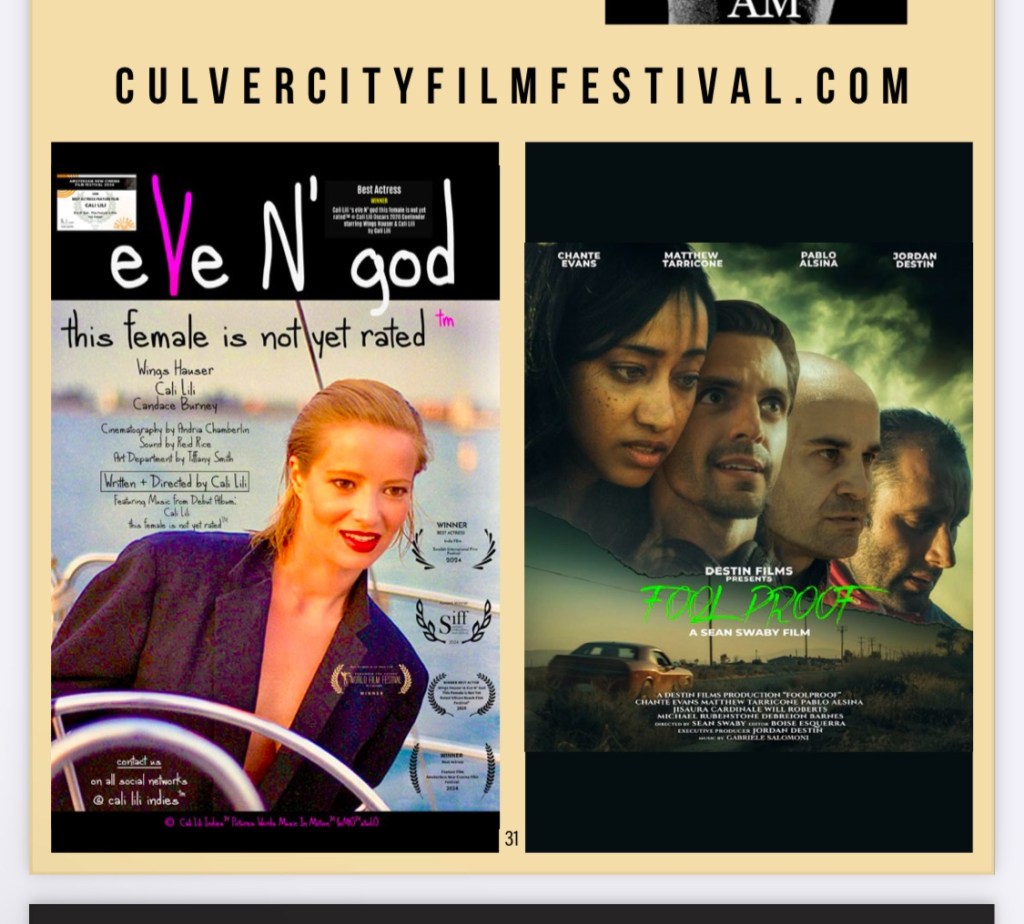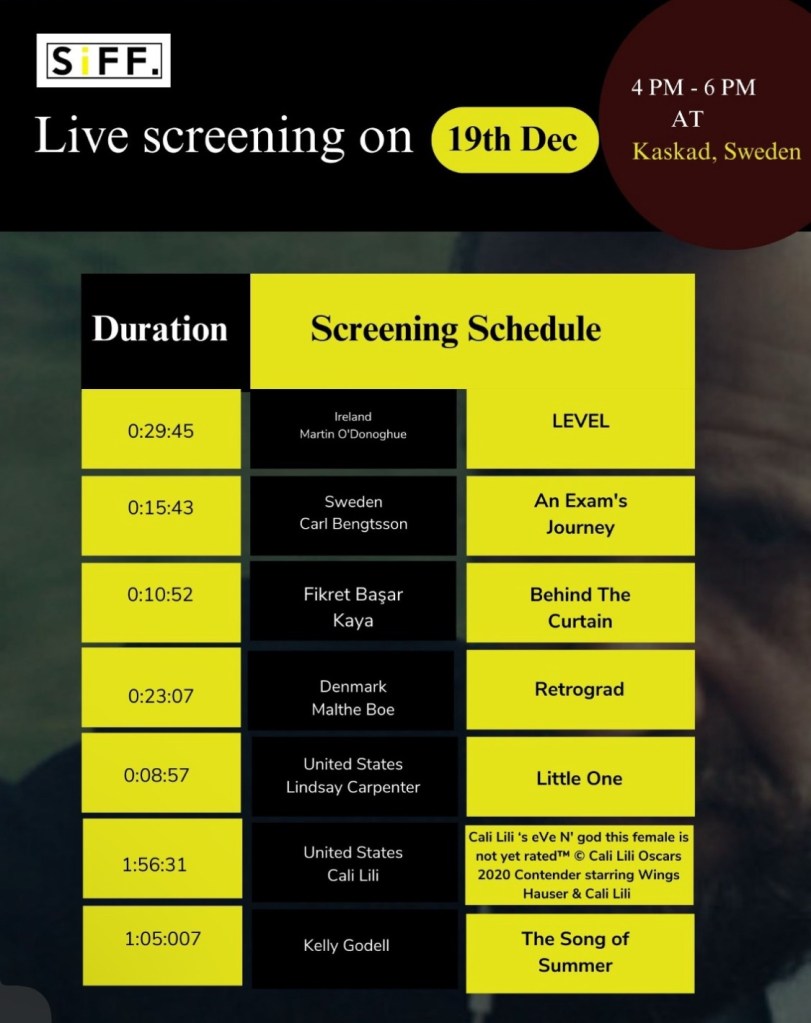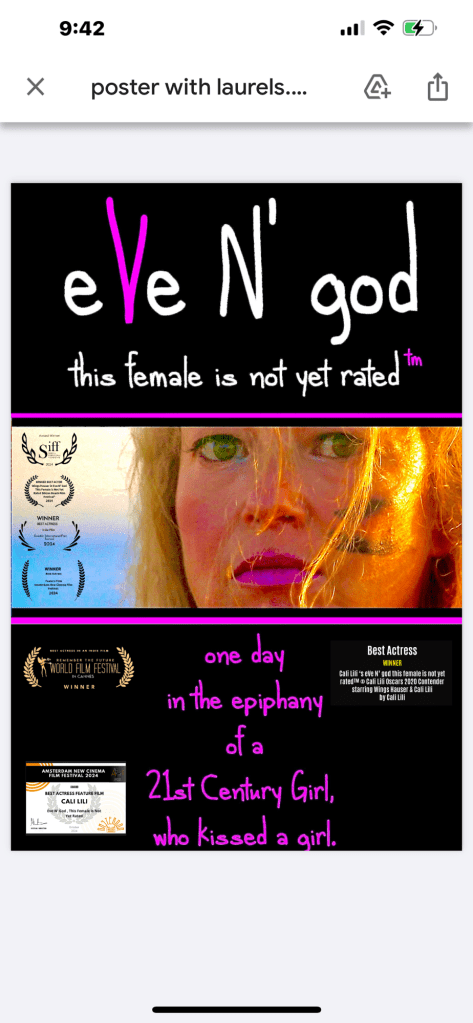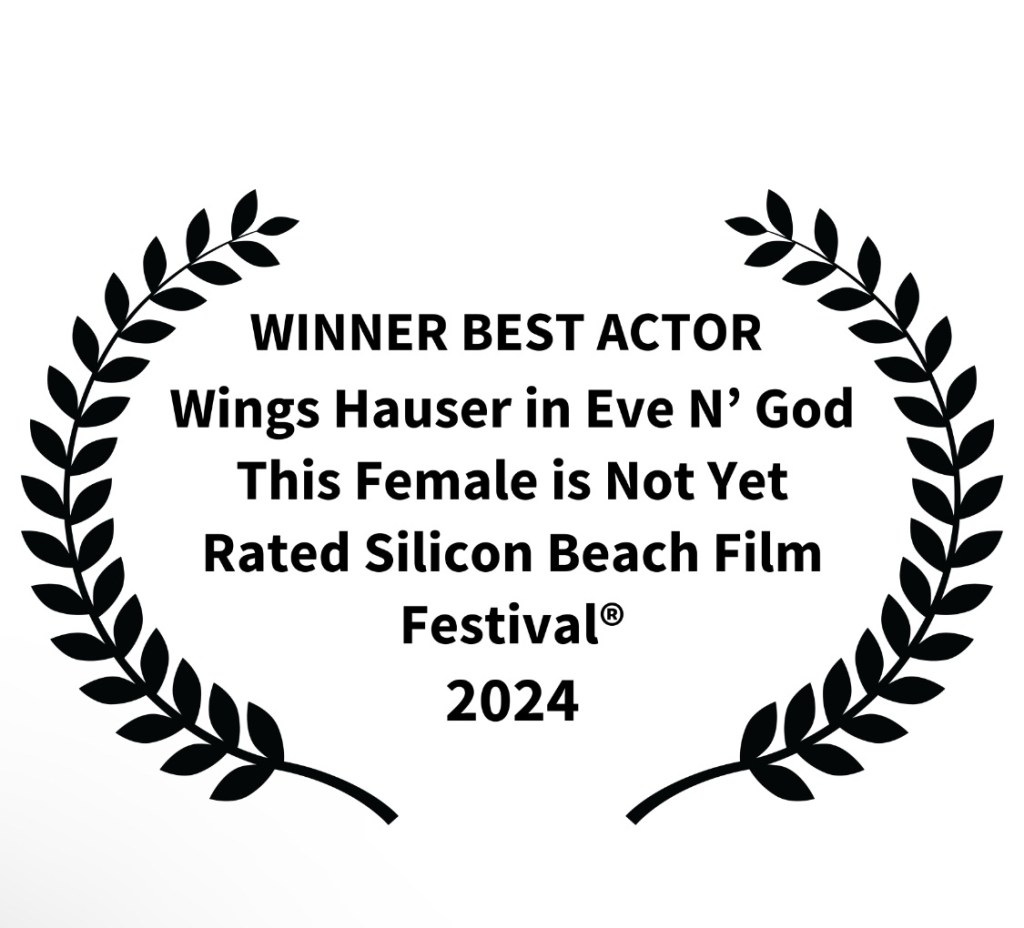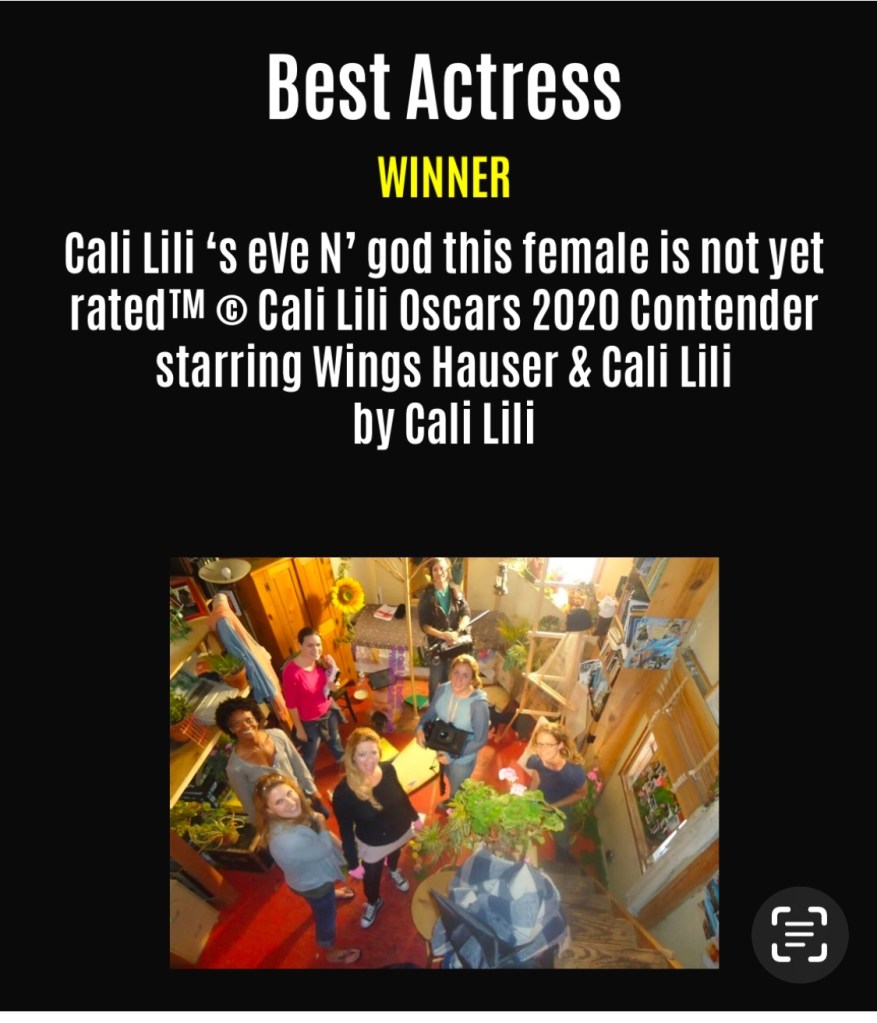
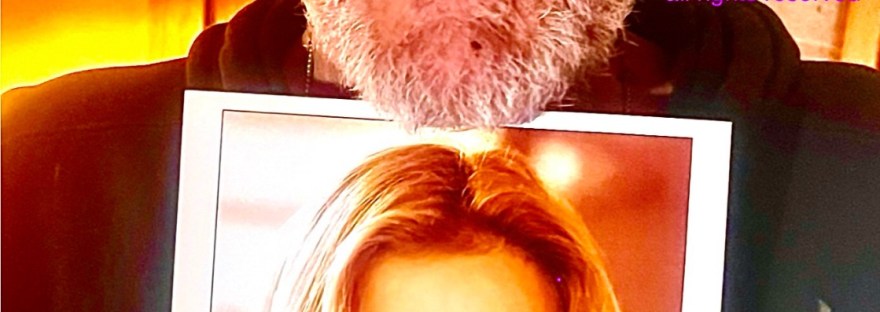
Twenty years ago when you were born I was deeply involved with trying to make a better world for you and your sisters and your brother ERICH to live in. Today I can’t promise you the kind of world I would have liked. I can however take some pride in the fact that it is a little better than it was. In the next 20 years, you and your generation will have a chance to make your contribution. You will not be satisfied with what you accomplish – but may you be able to say – the world is a little better – for the fact that I lived in it. I know it can be.
our Sustainable Studio where we create music, movies and books while also providing a tiny monarch butterfly sanctuary as well as a tiny natural reef for ocean life.
We actively employ the aloha spirit in the creation of our signature form of “aquaculture” Living in wellness & harmony with nature and reflecting that in the work is of utmost importance to the creation of our projects
We send each one out like a ripple on the ocean or one of our monarch butterflies after they emerge from their chrysalis
Full Transcript
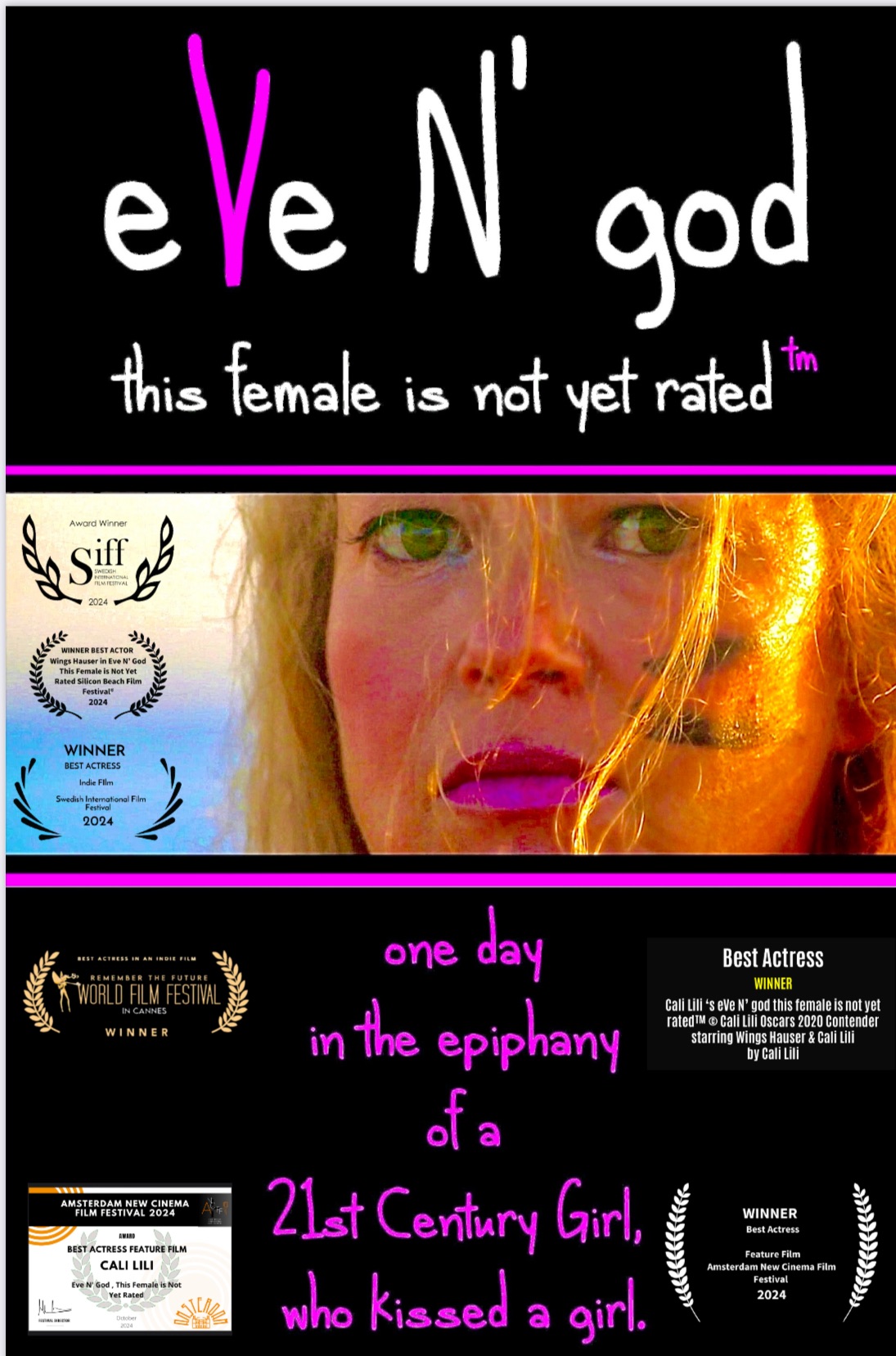
Interview with Cali Lili, Director/Writer and co-star of
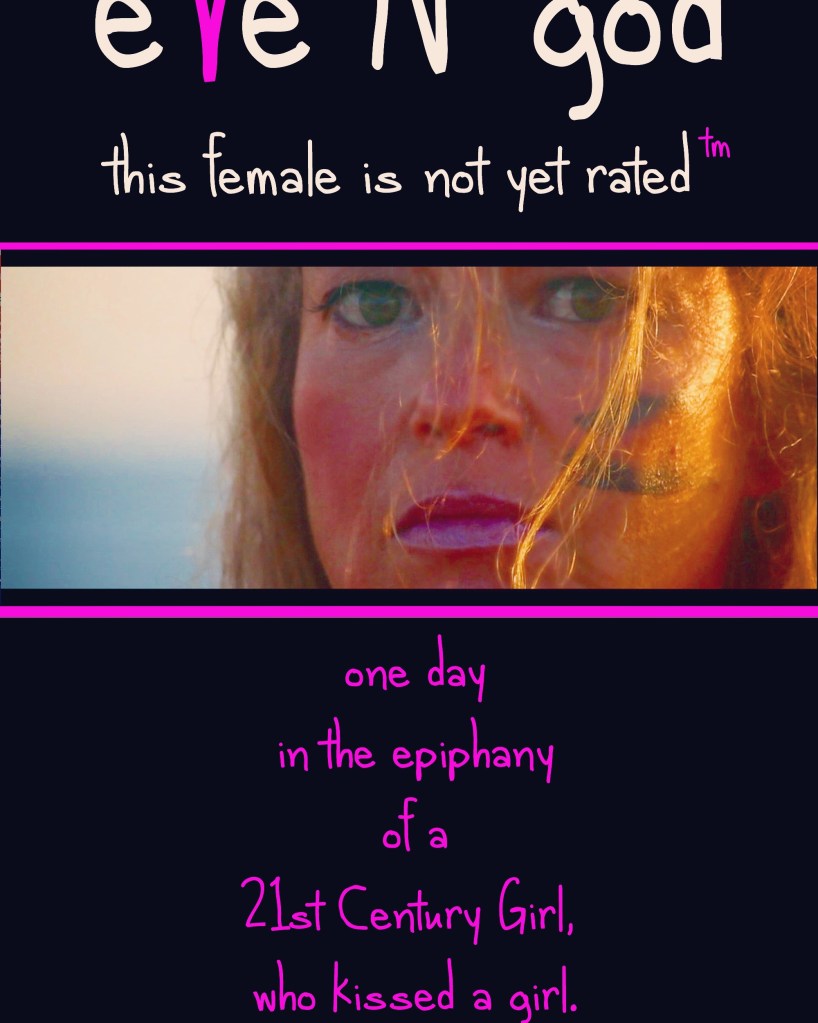
Eve N’ God: This Female is Not Yet Rated
Hi Cali,
It’s such a pleasure to speak with you today. I’ve just finished watching Eve N’ God: This Female is Not Yet Rated, and I have to say, it’s unlike anything I’ve seen in recent times.
Hello Subhabrata and Karma and the Swedish International Film Festival Team !
Thank you SO much for your enthusiasm, thoughtful comments and excellent questions !
On behalf of my co-star & partner, movie icon, Wings Hauser and the entire cast, production & post production teams we are honored and grateful for this opportunity to speak with you and share the first of many future projects with fellow movie & music lovers!
Your film is refreshingly bold and nuanced in so many ways, both in its visual style and its thematic exploration. It’s clear that a lot of thought went into this project and I’m excited to dive into some of the concepts you’ve explored.
Thank you so much !
Let’s dive in !
Speaking of thought, while “thought” does play its part, FEELING is my compass. LOVE is my core, it’s at the heart of our studio and the works we release.
“Eve N’ God ; This Female is Not Yet Rated”
and all our projects are variations of Love Stories. Our structures perhaps don’t duplicate the status quo structure and tenor of most love stories many of us are accustomed to?
Wings and I grew in love as we became more involved in the process of our collaborations as artists and that love continues to sustain us and our work today.
As the movie suggests, there are as many love stories as there are humans because every relationship forms its own vocabulary. Every life form, species, ecosphere, the planet herself becomes stronger through biodiversity. Even simple economics shows us that a portfolio is stronger through diversification. “Even When Divided, Love Multiplies” is a lyric from one of the songs.
I love that you put together the words “bold” and also “nuanced” when referring to my film! Thank you! YES ! I was striving for both! With our debut project, I was hoping to create an “experience.” A “destination.” A “tiny-world-within-the-world” like a “snow globe.“ A place we hope movie & music lovers choose to revisit and notice something new every time.
The movie and stand-alone album / soundtrack are available now on demand at Apple TV, YouTube & Google Play Movies, just search the titles & names. An upcoming book about this debut project and our “sustainable studio,” housed in our “surf shack loft,” will be published in a few months and we hope readers will look out for that and all future music, film & book projects.
I’m thinking it might be fun to include some introductory comments here about my “process,” of making the film “by hand” guided by artisanal principles, to create a “signature blend” in a manner similar to culinary blends. Our studio is hand-built & operates sustainably. That sensibility is infused into the “special sauce“ of hand-making the movie, album and now, the upcoming book. I call it “handmade to make a difference” TM ️ and always infused with SOUL and LOVE.
Every one of our projects is home-spun, like handmade cookies, instead of store-bought. Here is a brief excerpt and preview of the upcoming book about the movie “Eve N’ God This Female is Not Yet Rated,” the album, as well as the process and studio :
“Our sustainable studio organically blossomed from our desire to infuse projects with an authentic ‘mom & pop-up family farm’ essence, a ‘signature blend’ grown from the soil or ‘terroir’ (term used in the making a fine wine) of ‘Classic Hollywood’ nourished, then harvested in our own ‘microclimate’ extending beyond ‘the farm,’ in a manner that resembles ‘farm to table’ or in the case of ‘aquaculture,’ ‘aquaponics,’ ‘Sea to table.’
We view it as the most natural way to ‘grow art’ with roots and traditions, but also offshoots of innovation and then we should be able to ‘bring it to market.’ The “market” may not be quite as ‘organic’ as the art. That’s definitely a problem for many artists (and farmers) throughout the centuries. Certainly still a problem today. But I’m looking forward to a time when more independent artists can simply bring our ‘fruits to market’ just like the farmers market.
Or a painter selling a canvas without all of the gate-keeping complications that serve to shut many artists out. That was the original inspiration for simplifying this process. If a painter can put paint onto a canvas and sell the canvas why can’t an artist do the same with a film? “
“Eve N’ God This Female is Not Yet Rated” is our debut project and we consider it our “first harvest.” Unfortunately Covid and other things delayed the start of the next project, as it delayed the lives of so many people on this beautiful blue planet. We hold hands with everyone affected by forces beyond our control. For us, this ‘ first harvest ‘ paved the way for upcoming projects. The fact that our studio name includes this description :
“Pictures, Words, Music in Motion ™”
hints toward the fact that each project was intended to be realized in all three mediums: movie, album and book.
The book is set to be published in the next few months, completing that phase of the first while we are already preparing the next project.
The entire world is experiencing so many hardships. We are all in this together and our projects intend to share love & encourage kindness & community across boundaries. In fact, one of the themes in “Eve N’ God This Female is Not Yet Rated“ involves communicating beyond boundaries.
Written and shot before Covid two of the main protagonists speak to each other via Zoom throughout the entire movie. But their communication, their connection across that boundary is electric. We are not even certain they’re on the same dimension or planet. Yet their connection is palpable, visceral, eternal. Ultimately for us, it would become somewhat autobiographical.
As a matter of methodology, I was also keen to attend to experiential / feeling factors when it comes to physical production employing methods of organic sustainability. This includes maintaining an organic culture amongst the team. I wanted to create the atmosphere that resembles the intersection of a band and an athletic team. That’s how I think of our teams and as Wings and I are both athletes as well as musicians, this worked really well for us and the team.
Another example, I enlisted local diverse farmers to donate fruits and flowers to the set dressing and crew lunches. So our set dressing is sustainable and to some extent, “edible.” It was important for me to include local farmers. Other culinary aspects involve the fact that we include a scene where Eve employs a huge cleaver to hack open a fresh coconut.
Anyone who has hacked open a Thai coconut understands it’s a little risky. But the reward is divine. I’m pretty sure that was done in one take and that was a bit scary with the size of that clever but the result was delicious. Doctor Goddard cuts lemons throughout the movie and drinks straight up lemon juice. There is an essence of hunger and thirst for “Mother Earth, ” and “SisterOcean™”.
Another example involves the “sustainable wardrobe” with repurposed fabric & clothing. Additionally, the paintings featured in the film were painted by myself and Wings every New Years Day for the past few years. And then there were fun things like some of us doing two jobs. Wings, who co-stars in & co-produced the movie, has a special fondness & facility for serving food! He loves feeding people. So he insisted on managing craft services on the set! For fun! The crew loved what he served! During one lunch, he brought everybody a whole rotisserie chicken, lol the crew was stoked!
In our personal life, although I had spent most of my time living on arugula, I had to learn how to cook because I loved providing nutritional meals for Wings but he was a tough customer because he loves great food and he used to be a chef in a diner. So while he doesn’t cook healthy food, lol he cooks delicious food. I could not serve him healthy food that wasn’t also delicious so I had to learn.
The upcoming book will include recipes I developed that were healthy but became super delicious too! Part of our food theme stems from my concept that media (like meals) can be “nourishing.” For me personally, I think the first “grown-up“ thing I ever did was take responsibility for my own nutrition as soon as I learned what was going on with organic farming and small family farms. The second thing was to take responsibility for any other person that I feed. It was like a bolt of understanding that our food is our future. We are indeed what we eat, what we consume. And it became one of the most palpable and heartfelt ways that I could take care of my beautiful partner. I truly grew to adore cooking for Wings. I still cook for him.
Same with media consumption. The intellectual / creative / informational understandings or misunderstandings are “food for thought.” That’s also what we become when we consume media. Multiple aspects of what we’re doing stem from this methodology and it begins with what I call a “sustainable idea.” For me, that’s an idea infused with both thought & love, both heart and soul. Movies and music take time to seed, water, bloom and harvest and cook. Like fruits, vegetables, and aquaculture / aquaponics which I find especially endearing & inspiring.
As a person who practices & embraces sustainability, wellness, nutrition, and as a dancer / former yoga instructor, I choose to take responsibility for the “sustainability“ of the core idea. If it’s not an idea I can sustain with passion for long periods of time literally from “Farm to Studio” ™️ and beyond then I know it’s not something I can responsibly bring to my brilliant partner & talented crew & the audience in good conscience. I’m applying not just a passion test, but also testing for sustainability through consciousness. I’m very grateful to have experienced an inner compass since I was a kid.
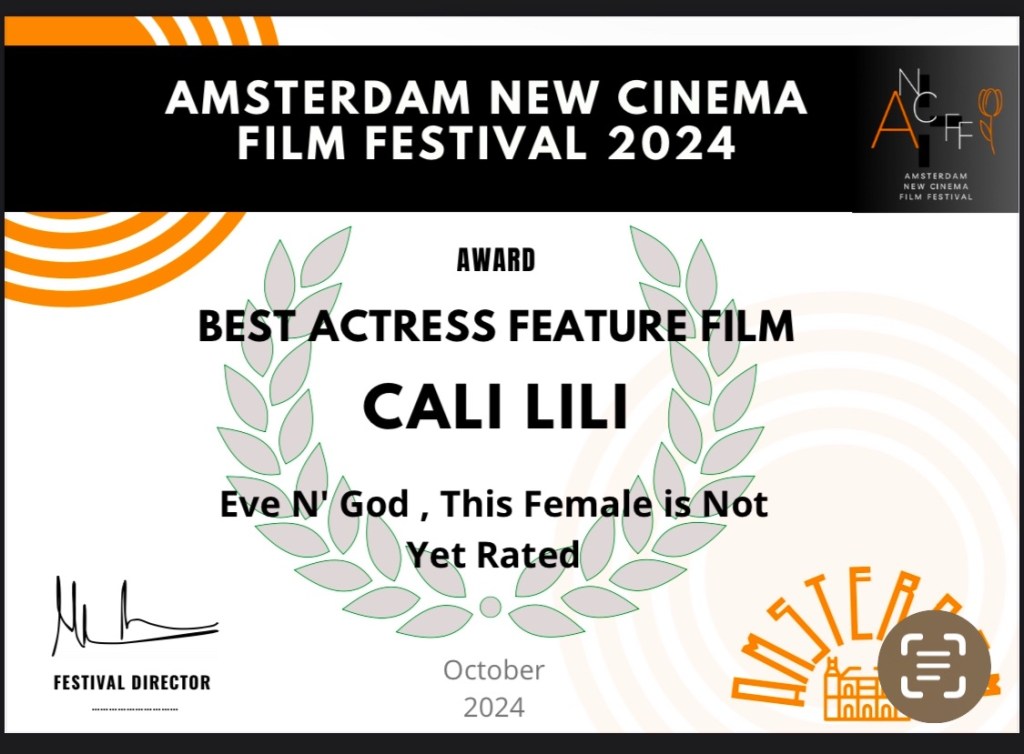
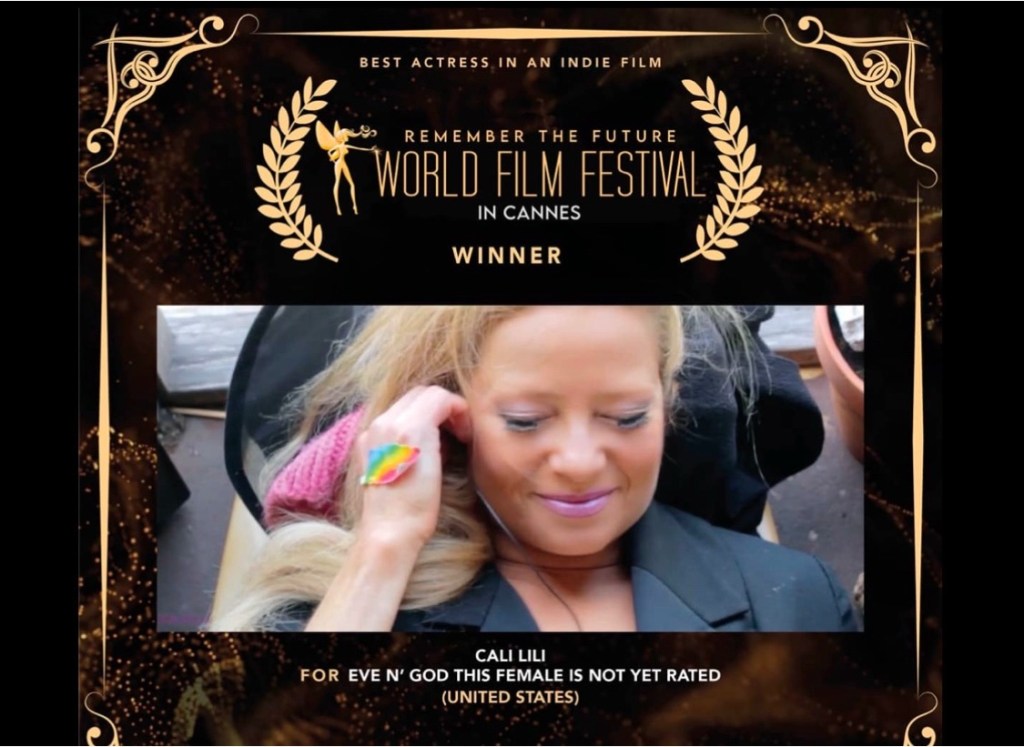
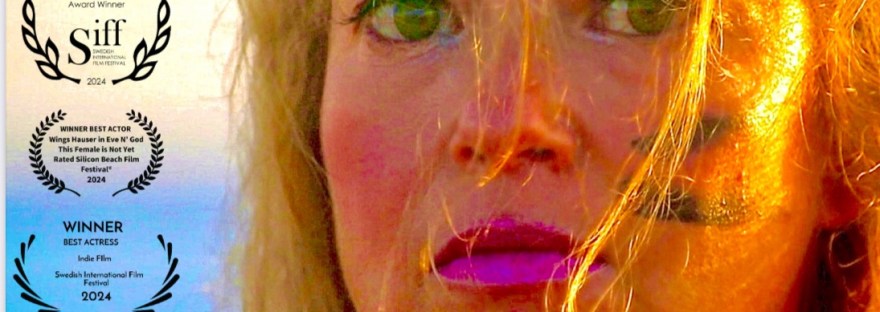
As I mentioned, this debut project is meant to pave the way for our future projects and I’m SO grateful my partner was able to experience the acknowledgments, screenings, and awards the film garnered in 2024 and 2025 ! Several years after the initial release! I had always wished that the film & album could be timeless. The way Wings expressed it to me :
“I told you ! Your Project Got ‘Legs’!
Just Like You!”
Wings Hauser
(referring to the classic phrase for a project that becomes a ‘sleeper’ hit )
1. Let’s start with the biblical references in your film. The title itself, Eve N’ God, immediately evokes ideas of creation, temptation, and divine power. Is there an intentional inversion of traditional biblical themes here, or are you playing with those ideas in a more subtle way?
I like that you highlight “creation, temptation & divine power” with regard to the first part of thetitle : “Eve N’ God.” The second part of the title: “this female is not yet rated” (which happens to be the title of the album / soundtrack ) is intended to lend a hint of irony to the fact that as you rightly pointed out, I am inviting us to “play.”
One of Eve’s lines of dialogue highlights the concept that our most important “work” involves opportunities to “play” :
“Doc ! I want to PLAY !
Put me back in the game !”
(dialogue from “Eve N’ God this female is not yet rated “)
This encapsulates the motivation for Eve, representing the “Every-Woman” enlisting other women as well as men, to ask questions about choice, voice, freedom. To “PLAY” is to participate, to choose, to be afforded opportunities to make a difference. If we are barred from “PLAY,” we have no choice, no voice, no opportunity.
“Creation, temptation & divine power” can all be employed as tools for opportunities to enhance people’s lives, cultures and societies but they can also become tools to hinder progress. So the story is a “meditation” asking questions and instead of forcing answers, as is often done with cultures that worship, dominance and supremacy, this meditation invites more questions and offers opportunities for cooperation as a means of defeating competition.
When you think about it, the “cooperation frame of mind” when applied to solving societal and cultural problems really does out-compete – the “competition frame of mind” because cooperation invites bonding, while competition invites separation. If “survival of the fittest” is slavishly applied to solving cultural and societal problems, and if that survival of the fittest model depends upon whomever has a larger bank account, no matter how that bank account was fattened, whether it was by true merit or by cheating, it seems that it might be wise in the 21st-century to consider new models, paradigms.
I think it’s also important to mention here, that “Eve N’ God This Female is Not Yet Rated” suggests that the “original Eve,” often conflated with “original sin,” and the myth of “Lilith” examined in the context of the myth of “Adam and Eve” is inextricably intertwined with my idea that “Lilith,” represented by our character named “Lila” (meaning “night”) is a black woman. That she is inextricably intertwined with the concept of “mitochondrial eve,“ the concept that we are all sisters and brothers from one mother in Africa. In our movie, the light-skinned “white” appearing character named “Eve” who is not in fact “white” considers herself the twin of “mitochondrial eve. ” The film is also pondering the fact that both of Adam’s wives both Lilith and Eve refused to be subservient and my script asks the question, perhaps Lilith and Eve found comfort in each other?
I think that’s worth chewing on.
2.
The first scene is extremely significant. It can symbolise resistance, difference, perseverance and what not. What inspired you to begin the film with such an intense moment of confrontation?
I love hearing about your experience with the film. The intense scene you are describing, which takes place early on, is like all the scenes in the film, a matter of poetry and music. It’s an essential piece, a building block, a molecule that appears in a sequence forming a rhythm that ultimately gives life to the whole organism, the poem, the “world” of the movie. Editing is so much fun and SO CRUCIAL as it’s the “time signature” of the movie, just like a metronome clocks a piece of music. People may be unaccustomed to unconventional forms of editing because we have all been trained to accept certain ‘conventional storytelling rhythms’ depending on the culture we were raised in or the dominant culture we can choose to either blindly accept or question.
It is a scientific fact that if you are exposed to a certain rhythm, your body / heart will sympathize / synchronize with that rhythm. Editing is about rhythm just like music. I posit that movie lovers have been somewhat indoctrinated into accepting certain editing rhythms dominating much of cinema. I have always felt we would benefit from remaining open to new rhythms including the rhythm of our own hearts.
For me, the first “scene” in the movie is actually a black screen with the sound of a mourning dove. It’s the empty page or stage and a cry from earth, from the heart. I don’t vibe with the “move fast break things” mentality so prevalent in too many cultures. My wish is to create projects through our studio that:
Music and poetry guide my rhythm, my vision, which I bring to my partner, and we apply principles that we both believe in. It’s kind of like our “secret sauce,” the traditions of our “tiny family farm-to-table.“ In fact we are like a tiny family farm, working from a tiny feMt0™studi0 Eco-LoFt™. Our hand built surf shack in Venice Beach represents a little bit of “aloha” combining elements at the intersection of beloved Hawaii and beloved Big Sur, California, with a hint of Greenwich Village New York thrown in.
So the sequence of the scenes and the edit design is definitely a form of visual music. As a director, I am all over the design of the edit because it’s so vital to the final cut. I feel it’s essential to take responsibility for the edit design and it’s also on my mind & in my heart during the rhythm I’m hearing while writing the screenplay and directing the scenes. So when I shoot, I’ve already got an editing rhythm in mind but of course it will shift and adjust according to all the happy mistakes & coincidences we can improvise upon. That’s also magic. I am open to letting the material find its own rhythm as long as it’s true to the integrity of the piece. It’s an ongoing dance on a moving wave, like surfing.
Sometimes Wings and I have slight differences when it comes to certain scenes but as with all of our disagreements, we always find the best solution due to the process of a debate and remaining open to discovery. We always arrive at an improved result by taking that time. At first, he felt the very first scene with the clock ticking was too quiet, too slow and he suggested that I cut earlier but as time went on, he eventually loved how it led us into the overall meditative pacing that is periodically disrupted by that intense scene you’re referring to.
It’s a necessary disruption from the hypnotic ticking clock. It’s a wake up call. An alarm.The very intense early scene you asked about exists in that time code, because that’s where it belongs in the “music” and “poetry” of the movie with each scene following inevitably after the previous scene blossoming like a flower. In the same way my next exhale follows my next inhale and then my next inhale follows my next exhale (an influence from yoga & vocal training) but nonetheless it is so organic to every sport, art form and practice – of course it’s like the art of life herself.
That particular scene just like every other scene in the movie is meant to be there because it could not be anywhere else for this movie to exist. We’ve experienced people who have never made a movie, but who are chained vehemently to a status quo understanding of what editing must be, express to me with shocking confidence, almost angrily, that they think I should edit the movie differently. That’s because they are chained to their notion of what is acceptable and therefore commercial. The “tell” is how angry they seem to be and sometimes it’s covert anger. But they’re trying to appear as though they’re trying to “help me” while they’re telling me that they feel I should’ve edited the film differently. As though I broke some rule that maybe they wish they could break free from too?
in these cases, we find that instead of accepting my invitation to come along for the ride – and SO MANY movie & music lovers gladly accepted the invitation and had a great time – a few others chose to seem somewhat angry that I had the courage to take a new trail. Sometimes people express it as though they want to “help me,” because I am a newcomer. But we wish that more people would come along for the discoveries, support our innovative projects instead of remaining chained to their old notions. It’s almost like there’s a quota on just a few selected filmmakers who are allowed to “break the rules” and that’s usually a matter of power and influence and probably money. I’m suggesting that audiences reward the tiny filmmakers like me who really are taking chances.
It’s true that the intense scene represents those excellent words you used: “resistance, difference, perseverance.“ It is a strong early statement born from the darkness and freedom of a blank screen and the mournful cry from a mourning dove. That intense scene “wakes us up” into the dreamscape we are about to enter. Paradoxically the scene is asking us to “wake up” while also inviting us to “wake into a dream.”
My team, and I are asking the audience to please care about the independent artist to take chances. Requesting that we all “pay attention“ to us tiny filmmakers because “attention” is arguably the most powerful “commodity” certainly in the media, but also in the world today. As my beautiful partner Wings Hauser would say, he appreciates it when people “give a damn.”
Whenever I hear the expression “pay attention” I always think of the great play by Arthur Miller “Death of aSalesman” in which “Willy Loman” (The Everyman) repeats his plea to humanity :
“attention must be paid !”
It’s kind of like that.
3. There’s a clear influence of Dogme 95 in your work. The rawness and immediacy of the cinematography, the handheld shots, and the natural lighting all echo the movement’s ideals. How did Dogme 95 influence your approach to Eve N’ God This Female is Not Yet Rated ?
Fascinating question!
Actually, I first learned of Dogme 95 after I had already formulated my concept of “sustainable filmmaking” based on my dance & yoga background as well as my love for ocean / sea life conservancy.
In school, I was very interested in the contemporary effects of the history of the works of experimental directors & actors, along with that of international artists in those fields. I think it’s really helpful to look back at the origins of certain traditions in order to find one’s place in the current repertoire. I always look back at the classics and that’s probably because ever since I was a kid I have been referred to as “mature for my age “ or “a young person with an old soul.“
I studied the effects of the Polish experimental director Jerzy Grotowski ( “Towards A Poor Theatre “ ) and the French Dramatist Antonin Artaud (“The Theater And its Double “) along with the work of Brecht AND a few other artists in theater, visual & music arts that were even more influential to me. I discuss those in detail in my upcoming book. In fact, my book, among other textures, will present the movie as a work of dramatic literature, complete with stage directions. The script would make an amazing stage play and I’ve devised a very detailed staging concept. It’s ironic to me that my early plays which I wrote as a teenager were often called “cinematic,” and because I was a theater snob, lol I took that as an insult. Sometimes we are idiots but can find great humor in our idiocy if we grow up a little bit.
My initial studies were in dance & theatre in New York and this greatly influences my cinema. As a kid, I won my first play writing contest, after being urged by my awesome professor, an immigrant from the Himalayas, to enter the contest. I was extremely hesitant to do this, but she was so sweetly encouraging that I did enter it. It was my first play. When she told me that I had won the contest, I can still remember the light in her eyes as she practically shouted out my victory. It was absolutely true that she won! I would never have entered that contest had it not been for her. The reason she thought it would be a good idea results from the fact that I find writing prose daunting but dialogue and poetry are very natural for me. As a teacher, a professor, she went the extra mile to think about how she could guide me. She was completely correct, and I am in touch with her to this day. I am so very grateful for all my teachers who saved me from an abusive childhood.
So, to get back to Dogme 95 , it seemed like a natural ally for the ideas that I was formulating in order to understand where my work was going. My wish to express concepts of “sustainability” based on my love for the oceans, sealife , aquaculture , farmers markets, small family farms, ocean conservancy, organic cuisine, farm to table, ecological and nutritional concerns in making film & music was a result of my wish to make “food for thought films.” I felt that culture and cultural spaces were becoming so “gentrified” that artists were being pushed out of our own “native waters” in the same way whales, dolphins, sea turtles, sea lions & sealife are bullied out of their own waters or small family farms are bullied by “big agriculture” and in the same way, so many cultures are bullied by “big money” in general.
Even as a teenager I was concerned about what I called “the gentrification of culture.” I felt it was the reason my family did not support what I knew was my purpose in life. The “gentrification of culture” made it appear as though “only rich people” could become artists and unfortunately, the reality seems to almost prove that true. Although many people can make films with advances in technology, distribution and audience awareness through marketing is mostly the domain of the wealthy. As my brilliant partner shared with me, at some point in the history of Hollywood, people could “buy their way” into the entertainment industry, whether it was through nepotism or actual money and connections. It was no longer a matter of merit, talent & hard work / dedication so much as “connections / influence / money” and the illusion of talent & seeming performative “hard work.”
Wings also expressed very rightly that he witnessed the transition of the audience’s interest from quality art to “box office.” He said that as soon as he first heard popular entertainment shows reporting mostly about “box office” profits instead of nuance in films, he felt that was harmful not only to actors but all film makers who deeply love the “making of film.” That reminds me of a great quote from Sir Michael Caine. I’m paraphrasing from him : “plays are performed while movies are made.” That quote has really inspired me. It’s very worrying to think that the audience is being manipulated into thinking about “box office” success and “visibility” whether it be on social media or traditional broadcasting/cultural events, instead of artistic merit because it conflates so-called “success” in industries that have become “gentrified” “closed loops” with actual talent / merit / cultural significance which is a very different dimension of success. That gentrification created the illusion that the privileged few works of art that were distributed / visible were inherently more culturally significant when actually they have only became culturally significant as a self fulfilling prophecy due to their privilege in distribution or opportunistic visibility.
I worried this might deeply harm authentic independent artists and I also worried it was diminishing culture. My pushback against this notion was not just a matter of survival for us as artists, I was worried about cultural ecosystems becoming toxic, in the same way other ecosystems are damaged by neglect. I’m still worried about that. We have to admit that the independent artist like many forms of wildlife, sealife and civilization itself are an “endangered species.“ Part of my graduate studies involved anthropology so I think of these things on an anthropological level as well as a practical creative hands-on artist level.
My aesthetic has also been informed by economics and I have gladly incorporated concepts from experimental theater into my style. Experimental theorists, like Grotowski, Artaud and Brecht among a few very significant others I mention in my upcoming book in various disciplines like painting and music have always inspired me. They were very influenced by economics and societal theory.
Less Can Be More and More Can Be Less
We hope audiences will support our sustainable studio as these methodologies are intended to maintain love, respect and survival for artists on this planet in exactly the same way we wish for us all to protect wildlife, sea life, and human rights on this beautiful interstellar, swimming pool planet. My works are my “babies” and many cultures provide incentives and benefits for women to have babies. Well, I feel so strongly that artists contribute to the culture just as much when we “give birth” to our “babies“ and I think cultures should “support the arts” by sustaining the living artist.
We are all interconnected. If we lose our innocence through indifference towards saving the planet, wildlife, sea life, women’s rights, human rights, the oceans, the forests, the cities AND LIVING ARTISTS – then we have lost confidence in ourselves.
As the great thinker Elie Wiesel said :
“the opposite of love is not hate, it is indifference “
It’s so important that we care, that we do what my partner Wings Hauser would describe as “giving a damn.” If we lose our ability to care about others and our planet, we would be abdicating ourselves, giving up on ourselves.
4. The music in the film feels very disruptive—almost unsettling at times. It doesn’t always follow traditional structures, and there’s an underlying chaos to it. Could you talk about how music was used to reflect the disruption of societal norms and to underscore the themes of subversion?
Thank you for noticing and expressing this so eloquently !
As a standalone purposely eclectic album (the album can be found on all music streaming services: Cali Lili “This Female is Not Yet Rated“ ) it has a life of its own along with belonging to the world of the film, as soundtrack. The Album and the Soundtrack are family but they are also individuals.
It’s so interesting that in many cultures around the world, we learn to regard questions that trace lines outside the boxes created by society as “subversion.” Of course the artist space, if it is a free space, provides the freedom to ask questions and think outside norms so our collective consciousness norms find it “sexy” to think of that “rock ‘n’ roll, smash the guitar, question society, style of “subversion.”
For me, it’s about playing, PLAY!
Asking questions and playing with the possibilities. Sometimes when we ask questions we feel are “dangerous” to our sense of status quo, we regard – just asking – the questions – to be “subversive.” If you’ll recall, our “Eve” humorously, refers to herself and anyone asking these questions as “dangerous,” she says:
“OK I want to be dangerous,”
She is playfully accepting a “play pretend” “mission” in-service to a higher goal.
Dr. Goddard responds :
“So you’re not going militant on me?”
Which leads Eve to giggle out loud and say:
“ just a Tango – up Pico Boulevard ”
Like most of us, she just wants to play.
It’s true that the songs AND the choreography in the film – are challenging norms, as are many of the lines of dialogue. The music and choreography support the story moving forward, asking questions, asking questions ASKING QUESTIONS – with a drum beat moving us forward, playing with answers, playing with a Multiverse of possibilities. There are several references to mirrors in the film. Visual rhythm including a few repeating frames and choreographed jump cuts in the unconventional edit design which are syncopating echoes that do follow their own internal map. A structure particular to an internal organic logic that dances unapologetically to its own time signature.
My script was “composed” with songs incorporated into the text & intended for the edit. The edit design is “composed” like one big poem unfurling, blossoming like a flower, one big “symphony” building from a sequence of “movements.” Including dance & actor movement, or non-movement. If you’ll notice, both primary characters are somewhat “penned in, contained” speaking to each other on ZOOM.
The songs rely HEAVILY on syncopated lyrics and percussive build. The lyrics are crucial to these songs and the album is somewhat of a “concept album” exploring new avenues about every theme in the movie carried by the purposely eclectic range of musical styles / genres. It’s not often that one album includes all these genres : rap , Americana, rock ‘n’ roll, folk rock, country punk, Reggaeton, world groove, and 12 bar blues.
So in this one album all the common themes are purposeful “explored” asking the question:
“How can I address each theme as” a rap song, but also as a folk song, a country song, an all out rock and roll song, a jazz or blues song, a punk song or a song that’s influenced by world groove? ” The album is intended to feel like a trip around Americana and world grooves and then back home to America, specifically Los Angeles with songs like “Sindarella GirlZ,” which is heavily influenced by Reggaeton.
The music in the movie wants to break out of the confines of the screen and run wild. In fact it’s one of many “cracks in the cement” where green sprouts break out of their confines described in of the songs “World is My Living Room, ” which includes this line :
The movie wants to jump off the screen, dance in the aisles of the movie theater, out of the doors and onto the street, dancing all the way to the beach splashing into the ocean.
5.
The theme of subversion through movement is quite prominent in your film, especially with the characters’ physical gestures and interactions. How do you see movement as a form of subversion, and what was your approach to choreographing or directing these movements?
Awesome that I began to answer this question in the previous answer. That’s how good your questions are!
So, I would add to everything I said in the previous answer, it was pretty eerie that this film was shot before Covid and yet two main characters speak to each other over ZOOM throughout the entire film. As I mentioned earlier, one of the themes is “communication across boundaries.”
So part of what you’re describing has to do with lack of movement. Or movement constrained, restrained. Wings and I were so excited to work together on so many levels, I mean, we just really love to work together on anything! We would often leave birthday messages for family members in the form of rap songs that we came up with on the spot after talking about it for a few seconds before we made the birthday call. He’s directed me several times and we’ve worked together in various ways. But one interesting factor is that he’s quite a physical actor. And I just knew that this character which remains in one location for the entire film would allow for a very high concentration of his acting chops.
So the characters are both somewhat constrained through much of the film. It’s the rhythm again. It allows us to relax and pay attention not just to what they are saying, feeling, doing and NOT doing on screen but also what we are feeling as an audience. And then – after restrained movement, the characters are set free. And so are we.
My choreography style stems from influences in classic choreography, Bob Fosse (I studied not just the movies but also in class with Ann Reinking), Twyla Tharp, and the OG : Isadora Duncan! Jazz choreography emphasizes “isolations” which for me is very meaningful. The characters are reaching to each other beyond physical, emotional, spiritual and intellectual boundaries.
For me, choreography like surfing, like life, is all about “flow.” So while the jazz choreography & character movement emphasized sharpness, anger, pain and challenges, “the elbows and knees of isolation” the other movements represented “flow” including water elements, pointing us toward healing, acceptance, understanding, communication, love and freedom.
6. The film also tackles the nature vs. nurture debate, particularly in the context of how societal expectations shape our identities. How do you see this theme playing out in the film, and why is it such an important issue to explore?
Nature is definitely a character in this film. When we cut to nature, it is always a reference to the essence of Eve, or Lilith. The “sacred feminine.” Eve is defending nature in her arguments with Dr. Goddard. It’s ironic because she’s advocating for freedom in the creation of this masterpiece called “Mother Earth,” and what I refer to as “Sister Ocean.” While “Doc” is afraid of that freedom because he’s defending that creation. We can see things from both perspectives.
Eve is an advocate! In the same way that proverbial “man” sought to conquer “nature,” he sought to conquer the sacred feminine. Before ancient female priests and goddesses were “kicked out” of the clergy, religion and out of many governmental / cultural leadership positions (sound familiar? Yeah,it’s happened before) there was a feminine, earthy, watery, often matriarchal aspect to many cultures which found itself dampened, muted and relegated to the “barefoot in the kitchen” duties.
The vestiges of such “excommunication of the feminine” & the natural watery world, expressed itself as patriarchy, which we all know is still active in many cultures. The voice of patriarchy might think it is “rallying” but unfortunately, all one needs to do is look around us on this beautiful blue planet, and recognize that patriarchal attempts at domination are harming everyone by denying its own feminine nature at the expense of its own survival.
Personally, we experienced this when we noticed the way culture retreats from married women. To be sure, my marriage with my amazing, beautiful partner and husband Wings Hauser, it’s not a conventional marriage. We are creative equals. Equals in every way, but we often encounter societal pressures and bizarre misunderstandings, simply due to the fact that we always express our relationship in terms reflecting our equal partnership. But then again, as a result of this expression, we would literally have people come up to us in the grocery store or at fancy parties, telling us how much they were inspired by our partnership.
As this was my first marriage, I was amazed to find myself in certain 21st century societal circumstances treated like “wives” may have been treated in the 1950’s – or the 1600s – or cavemen times! It was a bizarre “awakening” and you might’ve noticed that Eve “wakes up” quite a few times in the movie which is as much a dissertation about marriage as it is about every other theme. The discussion of what it means to be married as a 21st Century Girl is a deep core theme.
My beautiful partner / husband, Wings, is a real “feminist!” Always advocating for women. I mean, he raised a daughter on his own with no trust fund – having lost his own father at a very young age. He worked for everything he accomplished and still managed to raise a daughter as a single father! He’s much older than me but my reaction to the antiquated societal expectations of my identity, awoke his own inherent feminist nature. I had always said that I would never get married. Until I met my perfect partner, my soulmate, the love of my life, the only husband that could ever make sense. We bring out the best in each other. What more could anyone ask for? We are very lucky and always puzzled at the antiquated societal weirdness towards women and partnerships.
Ultimately, I figured out that cultures based on supremacy/domination benefit from division amongst people, whether it be race, culture, class or gender. The movie is based on a form of Socratic argumentative attempt to discover answers through finding more questions. The tension between a female “goddess entity” who wants to remain free while still enjoying partnership and a male “god entity” who basically wants the same thing – that’s what’s interesting. Edward Albee’s play “Who’s Afraid of Virginia Woolf” rocks a similar vibe in that regard.
A good marriage, a good partnership whether it be marriage or bandmates, athletic team or crew, whether it be male and female or female and female, or male and male – whether it be binary or trans or whatever, it’s about the partnership – the partnership is SO soul-affirming. It is also an affirmation of a society that can work to solve problems not just for the community but for the individuals.
Once again we return to the idea of “Cooperation Beats Competition ™.” Working together with well matched partners is a humane sustainable model for human happiness, planet happiness. It’s good for humans and it’s good for wildlife and sea life and plant life. I’ve always thought it was amazing that the country of Bhutan has a ”happiness index.” I think that’s really interesting for the 21st century world to consider. After all, we are literally spinning on a ball in the middle of the Multiverse splashing like a big old swimming pool. Let’s at least solve some of our mutual problems together, find some happiness together and stop fighting each other together.
Partnerships can solve problems instead of creating new ones. When people are divided, new problems are created. When people partner together, we solve problems, if our hearts are partnered with our minds and if our motivation is to make the world a better place for everybody, not just for a few of us. For all of us! It’s so simple.
Unfortunately, too many societal expectations have shut out the very important female energy in problem-solving. Once again it’s like the failed attempt to dominate nature. Those who attempt to eradicate the feminine, and dominate nature, do so at their own peril. The problem is, they also put the rest of the planet in peril.
As Eve’s dialogue is structured like a filibuster (like Jimmy Stewart in Frank Capra’s classic masterpiece “Mr. Smith Goes To Washington”) she’s making an argument before Dr. Goddard, otherwise known as the white straight male authority deity she refers to as :
“the most Supreme Court “
Her argument is a plea for the world to embrace the feminine “wild” because this sets us all free:
“It’s the wilderness in yourself!”
Eve says.
Without that freedom for the wild, for the feminine, we imprison the planet.
7.
The title, This Female is Not Yet Rated, feels like both a commentary on how women are often categorized or judged in society and a challenge to those labels. How does this title encapsulate the themes of the film?
Yes! and as I mentioned, that’s the title of the standalone album.The “female” in question is “not yet rated” because she is often “discounted” ( valued less ) as Eve informs Dr. Goddard.
Eve also says, “that female” still exists. She may be met with patriarchal “indifference” in the same way the great Elie Weisel defined it but she exists. She may “not be rated,” she may experience attempts at erasure or appropriation, but the look in her eyes and the arguments she makes, her actions – might save us all! As long as most of us do not remain silent.
The movie asks :
“ Are we dreaming of Eve
or
Is Eve dreaming of us ?”
Either way, if we don’t wake up and respect her, if we don’t save the oceans, save the climate of our precious blue planet, we won’t be able to save ourselves.
8. Lastly, in today’s world, where subverting traditional styles has become almost a style in itself, do you think there’s still room for truly revolutionary cinema that challenges established norms?
I feel that somehow the arts & media commercial marketplace has surrendered to corporate attempts to interfere with, even steal the magic of our inherent human response to each other’s authenticity. I mean, the proof is in the AI. What’s the AI doing? It’s attempting to “capture” our humanity. Yikes. But it’s not the actual technical advances because those can be used for great good. Those technological advances can be used to help humans. Should be in the hands of humans with guard rails everywhere. So this attempt to “capture” humanity far predates the advances in AI.
Once again it is the worship of domination, the use of unfair competition, instead of the embrace of cooperation, which could include all forms of technological advance. The entertainment industry was already moving towards a “simulation““ of what the artist really does. It was already edging out the independent artist with integrity who cannot be controlled by a corporation. The one presenters who are corporate artists many of them are billionaires might mean well, but they are part of a system that suppresses the less wealthy, less powerful independent artists, and therefore diminishes the potential freshness of any given cultural marketplace.
That’s why I feel strongly that if we don’t embrace the authentic independent artist, the living breathing artist who may not be privileged enough to be featured by the upper gentrified levels of the media industry, who might live next-door to us or in another country and if we don’t set some boundaries with AI, tech giants, big money corporate art and also set some boundaries when it comes to privacy and individual human rights, then we really risk our ability to connect with each other.
There should be nobody standing in the middle of that sacred space between the artist and the fellow art lover. The artist is also an art lover. These are love stories! As I mentioned earlier : every project we make from our sustainable studio is a love story. Not that status quo thing we are taught to recognize is a love story. There are so many ways to express love stories.
There’s just an “authentic” human response to “authenticity” and for the artist – artist lover relationship – it’s a lifeline. The more big money corporate entities continue to do what I have been referring to as “gentrification of culture,” the weaker the authentic relationship between artist & art lover.
No middleman or middle woman belongs in the middle of that relationship, but so often, artists with smaller budgets just don’t reach the audience, rendering “the arts” a playground for the wealthy, the powerful, leading cultural ideas, tastes and aspirations to mold (dominate) the minds of individuals who form the “body” of every culture. On so many levels of culture and society, I think we should be careful to sustain our humanity. Not just ideologically, but somatically. Through our bodies.
One of our sustainability mottos is:
“Support The Arts,
Sustain The Artist ™”
If we can embrace the living artists around us. The artist right now, especially those who are respectful of those who came before us, then we can honor traditions while paving new pathways.
We can show respect, but also expand our boundaries toward each other, not away from each other. It really does “take a village” and as we are all spinning on this blue, beautiful planet in the middle of so many solar systems my movie and album are asking :
“When will we finally get the clue that WE ARE – the village. WE ARE – the family.”
The “Eve” in my movie refers to her twin, “Lilith” as “mitochondrial eve” – “the one mother” of us all who originated in Africa. Whether people want to find controversy with that theory or that discovery under the microscope, doesn’t really matter. In the 21st-century, it should be quite apparent to us all that we are all on the same airplane – what I call an “interplanetary swimming pool” and we need each other to make good decisions and to solve problems wisely. Even if it’s only for our own self interest. It would be great if we could all cultivate a sense of responsibility and motherly sisterly brotherly fatherly love toward each other, but even if we inexplicably feel the need to eschew utopias, if only for our self interest, let’s get it together and save this planet. Please.
On behalf of myself, my partner, Wings Hauser, and our little family at the Cali Lili Indies : We always knew the project was ahead of her time.
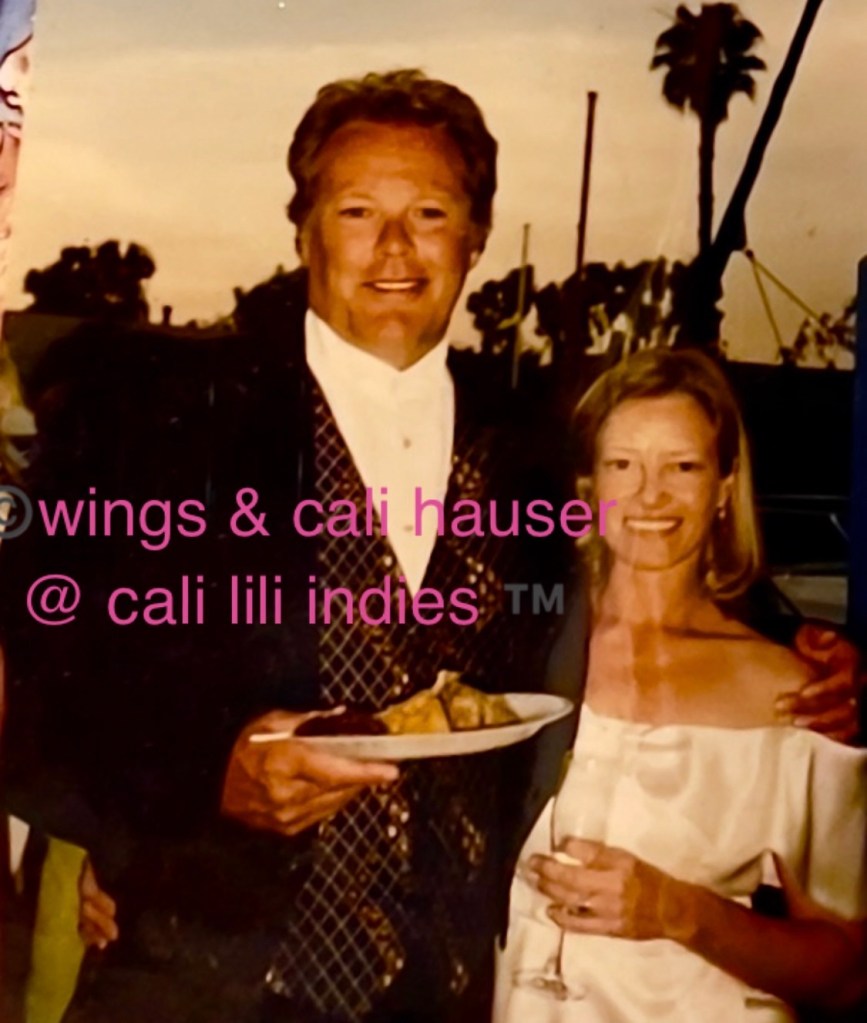
Tragically, devastatingly, in 2025 I find myself breathing for us both now. Seeing through my partner’s eyes, literally walking through the world with our twin souls in my heart and carrying us into the future, as he made me promise I would do. I gladly accepted the responsibility and the privilege. But I won’t be talking about him in the past. I will keep him in the present tense, which is where I feel him every day. He’s right here with me helping me.
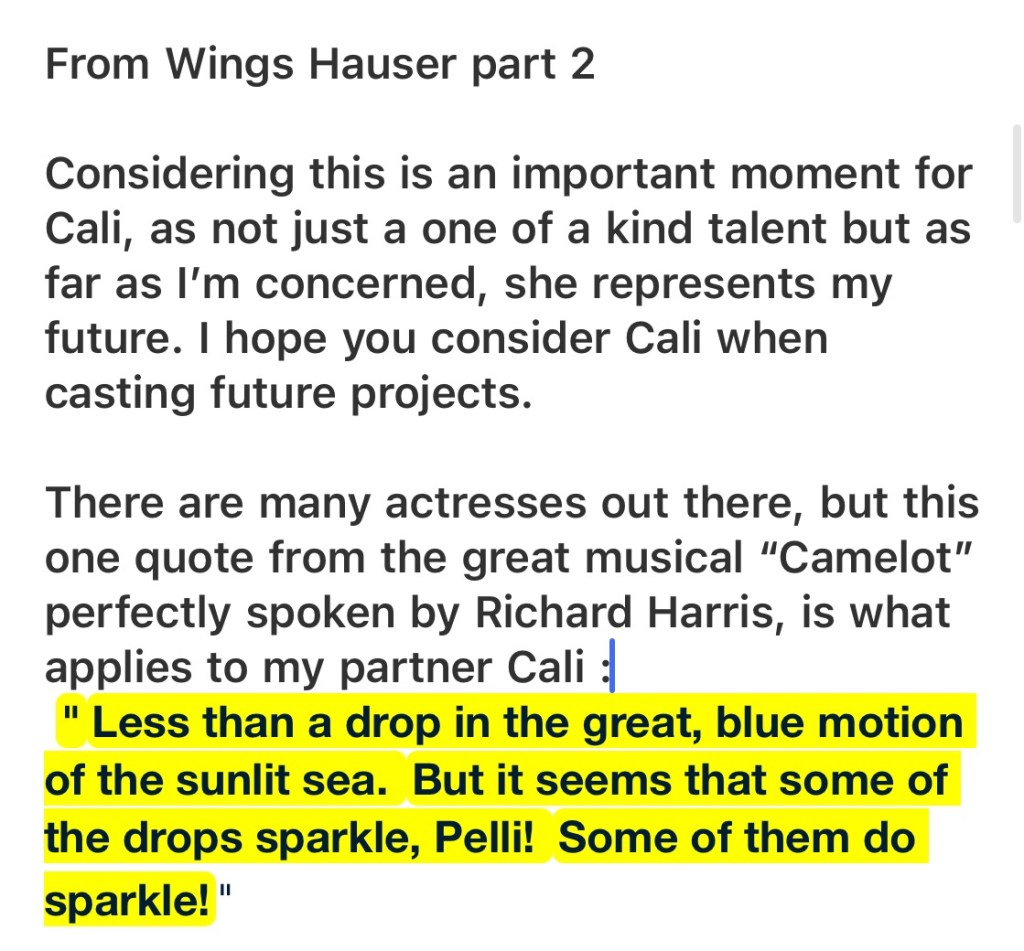
He has many endearing nicknames for me, like “Cali Curls,” but one nickname he took seriously. He called me “his future” and it is my privilege as well as my responsibility to fulfill that role of carrying on our work at the studio, honoring our partnership goals, our ongoing forever love story, and his legacy.
We hope your readers will support us and our projects in every way possible now and in the future.
I always strived for and managed to not only express our love to the audience, but also to make my partner proud. That’s what I’ll continue to do.
9. To wrap up, do you have any underrated film recommendations for our audience—something that pushes boundaries in a similar way to “ Eve N’ God ; This Female is Not Yet Rated “ ?
I am in love with so many films and my beautiful partner Wings and I watch so many films together more than once. We love revisiting films.
So many quality projects are underrated! Because the rating system is hijacked by big money on many levels so movie lovers, music lovers, art lovers, we have to discover each other for ourselves.
I can hear Wings tell me right now:
“YOUR film has been
“under the radar”
And is literally “not yet rated” ! “
It’s quite awesome. That film festival is like yours have suddenly discovered my film in 2024 and 2025! We are thrilled about this! Thank you !
So as Wings always said to anyone inquiring :
“go buy a ticket and support our movie … go download our songs and SHARE “
“WE are underrated! “
it’s in the title! lol
On behalf of Wings & the team – we encourage people to see it more than once and hear the full album!
Mentioning other underappreciated films is so challenging because it’s like being in a candy store. There are so many, truly unique films which many people are not exposed to. ever since the ancients.
So I think the most important thing is – for US – the lovers of art – to be adventurous in our tastes! Like lovers, we must seek out our own love of the arts ! Those of us who love the arts understand that this is a lifestyle in and of itself !
Once again, I will employ a metaphor from “Farm to Table.” If we explore new ingredients that are fresh and then explore new cuisines that might be unusual or new, we expand our thinking and our capacity for appreciation. That’s how we meet each other! If we get to travel or try new cuisines, it’s so very similar to trying a new kind of film or music.
So I would suggest a similar approach to discovering what’s out there! It’s also like going to an art gallery. Or a museum. You could follow the pathway that has been designed and learn something, but you could also do what I do in an art gallery – I just go towards the pieces that call out to me and then place myself in the vibe. Communing with the artist. like a surfer : “be the wave.”
In this current climate, I don’t really know who appreciates what. Maybe that’s a good thing? The Internet makes it easy to rediscover classics and I really love to learn from the classics.
I love everything by Bob Fosse and I feel “Lenny” directed by Bob Fosse starring Dustin Hoffman, Valerie Perrine & an excellent cast might be under-appreciated?
I adore the movie “Network” written by the great screenwriter Paddy Chayefsky, starring William Holden, Faye Dunaway, Peter Finch, Piper Laurie.
Any movie that Cicely Tyson has ever been in!
Sidney Poitier in “Lilies of the Field” and “A Patch of Blue.” And the one he directed, “A Warm December.”
Wings introduced me to a film called : “They Might Be Giants” early on in our relationship and it was an ongoing favorite for us. Directed by Anthony Harvey starring George C Scott , Joanne Woodward, Jack Gilford, Lester Rawlins.
“Defiance” directed by Ed Zwick is a fave of ours.
All of Hal Ashby’s films, especially “Harold & Maude,” “Coming Home,” “Bound For Glory,” and “Being There. ”
“Heaven Can Wait” starring Warren Beatty and Julie Christie. So romantic.
“McCabe & Mrs. Miller” also with Warren Beatty and Julie Christie, with holy music by the Great Leonard Cohen. My partner Wings, once met Mr. Cohen in a hardware store in West Los Angeles and cherished that moment.
I love all of George Clooney’s films. Especially “Good Night and Good Luck” as well as “Up In The Air” and “Michael Clayton” with Tilda Swinton.
Every film by the great director, Frank Capra.
I love films made in the 1930s when they were very strong female roles.
Every film that the actress Jean Arthur was ever in.
Every film that John Crawford was ever in.
Every film with Elizabeth Taylor.
Every film with Katharine Hepburn.
Every film with Ingrid Bergman!
And I also have to mention every film with Spencer Tracey, Audrey Hepburn, Cary Grant, Barbara Stanwyck, Bette Davis –
Rosalind Russell, Jimmy Stewart, Gary Cooper!
I think there is a romance to the films that I feel are underappreciated. I think we’ve been so busy as a culture trying to “act cool” – we started to become a little bit “cold. ”
It became fashionable to withhold emotion from the screen it seems? Like suddenly, if you “grunted” your lines as an actor, with people imitating the great Marlon Brando or James Dean, then maybe they thought they were being “cool”?
But no, Brando, Jimmy Dean did not grunt without passion. There is a volcano of emotion sitting dangerously underneath each subtle moment and you can’t fake that. Similarly, there is a gentle vulnerable flower underneath each explosion. I think what’s underrated, is a feeling for humanity in cinema and music. Almost as though we are being guided toward robot culture.
That’s one thing we are not afraid to illustrate at our studio : humanity. I just hope we can all cherish and support films made with heart, where humanity triumphs over the so-called “ box office .” Where kindness and cooperation beat competition. Where the artist can thrive.
This is not just some sort of platform. This is very personal to me and to us as partners and as a family carrying on a tradition. Especially now during a time of deep grief. Movies play such a huge role in my personal love story with my beautiful partner, Wings. We had a very platonic friendship as buddies way before we became creative partners and then – we grew in love as we deepened our creative partnership.
There is such a huge difference in age between us but we truly met as a result of our sheer love of acting, filmmaking and music making. I was sort of a “runaway with a scholarship” and he sort of “rescued me” and then I sort of“rescued” him.
We rescued each other. That’s a vibe that’s carried into our work and continues today.
Thank you so much for your time today, Cali. Eve N’ God ; This Female is Not Yet Rated” is truly an extraordinary film, and I’m sure it will continue to spark conversations for a long time. I can’t wait to see what you do next.
Thank YOU so much ! I love that you mentioned “sparking conversations” – especially at this time in history/herstory when dialogue has been replaced by vitriol!
I always wished for this film to spark dialogue, and there have actually been audience members who wrote to us telling us that they have formed watch parties where people discuss the film after the viewing. In fact. we sometimes describe the film as :
“ a conversation, long overdue “
As far as the future, wow, thank you so much for that. I am eager to share upcoming projects with everybody.
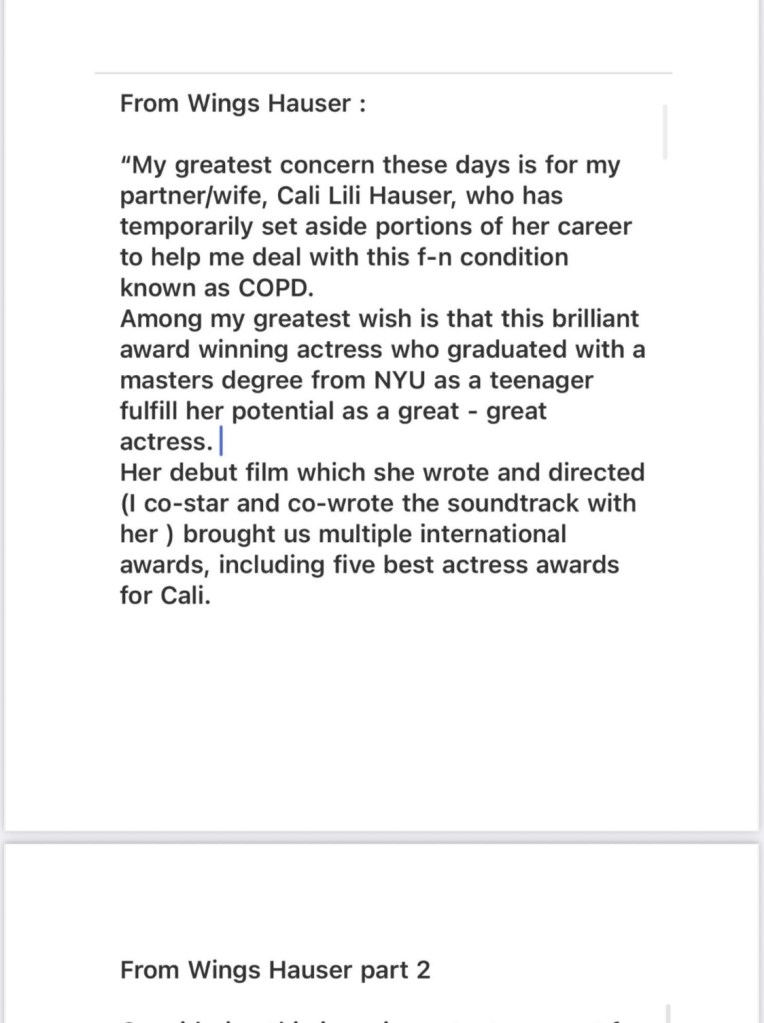
I feel that I need to add a personal note here. My beautiful partner and husband, Wings Hauser, and I battled a terrible disease which had attacked him. The disease is known as COPD. As we always had a multigenerational age difference between us, we knew that someday I would be carrying the work forward. We always knew this would be excruciating, and it has been much more painful than I could ever have imagined. But I have to say I did always know that it would be excruciating.
In spite of the fact that I am currently feeling quite broken, devastated about the love of my life, my soulmate, I’m so grateful for the love that never ends. Few people are blessed with this level of partnership and the depth of our love makes this moment ever so much more painful. I am getting all kinds of spiritual signs from him every day and those are shocking because I’ve never really been into ghost stories. But I know now that he is still with me.
He made me promise that I would continue to be motivated in my art and he was worried that I had to set aside some of my acting career time while we were battling the disease. I made sure he understood that there was no place I would rather be than here with him at our studio. I am so grateful I did not waste one moment of precious time with him.
As I mentioned, for us, the work in and of itself – is ALL about LOVE. The upcoming projects are our babies. He called me “his future.” I am breathing for us both now, seeing the world through his eyes as well as mine and carrying our twin souls in my heart and into the future.
We prepped future feature films, as well as several books, including his memoirs and at least five or more albums worth of music/soundtracks.
There is also an upcoming documentary about my partner :
“ Wings Hauser ; Working Class Actor “
produced by La La Land Films, which features clips from “Eve N’ God This Female Is Not Yet Rated,” as well as discussions of our unique partnership and love story.
A new music single will also be released with the documentary. The producers of that documentary asked me to record one of my songs for their title track. As with all the songs, Wings & I co-wrote the music. We recorded it at the “legendary rock n’ roll hotel” : Sunset Marquis hotel in West Hollywood, which houses the equally legendary Nightbird Studio, where Aretha Franklin, John Lennon, Bob Dylan, Jim Morrison, Rihanna, and so many others have recorded.
That recording session was pure magic. Complete with a rare thunderstorm in West Hollywood that night. Epic.
I hope your readers, Film and Music lovers, will not only choose to see & hear “Eve N’ God ; This Female is Not Yet Rated “ more than once, listen to the full album soundtrack, read the lyrics and follow our studio : @CaliLiliIndies™ on all social media for updates on future releases and current content, but that they might also take the initiative to actively support our work. As I mentioned one of our mottos is:
“support the arts sustain the artist” ™
Humanity faces so many challenges. Artist rights,, like women’s rights , wildlife and sea life, our nature, our wildness, and our innocence are very much at risk. Like “canaries in the coal mine of culture,” we artists really need the support of our fellow art lovers, our community, our villages. It really is one big global love story.
As far as our personal love story, we were always amazed that people could see our love story so clearly – whether it was at the supermarket or at a fancy party. It’s a never-ending love. We spoke together on stage in front of several audiences, including a sold out crowd at the Egyptian Theatre in West Hollywood,Los Angeles and a simulcast streamed into an audience at a theater in Atlanta, sponsored by Videodrome Atlanta.
In preparation for these appearances, I made a few notes, to prepare for speaking before a large crowd. Wings introduced me to the audience when he asked me to speak to them about our partnership and future projects as he was so keen to bring his fans forward with us on our future adventures.
My notes turned into an essay, which is now a chapter in an upcoming book about the movie, album and our sustainable studio ™ in Venice Beach, Los Angeles California.
Here is the essay, a preview of the upcoming book :
our Sustainable Studio where we create music, movies and books while also providing a tiny monarch butterfly sanctuary as well as a tiny natural reef for ocean life.
We actively employ the aloha spirit in the creation of our signature form of “aquaculture” Living in wellness & harmony with nature and reflecting that in the work is of utmost importance to the creation of our projects
We send each one out like a ripple on the ocean or one of our monarch butterflies after they emerge from their chrysalis
Full Transcript
Interview with Cali Lili, Director/Writer and co-star of
Eve N’ God: This Female is Not Yet Rated
Hi Cali,
It’s such a pleasure to speak with you today. I’ve just finished watching Eve N’ God: This Female is Not Yet Rated, and I have to say, it’s unlike anything I’ve seen in recent times.
Hello Subhabrata and Karma and the Swedish International Film Festival Team !
Thank you SO much for your enthusiasm, thoughtful comments and excellent questions !
On behalf of my co-star & partner, movie icon, Wings Hauser and the entire cast, production & post production teams we are honored and grateful for this opportunity to speak with you and share the first of many future projects with fellow movie & music lovers!
Your film is refreshingly bold and nuanced in so many ways, both in its visual style and its thematic exploration. It’s clear that a lot of thought went into this project and I’m excited to dive into some of the concepts you’ve explored.
Thank you so much !
Let’s dive in !
Speaking of thought, while “thought” does play its part, FEELING is my compass. LOVE is my core, it’s at the heart of our studio and the works we release.
“Eve N’ God ; This Female is Not Yet Rated”
and all our projects are variations of Love Stories. Our structures perhaps don’t duplicate the status quo structure and tenor of most love stories many of us are accustomed to?
Wings and I grew in love as we became more involved in the process of our collaborations as artists and that love continues to sustain us and our work today.
As the movie suggests, there are as many love stories as there are humans because every relationship forms its own vocabulary. Every life form, species, ecosphere, the planet herself becomes stronger through biodiversity. Even simple economics shows us that a portfolio is stronger through diversification. “Even When Divided, Love Multiplies” is a lyric from one of the songs.
I love that you put together the words “bold” and also “nuanced” when referring to my film! Thank you! YES ! I was striving for both! With our debut project, I was hoping to create an “experience.” A “destination.” A “tiny-world-within-the-world” like a “snow globe.“ A place we hope movie & music lovers choose to revisit and notice something new every time.
The movie and stand-alone album / soundtrack are available now on demand at Apple TV, YouTube & Google Play Movies, just search the titles & names. An upcoming book about this debut project and our “sustainable studio,” housed in our “surf shack loft,” will be published in a few months and we hope readers will look out for that and all future music, film & book projects.
I’m thinking it might be fun to include some introductory comments here about my “process,” of making the film “by hand” guided by artisanal principles, to create a “signature blend” in a manner similar to culinary blends. Our studio is hand-built & operates sustainably. That sensibility is infused into the “special sauce“ of hand-making the movie, album and now, the upcoming book. I call it “handmade to make a difference” TM ️ and always infused with SOUL and LOVE.
Every one of our projects is home-spun, like handmade cookies, instead of store-bought. Here is a brief excerpt and preview of the upcoming book about the movie “Eve N’ God This Female is Not Yet Rated,” the album, as well as the process and studio :
“Our sustainable studio organically blossomed from our desire to infuse projects with an authentic ‘mom & pop-up family farm’ essence, a ‘signature blend’ grown from the soil or ‘terroir’ (term used in the making a fine wine) of ‘Classic Hollywood’ nourished, then harvested in our own ‘microclimate’ extending beyond ‘the farm,’ in a manner that resembles ‘farm to table’ or in the case of ‘aquaculture,’ ‘aquaponics,’ ‘Sea to table.’
We view it as the most natural way to ‘grow art’ with roots and traditions, but also offshoots of innovation and then we should be able to ‘bring it to market.’ The “market” may not be quite as ‘organic’ as the art. That’s definitely a problem for many artists (and farmers) throughout the centuries. Certainly still a problem today. But I’m looking forward to a time when more independent artists can simply bring our ‘fruits to market’ just like the farmers market.
Or a painter selling a canvas without all of the gate-keeping complications that serve to shut many artists out. That was the original inspiration for simplifying this process. If a painter can put paint onto a canvas and sell the canvas why can’t an artist do the same with a film? “
“Eve N’ God This Female is Not Yet Rated” is our debut project and we consider it our “first harvest.” Unfortunately Covid and other things delayed the start of the next project, as it delayed the lives of so many people on this beautiful blue planet. We hold hands with everyone affected by forces beyond our control. For us, this ‘ first harvest ‘ paved the way for upcoming projects. The fact that our studio name includes this description :
“Pictures, Words, Music in Motion ™”
hints toward the fact that each project was intended to be realized in all three mediums: movie, album and book.
The book is set to be published in the next few months, completing that phase of the first while we are already preparing the next project.
The entire world is experiencing so many hardships. We are all in this together and our projects intend to share love & encourage kindness & community across boundaries. In fact, one of the themes in “Eve N’ God This Female is Not Yet Rated“ involves communicating beyond boundaries.
Written and shot before Covid two of the main protagonists speak to each other via Zoom throughout the entire movie. But their communication, their connection across that boundary is electric. We are not even certain they’re on the same dimension or planet. Yet their connection is palpable, visceral, eternal. Ultimately for us, it would become somewhat autobiographical.
As a matter of methodology, I was also keen to attend to experiential / feeling factors when it comes to physical production employing methods of organic sustainability. This includes maintaining an organic culture amongst the team. I wanted to create the atmosphere that resembles the intersection of a band and an athletic team. That’s how I think of our teams and as Wings and I are both athletes as well as musicians, this worked really well for us and the team.
Another example, I enlisted local diverse farmers to donate fruits and flowers to the set dressing and crew lunches. So our set dressing is sustainable and to some extent, “edible.” It was important for me to include local farmers. Other culinary aspects involve the fact that we include a scene where Eve employs a huge cleaver to hack open a fresh coconut.
Anyone who has hacked open a Thai coconut understands it’s a little risky. But the reward is divine. I’m pretty sure that was done in one take and that was a bit scary with the size of that clever but the result was delicious. Doctor Goddard cuts lemons throughout the movie and drinks straight up lemon juice. There is an essence of hunger and thirst for “Mother Earth, ” and “SisterOcean™”.
Another example involves the “sustainable wardrobe” with repurposed fabric & clothing. Additionally, the paintings featured in the film were painted by myself and Wings every New Years Day for the past few years. And then there were fun things like some of us doing two jobs. Wings, who co-stars in & co-produced the movie, has a special fondness & facility for serving food! He loves feeding people. So he insisted on managing craft services on the set! For fun! The crew loved what he served! During one lunch, he brought everybody a whole rotisserie chicken, lol the crew was stoked!
In our personal life, although I had spent most of my time living on arugula, I had to learn how to cook because I loved providing nutritional meals for Wings but he was a tough customer because he loves great food and he used to be a chef in a diner. So while he doesn’t cook healthy food, lol he cooks delicious food. I could not serve him healthy food that wasn’t also delicious so I had to learn.
The upcoming book will include recipes I developed that were healthy but became super delicious too! Part of our food theme stems from my concept that media (like meals) can be “nourishing.” For me personally, I think the first “grown-up“ thing I ever did was take responsibility for my own nutrition as soon as I learned what was going on with organic farming and small family farms. The second thing was to take responsibility for any other person that I feed. It was like a bolt of understanding that our food is our future. We are indeed what we eat, what we consume. And it became one of the most palpable and heartfelt ways that I could take care of my beautiful partner. I truly grew to adore cooking for Wings. I still cook for him.
Same with media consumption. The intellectual / creative / informational understandings or misunderstandings are “food for thought.” That’s also what we become when we consume media. Multiple aspects of what we’re doing stem from this methodology and it begins with what I call a “sustainable idea.” For me, that’s an idea infused with both thought & love, both heart and soul. Movies and music take time to seed, water, bloom and harvest and cook. Like fruits, vegetables, and aquaculture / aquaponics which I find especially endearing & inspiring.
As a person who practices & embraces sustainability, wellness, nutrition, and as a dancer / former yoga instructor, I choose to take responsibility for the “sustainability“ of the core idea. If it’s not an idea I can sustain with passion for long periods of time literally from “Farm to Studio” ™️ and beyond then I know it’s not something I can responsibly bring to my brilliant partner & talented crew & the audience in good conscience. I’m applying not just a passion test, but also testing for sustainability through consciousness. I’m very grateful to have experienced an inner compass since I was a kid.
As I mentioned, this debut project is meant to pave the way for our future projects and I’m SO grateful my partner was able to experience the acknowledgments, screenings, and awards the film garnered in 2024 and 2025 ! Several years after the initial release! I had always wished that the film & album could be timeless. The way Wings expressed it to me :
“I told you ! Your Project Got ‘Legs’!
Just Like You!”
Wings Hauser
(referring to the classic phrase for a project that becomes a ‘sleeper’ hit )
1. Let’s start with the biblical references in your film. The title itself, Eve N’ God, immediately evokes ideas of creation, temptation, and divine power. Is there an intentional inversion of traditional biblical themes here, or are you playing with those ideas in a more subtle way?
I like that you highlight “creation, temptation & divine power” with regard to the first part of thetitle : “Eve N’ God.” The second part of the title: “this female is not yet rated” (which happens to be the title of the album / soundtrack ) is intended to lend a hint of irony to the fact that as you rightly pointed out, I am inviting us to “play.”
One of Eve’s lines of dialogue highlights the concept that our most important “work” involves opportunities to “play” :
“Doc ! I want to PLAY !
Put me back in the game !”
(dialogue from “Eve N’ God this female is not yet rated “)
This encapsulates the motivation for Eve, representing the “Every-Woman” enlisting other women as well as men, to ask questions about choice, voice, freedom. To “PLAY” is to participate, to choose, to be afforded opportunities to make a difference. If we are barred from “PLAY,” we have no choice, no voice, no opportunity.
“Creation, temptation & divine power” can all be employed as tools for opportunities to enhance people’s lives, cultures and societies but they can also become tools to hinder progress. So the story is a “meditation” asking questions and instead of forcing answers, as is often done with cultures that worship, dominance and supremacy, this meditation invites more questions and offers opportunities for cooperation as a means of defeating competition.
When you think about it, the “cooperation frame of mind” when applied to solving societal and cultural problems really does out-compete – the “competition frame of mind” because cooperation invites bonding, while competition invites separation. If “survival of the fittest” is slavishly applied to solving cultural and societal problems, and if that survival of the fittest model depends upon whomever has a larger bank account, no matter how that bank account was fattened, whether it was by true merit or by cheating, it seems that it might be wise in the 21st-century to consider new models, paradigms.
I think it’s also important to mention here, that “Eve N’ God This Female is Not Yet Rated” suggests that the “original Eve,” often conflated with “original sin,” and the myth of “Lilith” examined in the context of the myth of “Adam and Eve” is inextricably intertwined with my idea that “Lilith,” represented by our character named “Lila” (meaning “night”) is a black woman. That she is inextricably intertwined with the concept of “mitochondrial eve,“ the concept that we are all sisters and brothers from one mother in Africa. In our movie, the light-skinned “white” appearing character named “Eve” who is not in fact “white” considers herself the twin of “mitochondrial eve. ” The film is also pondering the fact that both of Adam’s wives both Lilith and Eve refused to be subservient and my script asks the question, perhaps Lilith and Eve found comfort in each other?
I think that’s worth chewing on.
2.
The first scene is extremely significant. It can symbolise resistance, difference, perseverance and what not. What inspired you to begin the film with such an intense moment of confrontation?
I love hearing about your experience with the film. The intense scene you are describing, which takes place early on, is like all the scenes in the film, a matter of poetry and music. It’s an essential piece, a building block, a molecule that appears in a sequence forming a rhythm that ultimately gives life to the whole organism, the poem, the “world” of the movie. Editing is so much fun and SO CRUCIAL as it’s the “time signature” of the movie, just like a metronome clocks a piece of music. People may be unaccustomed to unconventional forms of editing because we have all been trained to accept certain ‘conventional storytelling rhythms’ depending on the culture we were raised in or the dominant culture we can choose to either blindly accept or question.
It is a scientific fact that if you are exposed to a certain rhythm, your body / heart will sympathize / synchronize with that rhythm. Editing is about rhythm just like music. I posit that movie lovers have been somewhat indoctrinated into accepting certain editing rhythms dominating much of cinema. I have always felt we would benefit from remaining open to new rhythms including the rhythm of our own hearts.
For me, the first “scene” in the movie is actually a black screen with the sound of a mourning dove. It’s the empty page or stage and a cry from earth, from the heart. I don’t vibe with the “move fast break things” mentality so prevalent in too many cultures. My wish is to create projects through our studio that:
Music and poetry guide my rhythm, my vision, which I bring to my partner, and we apply principles that we both believe in. It’s kind of like our “secret sauce,” the traditions of our “tiny family farm-to-table.“ In fact we are like a tiny family farm, working from a tiny feMt0™studi0 Eco-LoFt™. Our hand built surf shack in Venice Beach represents a little bit of “aloha” combining elements at the intersection of beloved Hawaii and beloved Big Sur, California, with a hint of Greenwich Village New York thrown in.
So the sequence of the scenes and the edit design is definitely a form of visual music. As a director, I am all over the design of the edit because it’s so vital to the final cut. I feel it’s essential to take responsibility for the edit design and it’s also on my mind & in my heart during the rhythm I’m hearing while writing the screenplay and directing the scenes. So when I shoot, I’ve already got an editing rhythm in mind but of course it will shift and adjust according to all the happy mistakes & coincidences we can improvise upon. That’s also magic. I am open to letting the material find its own rhythm as long as it’s true to the integrity of the piece. It’s an ongoing dance on a moving wave, like surfing.
Sometimes Wings and I have slight differences when it comes to certain scenes but as with all of our disagreements, we always find the best solution due to the process of a debate and remaining open to discovery. We always arrive at an improved result by taking that time. At first, he felt the very first scene with the clock ticking was too quiet, too slow and he suggested that I cut earlier but as time went on, he eventually loved how it led us into the overall meditative pacing that is periodically disrupted by that intense scene you’re referring to.
It’s a necessary disruption from the hypnotic ticking clock. It’s a wake up call. An alarm.The very intense early scene you asked about exists in that time code, because that’s where it belongs in the “music” and “poetry” of the movie with each scene following inevitably after the previous scene blossoming like a flower. In the same way my next exhale follows my next inhale and then my next inhale follows my next exhale (an influence from yoga & vocal training) but nonetheless it is so organic to every sport, art form and practice – of course it’s like the art of life herself.
That particular scene just like every other scene in the movie is meant to be there because it could not be anywhere else for this movie to exist. We’ve experienced people who have never made a movie, but who are chained vehemently to a status quo understanding of what editing must be, express to me with shocking confidence, almost angrily, that they think I should edit the movie differently. That’s because they are chained to their notion of what is acceptable and therefore commercial. The “tell” is how angry they seem to be and sometimes it’s covert anger. But they’re trying to appear as though they’re trying to “help me” while they’re telling me that they feel I should’ve edited the film differently. As though I broke some rule that maybe they wish they could break free from too?
in these cases, we find that instead of accepting my invitation to come along for the ride – and SO MANY movie & music lovers gladly accepted the invitation and had a great time – a few others chose to seem somewhat angry that I had the courage to take a new trail. Sometimes people express it as though they want to “help me,” because I am a newcomer. But we wish that more people would come along for the discoveries, support our innovative projects instead of remaining chained to their old notions. It’s almost like there’s a quota on just a few selected filmmakers who are allowed to “break the rules” and that’s usually a matter of power and influence and probably money. I’m suggesting that audiences reward the tiny filmmakers like me who really are taking chances.
It’s true that the intense scene represents those excellent words you used: “resistance, difference, perseverance.“ It is a strong early statement born from the darkness and freedom of a blank screen and the mournful cry from a mourning dove. That intense scene “wakes us up” into the dreamscape we are about to enter. Paradoxically the scene is asking us to “wake up” while also inviting us to “wake into a dream.”
My team, and I are asking the audience to please care about the independent artist to take chances. Requesting that we all “pay attention“ to us tiny filmmakers because “attention” is arguably the most powerful “commodity” certainly in the media, but also in the world today. As my beautiful partner Wings Hauser would say, he appreciates it when people “give a damn.”
Whenever I hear the expression “pay attention” I always think of the great play by Arthur Miller “Death of aSalesman” in which “Willy Loman” (The Everyman) repeats his plea to humanity :
“attention must be paid !”
It’s kind of like that.
3. There’s a clear influence of Dogme 95 in your work. The rawness and immediacy of the cinematography, the handheld shots, and the natural lighting all echo the movement’s ideals. How did Dogme 95 influence your approach to Eve N’ God This Female is Not Yet Rated ?
Fascinating question!
Actually, I first learned of Dogme 95 after I had already formulated my concept of “sustainable filmmaking” based on my dance & yoga background as well as my love for ocean / sea life conservancy.
In school, I was very interested in the contemporary effects of the history of the works of experimental directors & actors, along with that of international artists in those fields. I think it’s really helpful to look back at the origins of certain traditions in order to find one’s place in the current repertoire. I always look back at the classics and that’s probably because ever since I was a kid I have been referred to as “mature for my age “ or “a young person with an old soul.“
I studied the effects of the Polish experimental director Jerzy Grotowski ( “Towards A Poor Theatre “ ) and the French Dramatist Antonin Artaud (“The Theater And its Double “) along with the work of Brecht AND a few other artists in theater, visual & music arts that were even more influential to me. I discuss those in detail in my upcoming book. In fact, my book, among other textures, will present the movie as a work of dramatic literature, complete with stage directions. The script would make an amazing stage play and I’ve devised a very detailed staging concept. It’s ironic to me that my early plays which I wrote as a teenager were often called “cinematic,” and because I was a theater snob, lol I took that as an insult. Sometimes we are idiots but can find great humor in our idiocy if we grow up a little bit.
My initial studies were in dance & theatre in New York and this greatly influences my cinema. As a kid, I won my first play writing contest, after being urged by my awesome professor, an immigrant from the Himalayas, to enter the contest. I was extremely hesitant to do this, but she was so sweetly encouraging that I did enter it. It was my first play. When she told me that I had won the contest, I can still remember the light in her eyes as she practically shouted out my victory. It was absolutely true that she won! I would never have entered that contest had it not been for her. The reason she thought it would be a good idea results from the fact that I find writing prose daunting but dialogue and poetry are very natural for me. As a teacher, a professor, she went the extra mile to think about how she could guide me. She was completely correct, and I am in touch with her to this day. I am so very grateful for all my teachers who saved me from an abusive childhood.
So, to get back to Dogme 95 , it seemed like a natural ally for the ideas that I was formulating in order to understand where my work was going. My wish to express concepts of “sustainability” based on my love for the oceans, sealife , aquaculture , farmers markets, small family farms, ocean conservancy, organic cuisine, farm to table, ecological and nutritional concerns in making film & music was a result of my wish to make “food for thought films.” I felt that culture and cultural spaces were becoming so “gentrified” that artists were being pushed out of our own “native waters” in the same way whales, dolphins, sea turtles, sea lions & sealife are bullied out of their own waters or small family farms are bullied by “big agriculture” and in the same way, so many cultures are bullied by “big money” in general.
Even as a teenager I was concerned about what I called “the gentrification of culture.” I felt it was the reason my family did not support what I knew was my purpose in life. The “gentrification of culture” made it appear as though “only rich people” could become artists and unfortunately, the reality seems to almost prove that true. Although many people can make films with advances in technology, distribution and audience awareness through marketing is mostly the domain of the wealthy. As my brilliant partner shared with me, at some point in the history of Hollywood, people could “buy their way” into the entertainment industry, whether it was through nepotism or actual money and connections. It was no longer a matter of merit, talent & hard work / dedication so much as “connections / influence / money” and the illusion of talent & seeming performative “hard work.”
Wings also expressed very rightly that he witnessed the transition of the audience’s interest from quality art to “box office.” He said that as soon as he first heard popular entertainment shows reporting mostly about “box office” profits instead of nuance in films, he felt that was harmful not only to actors but all film makers who deeply love the “making of film.” That reminds me of a great quote from Sir Michael Caine. I’m paraphrasing from him : “plays are performed while movies are made.” That quote has really inspired me. It’s very worrying to think that the audience is being manipulated into thinking about “box office” success and “visibility” whether it be on social media or traditional broadcasting/cultural events, instead of artistic merit because it conflates so-called “success” in industries that have become “gentrified” “closed loops” with actual talent / merit / cultural significance which is a very different dimension of success. That gentrification created the illusion that the privileged few works of art that were distributed / visible were inherently more culturally significant when actually they have only became culturally significant as a self fulfilling prophecy due to their privilege in distribution or opportunistic visibility.
I worried this might deeply harm authentic independent artists and I also worried it was diminishing culture. My pushback against this notion was not just a matter of survival for us as artists, I was worried about cultural ecosystems becoming toxic, in the same way other ecosystems are damaged by neglect. I’m still worried about that. We have to admit that the independent artist like many forms of wildlife, sealife and civilization itself are an “endangered species.“ Part of my graduate studies involved anthropology so I think of these things on an anthropological level as well as a practical creative hands-on artist level.
My aesthetic has also been informed by economics and I have gladly incorporated concepts from experimental theater into my style. Experimental theorists, like Grotowski, Artaud and Brecht among a few very significant others I mention in my upcoming book in various disciplines like painting and music have always inspired me. They were very influenced by economics and societal theory.
Less Can Be More and More Can Be Less
We hope audiences will support our sustainable studio as these methodologies are intended to maintain love, respect and survival for artists on this planet in exactly the same way we wish for us all to protect wildlife, sea life, and human rights on this beautiful interstellar, swimming pool planet. My works are my “babies” and many cultures provide incentives and benefits for women to have babies. Well, I feel so strongly that artists contribute to the culture just as much when we “give birth” to our “babies“ and I think cultures should “support the arts” by sustaining the living artist.
We are all interconnected. If we lose our innocence through indifference towards saving the planet, wildlife, sea life, women’s rights, human rights, the oceans, the forests, the cities AND LIVING ARTISTS – then we have lost confidence in ourselves.
As the great thinker Elie Wiesel said :
“the opposite of love is not hate, it is indifference “
It’s so important that we care, that we do what my partner Wings Hauser would describe as “giving a damn.” If we lose our ability to care about others and our planet, we would be abdicating ourselves, giving up on ourselves.
4. The music in the film feels very disruptive—almost unsettling at times. It doesn’t always follow traditional structures, and there’s an underlying chaos to it. Could you talk about how music was used to reflect the disruption of societal norms and to underscore the themes of subversion?
Thank you for noticing and expressing this so eloquently !
As a standalone purposely eclectic album (the album can be found on all music streaming services: Cali Lili “This Female is Not Yet Rated“ ) it has a life of its own along with belonging to the world of the film, as soundtrack. The Album and the Soundtrack are family but they are also individuals.
It’s so interesting that in many cultures around the world, we learn to regard questions that trace lines outside the boxes created by society as “subversion.” Of course the artist space, if it is a free space, provides the freedom to ask questions and think outside norms so our collective consciousness norms find it “sexy” to think of that “rock ‘n’ roll, smash the guitar, question society, style of “subversion.”
For me, it’s about playing, PLAY!
Asking questions and playing with the possibilities. Sometimes when we ask questions we feel are “dangerous” to our sense of status quo, we regard – just asking – the questions – to be “subversive.” If you’ll recall, our “Eve” humorously, refers to herself and anyone asking these questions as “dangerous,” she says:
“OK I want to be dangerous,”
She is playfully accepting a “play pretend” “mission” in-service to a higher goal.
Dr. Goddard responds :
“So you’re not going militant on me?”
Which leads Eve to giggle out loud and say:
“ just a Tango – up Pico Boulevard ”
Like most of us, she just wants to play.
It’s true that the songs AND the choreography in the film – are challenging norms, as are many of the lines of dialogue. The music and choreography support the story moving forward, asking questions, asking questions ASKING QUESTIONS – with a drum beat moving us forward, playing with answers, playing with a Multiverse of possibilities. There are several references to mirrors in the film. Visual rhythm including a few repeating frames and choreographed jump cuts in the unconventional edit design which are syncopating echoes that do follow their own internal map. A structure particular to an internal organic logic that dances unapologetically to its own time signature.
My script was “composed” with songs incorporated into the text & intended for the edit. The edit design is “composed” like one big poem unfurling, blossoming like a flower, one big “symphony” building from a sequence of “movements.” Including dance & actor movement, or non-movement. If you’ll notice, both primary characters are somewhat “penned in, contained” speaking to each other on ZOOM.
The songs rely HEAVILY on syncopated lyrics and percussive build. The lyrics are crucial to these songs and the album is somewhat of a “concept album” exploring new avenues about every theme in the movie carried by the purposely eclectic range of musical styles / genres. It’s not often that one album includes all these genres : rap , Americana, rock ‘n’ roll, folk rock, country punk, Reggaeton, world groove, and 12 bar blues.
So in this one album all the common themes are purposeful “explored” asking the question:
“How can I address each theme as” a rap song, but also as a folk song, a country song, an all out rock and roll song, a jazz or blues song, a punk song or a song that’s influenced by world groove? ” The album is intended to feel like a trip around Americana and world grooves and then back home to America, specifically Los Angeles with songs like “Sindarella GirlZ,” which is heavily influenced by Reggaeton.
The music in the movie wants to break out of the confines of the screen and run wild. In fact it’s one of many “cracks in the cement” where green sprouts break out of their confines described in of the songs “World is My Living Room, ” which includes this line :
The movie wants to jump off the screen, dance in the aisles of the movie theater, out of the doors and onto the street, dancing all the way to the beach splashing into the ocean.
5.
The theme of subversion through movement is quite prominent in your film, especially with the characters’ physical gestures and interactions. How do you see movement as a form of subversion, and what was your approach to choreographing or directing these movements?
Awesome that I began to answer this question in the previous answer. That’s how good your questions are!
So, I would add to everything I said in the previous answer, it was pretty eerie that this film was shot before Covid and yet two main characters speak to each other over ZOOM throughout the entire film. As I mentioned earlier, one of the themes is “communication across boundaries.”
So part of what you’re describing has to do with lack of movement. Or movement constrained, restrained. Wings and I were so excited to work together on so many levels, I mean, we just really love to work together on anything! We would often leave birthday messages for family members in the form of rap songs that we came up with on the spot after talking about it for a few seconds before we made the birthday call. He’s directed me several times and we’ve worked together in various ways. But one interesting factor is that he’s quite a physical actor. And I just knew that this character which remains in one location for the entire film would allow for a very high concentration of his acting chops.
So the characters are both somewhat constrained through much of the film. It’s the rhythm again. It allows us to relax and pay attention not just to what they are saying, feeling, doing and NOT doing on screen but also what we are feeling as an audience. And then – after restrained movement, the characters are set free. And so are we.
My choreography style stems from influences in classic choreography, Bob Fosse (I studied not just the movies but also in class with Ann Reinking), Twyla Tharp, and the OG : Isadora Duncan! Jazz choreography emphasizes “isolations” which for me is very meaningful. The characters are reaching to each other beyond physical, emotional, spiritual and intellectual boundaries.
For me, choreography like surfing, like life, is all about “flow.” So while the jazz choreography & character movement emphasized sharpness, anger, pain and challenges, “the elbows and knees of isolation” the other movements represented “flow” including water elements, pointing us toward healing, acceptance, understanding, communication, love and freedom.
6. The film also tackles the nature vs. nurture debate, particularly in the context of how societal expectations shape our identities. How do you see this theme playing out in the film, and why is it such an important issue to explore?
Nature is definitely a character in this film. When we cut to nature, it is always a reference to the essence of Eve, or Lilith. The “sacred feminine.” Eve is defending nature in her arguments with Dr. Goddard. It’s ironic because she’s advocating for freedom in the creation of this masterpiece called “Mother Earth,” and what I refer to as “Sister Ocean.” While “Doc” is afraid of that freedom because he’s defending that creation. We can see things from both perspectives.
Eve is an advocate! In the same way that proverbial “man” sought to conquer “nature,” he sought to conquer the sacred feminine. Before ancient female priests and goddesses were “kicked out” of the clergy, religion and out of many governmental / cultural leadership positions (sound familiar? Yeah,it’s happened before) there was a feminine, earthy, watery, often matriarchal aspect to many cultures which found itself dampened, muted and relegated to the “barefoot in the kitchen” duties.
The vestiges of such “excommunication of the feminine” & the natural watery world, expressed itself as patriarchy, which we all know is still active in many cultures. The voice of patriarchy might think it is “rallying” but unfortunately, all one needs to do is look around us on this beautiful blue planet, and recognize that patriarchal attempts at domination are harming everyone by denying its own feminine nature at the expense of its own survival.
Personally, we experienced this when we noticed the way culture retreats from married women. To be sure, my marriage with my amazing, beautiful partner and husband Wings Hauser, it’s not a conventional marriage. We are creative equals. Equals in every way, but we often encounter societal pressures and bizarre misunderstandings, simply due to the fact that we always express our relationship in terms reflecting our equal partnership. But then again, as a result of this expression, we would literally have people come up to us in the grocery store or at fancy parties, telling us how much they were inspired by our partnership.
As this was my first marriage, I was amazed to find myself in certain 21st century societal circumstances treated like “wives” may have been treated in the 1950’s – or the 1600s – or cavemen times! It was a bizarre “awakening” and you might’ve noticed that Eve “wakes up” quite a few times in the movie which is as much a dissertation about marriage as it is about every other theme. The discussion of what it means to be married as a 21st Century Girl is a deep core theme.
My beautiful partner / husband, Wings, is a real “feminist!” Always advocating for women. I mean, he raised a daughter on his own with no trust fund – having lost his own father at a very young age. He worked for everything he accomplished and still managed to raise a daughter as a single father! He’s much older than me but my reaction to the antiquated societal expectations of my identity, awoke his own inherent feminist nature. I had always said that I would never get married. Until I met my perfect partner, my soulmate, the love of my life, the only husband that could ever make sense. We bring out the best in each other. What more could anyone ask for? We are very lucky and always puzzled at the antiquated societal weirdness towards women and partnerships.
Ultimately, I figured out that cultures based on supremacy/domination benefit from division amongst people, whether it be race, culture, class or gender. The movie is based on a form of Socratic argumentative attempt to discover answers through finding more questions. The tension between a female “goddess entity” who wants to remain free while still enjoying partnership and a male “god entity” who basically wants the same thing – that’s what’s interesting. Edward Albee’s play “Who’s Afraid of Virginia Woolf” rocks a similar vibe in that regard.
A good marriage, a good partnership whether it be marriage or bandmates, athletic team or crew, whether it be male and female or female and female, or male and male – whether it be binary or trans or whatever, it’s about the partnership – the partnership is SO soul-affirming. It is also an affirmation of a society that can work to solve problems not just for the community but for the individuals.
Once again we return to the idea of “Cooperation Beats Competition ™.” Working together with well matched partners is a humane sustainable model for human happiness, planet happiness. It’s good for humans and it’s good for wildlife and sea life and plant life. I’ve always thought it was amazing that the country of Bhutan has a ”happiness index.” I think that’s really interesting for the 21st century world to consider. After all, we are literally spinning on a ball in the middle of the Multiverse splashing like a big old swimming pool. Let’s at least solve some of our mutual problems together, find some happiness together and stop fighting each other together.
Partnerships can solve problems instead of creating new ones. When people are divided, new problems are created. When people partner together, we solve problems, if our hearts are partnered with our minds and if our motivation is to make the world a better place for everybody, not just for a few of us. For all of us! It’s so simple.
Unfortunately, too many societal expectations have shut out the very important female energy in problem-solving. Once again it’s like the failed attempt to dominate nature. Those who attempt to eradicate the feminine, and dominate nature, do so at their own peril. The problem is, they also put the rest of the planet in peril.
As Eve’s dialogue is structured like a filibuster (like Jimmy Stewart in Frank Capra’s classic masterpiece “Mr. Smith Goes To Washington”) she’s making an argument before Dr. Goddard, otherwise known as the white straight male authority deity she refers to as :
“the most Supreme Court “
Her argument is a plea for the world to embrace the feminine “wild” because this sets us all free:
“It’s the wilderness in yourself!”
Eve says.
Without that freedom for the wild, for the feminine, we imprison the planet.
7.
The title, This Female is Not Yet Rated, feels like both a commentary on how women are often categorized or judged in society and a challenge to those labels. How does this title encapsulate the themes of the film?
Yes! and as I mentioned, that’s the title of the standalone album.The “female” in question is “not yet rated” because she is often “discounted” ( valued less ) as Eve informs Dr. Goddard.
Eve also says, “that female” still exists. She may be met with patriarchal “indifference” in the same way the great Elie Weisel defined it but she exists. She may “not be rated,” she may experience attempts at erasure or appropriation, but the look in her eyes and the arguments she makes, her actions – might save us all! As long as most of us do not remain silent.
The movie asks :
“ Are we dreaming of Eve
or
Is Eve dreaming of us ?”
Either way, if we don’t wake up and respect her, if we don’t save the oceans, save the climate of our precious blue planet, we won’t be able to save ourselves.
8. Lastly, in today’s world, where subverting traditional styles has become almost a style in itself, do you think there’s still room for truly revolutionary cinema that challenges established norms?
I feel that somehow the arts & media commercial marketplace has surrendered to corporate attempts to interfere with, even steal the magic of our inherent human response to each other’s authenticity. I mean, the proof is in the AI. What’s the AI doing? It’s attempting to “capture” our humanity. Yikes. But it’s not the actual technical advances because those can be used for great good. Those technological advances can be used to help humans. Should be in the hands of humans with guard rails everywhere. So this attempt to “capture” humanity far predates the advances in AI.
Once again it is the worship of domination, the use of unfair competition, instead of the embrace of cooperation, which could include all forms of technological advance. The entertainment industry was already moving towards a “simulation““ of what the artist really does. It was already edging out the independent artist with integrity who cannot be controlled by a corporation. The one presenters who are corporate artists many of them are billionaires might mean well, but they are part of a system that suppresses the less wealthy, less powerful independent artists, and therefore diminishes the potential freshness of any given cultural marketplace.
That’s why I feel strongly that if we don’t embrace the authentic independent artist, the living breathing artist who may not be privileged enough to be featured by the upper gentrified levels of the media industry, who might live next-door to us or in another country and if we don’t set some boundaries with AI, tech giants, big money corporate art and also set some boundaries when it comes to privacy and individual human rights, then we really risk our ability to connect with each other.
There should be nobody standing in the middle of that sacred space between the artist and the fellow art lover. The artist is also an art lover. These are love stories! As I mentioned earlier : every project we make from our sustainable studio is a love story. Not that status quo thing we are taught to recognize is a love story. There are so many ways to express love stories.
There’s just an “authentic” human response to “authenticity” and for the artist – artist lover relationship – it’s a lifeline. The more big money corporate entities continue to do what I have been referring to as “gentrification of culture,” the weaker the authentic relationship between artist & art lover.
No middleman or middle woman belongs in the middle of that relationship, but so often, artists with smaller budgets just don’t reach the audience, rendering “the arts” a playground for the wealthy, the powerful, leading cultural ideas, tastes and aspirations to mold (dominate) the minds of individuals who form the “body” of every culture. On so many levels of culture and society, I think we should be careful to sustain our humanity. Not just ideologically, but somatically. Through our bodies.
One of our sustainability mottos is:
“Support The Arts,
Sustain The Artist ™”
If we can embrace the living artists around us. The artist right now, especially those who are respectful of those who came before us, then we can honor traditions while paving new pathways.
We can show respect, but also expand our boundaries toward each other, not away from each other. It really does “take a village” and as we are all spinning on this blue, beautiful planet in the middle of so many solar systems my movie and album are asking :
“When will we finally get the clue that WE ARE – the village. WE ARE – the family.”
The “Eve” in my movie refers to her twin, “Lilith” as “mitochondrial eve” – “the one mother” of us all who originated in Africa. Whether people want to find controversy with that theory or that discovery under the microscope, doesn’t really matter. In the 21st-century, it should be quite apparent to us all that we are all on the same airplane – what I call an “interplanetary swimming pool” and we need each other to make good decisions and to solve problems wisely. Even if it’s only for our own self interest. It would be great if we could all cultivate a sense of responsibility and motherly sisterly brotherly fatherly love toward each other, but even if we inexplicably feel the need to eschew utopias, if only for our self interest, let’s get it together and save this planet. Please.
On behalf of myself, my partner, Wings Hauser, and our little family at the Cali Lili Indies : We always knew the project was ahead of her time.
Tragically, devastatingly, in 2025 I find myself breathing for us both now. Seeing through my partner’s eyes, literally walking through the world with our twin souls in my heart and carrying us into the future, as he made me promise I would do. I gladly accepted the responsibility and the privilege. But I won’t be talking about him in the past. I will keep him in the present tense, which is where I feel him every day. He’s right here with me helping me.
He has many endearing nicknames for me, like “Cali Curls,” but one nickname he took seriously. He called me “his future” and it is my privilege as well as my responsibility to fulfill that role of carrying on our work at the studio, honoring our partnership goals, our ongoing forever love story, and his legacy.
We hope your readers will support us and our projects in every way possible now and in the future.
I always strived for and managed to not only express our love to the audience, but also to make my partner proud. That’s what I’ll continue to do.
9. To wrap up, do you have any underrated film recommendations for our audience—something that pushes boundaries in a similar way to “ Eve N’ God ; This Female is Not Yet Rated “ ?
I am in love with so many films and my beautiful partner Wings and I watch so many films together more than once. We love revisiting films.
So many quality projects are underrated! Because the rating system is hijacked by big money on many levels so movie lovers, music lovers, art lovers, we have to discover each other for ourselves.
I can hear Wings tell me right now:
“YOUR film has been
“under the radar”
And is literally “not yet rated” ! “
It’s quite awesome. That film festival is like yours have suddenly discovered my film in 2024 and 2025! We are thrilled about this! Thank you !
So as Wings always said to anyone inquiring :
“go buy a ticket and support our movie … go download our songs and SHARE “
“WE are underrated! “
it’s in the title! lol
On behalf of Wings & the team – we encourage people to see it more than once and hear the full album!
Mentioning other underappreciated films is so challenging because it’s like being in a candy store. There are so many, truly unique films which many people are not exposed to. ever since the ancients.
So I think the most important thing is – for US – the lovers of art – to be adventurous in our tastes! Like lovers, we must seek out our own love of the arts ! Those of us who love the arts understand that this is a lifestyle in and of itself !
Once again, I will employ a metaphor from “Farm to Table.” If we explore new ingredients that are fresh and then explore new cuisines that might be unusual or new, we expand our thinking and our capacity for appreciation. That’s how we meet each other! If we get to travel or try new cuisines, it’s so very similar to trying a new kind of film or music.
So I would suggest a similar approach to discovering what’s out there! It’s also like going to an art gallery. Or a museum. You could follow the pathway that has been designed and learn something, but you could also do what I do in an art gallery – I just go towards the pieces that call out to me and then place myself in the vibe. Communing with the artist. like a surfer : “be the wave.”
In this current climate, I don’t really know who appreciates what. Maybe that’s a good thing? The Internet makes it easy to rediscover classics and I really love to learn from the classics.
I love everything by Bob Fosse and I feel “Lenny” directed by Bob Fosse starring Dustin Hoffman, Valerie Perrine & an excellent cast might be under-appreciated?
I adore the movie “Network” written by the great screenwriter Paddy Chayefsky, starring William Holden, Faye Dunaway, Peter Finch, Piper Laurie.
Any movie that Cicely Tyson has ever been in!
Sidney Poitier in “Lilies of the Field” and “A Patch of Blue.” And the one he directed, “A Warm December.”
Wings introduced me to a film called : “They Might Be Giants” early on in our relationship and it was an ongoing favorite for us. Directed by Anthony Harvey starring George C Scott , Joanne Woodward, Jack Gilford, Lester Rawlins.
“Defiance” directed by Ed Zwick is a fave of ours.
All of Hal Ashby’s films, especially “Harold & Maude,” “Coming Home,” “Bound For Glory,” and “Being There. ”
“Heaven Can Wait” starring Warren Beatty and Julie Christie. So romantic.
“McCabe & Mrs. Miller” also with Warren Beatty and Julie Christie, with holy music by the Great Leonard Cohen. My partner Wings, once met Mr. Cohen in a hardware store in West Los Angeles and cherished that moment.
I love all of George Clooney’s films. Especially “Good Night and Good Luck” as well as “Up In The Air” and “Michael Clayton” with Tilda Swinton.
Every film by the great director, Frank Capra.
I love films made in the 1930s when they were very strong female roles.
Every film that the actress Jean Arthur was ever in.
Every film that John Crawford was ever in.
Every film with Elizabeth Taylor.
Every film with Katharine Hepburn.
Every film with Ingrid Bergman!
And I also have to mention every film with Spencer Tracey, Audrey Hepburn, Cary Grant, Barbara Stanwyck, Bette Davis –
Rosalind Russell, Jimmy Stewart, Gary Cooper!
I think there is a romance to the films that I feel are underappreciated. I think we’ve been so busy as a culture trying to “act cool” – we started to become a little bit “cold. ”
It became fashionable to withhold emotion from the screen it seems? Like suddenly, if you “grunted” your lines as an actor, with people imitating the great Marlon Brando or James Dean, then maybe they thought they were being “cool”?
But no, Brando, Jimmy Dean did not grunt without passion. There is a volcano of emotion sitting dangerously underneath each subtle moment and you can’t fake that. Similarly, there is a gentle vulnerable flower underneath each explosion. I think what’s underrated, is a feeling for humanity in cinema and music. Almost as though we are being guided toward robot culture.
That’s one thing we are not afraid to illustrate at our studio : humanity. I just hope we can all cherish and support films made with heart, where humanity triumphs over the so-called “ box office .” Where kindness and cooperation beat competition. Where the artist can thrive.
This is not just some sort of platform. This is very personal to me and to us as partners and as a family carrying on a tradition. Especially now during a time of deep grief. Movies play such a huge role in my personal love story with my beautiful partner, Wings. We had a very platonic friendship as buddies way before we became creative partners and then – we grew in love as we deepened our creative partnership.
There is such a huge difference in age between us but we truly met as a result of our sheer love of acting, filmmaking and music making. I was sort of a “runaway with a scholarship” and he sort of “rescued me” and then I sort of“rescued” him.
We rescued each other. That’s a vibe that’s carried into our work and continues today.
Thank you so much for your time today, Cali. Eve N’ God ; This Female is Not Yet Rated” is truly an extraordinary film, and I’m sure it will continue to spark conversations for a long time. I can’t wait to see what you do next.
Thank YOU so much ! I love that you mentioned “sparking conversations” – especially at this time in history/herstory when dialogue has been replaced by vitriol!
I always wished for this film to spark dialogue, and there have actually been audience members who wrote to us telling us that they have formed watch parties where people discuss the film after the viewing. In fact. we sometimes describe the film as :
“ a conversation, long overdue “
As far as the future, wow, thank you so much for that. I am eager to share upcoming projects with everybody.
I feel that I need to add a personal note here. My beautiful partner and husband, Wings Hauser, and I battled a terrible disease which had attacked him. The disease is known as COPD. As we always had a multigenerational age difference between us, we knew that someday I would be carrying the work forward. We always knew this would be excruciating, and it has been much more painful than I could ever have imagined. But I have to say I did always know that it would be excruciating.
In spite of the fact that I am currently feeling quite broken, devastated about the love of my life, my soulmate, I’m so grateful for the love that never ends. Few people are blessed with this level of partnership and the depth of our love makes this moment ever so much more painful. I am getting all kinds of spiritual signs from him every day and those are shocking because I’ve never really been into ghost stories. But I know now that he is still with me.
He made me promise that I would continue to be motivated in my art and he was worried that I had to set aside some of my acting career time while we were battling the disease. I made sure he understood that there was no place I would rather be than here with him at our studio. I am so grateful I did not waste one moment of precious time with him.
As I mentioned, for us, the work in and of itself – is ALL about LOVE. The upcoming projects are our babies. He called me “his future.” I am breathing for us both now, seeing the world through his eyes as well as mine and carrying our twin souls in my heart and into the future.
We prepped future feature films, as well as several books, including his memoirs and at least five or more albums worth of music/soundtracks.
There is also an upcoming documentary about my partner :
“ Wings Hauser ; Working Class Actor “
produced by La La Land Films, which features clips from “Eve N’ God This Female Is Not Yet Rated,” as well as discussions of our unique partnership and love story.
A new music single will also be released with the documentary. The producers of that documentary asked me to record one of my songs for their title track. As with all the songs, Wings & I co-wrote the music. We recorded it at the “legendary rock n’ roll hotel” : Sunset Marquis hotel in West Hollywood, which houses the equally legendary Nightbird Studio, where Aretha Franklin, John Lennon, Bob Dylan, Jim Morrison, Rihanna, and so many others have recorded.
That recording session was pure magic. Complete with a rare thunderstorm in West Hollywood that night. Epic.
I hope your readers, Film and Music lovers, will not only choose to see & hear “Eve N’ God ; This Female is Not Yet Rated “ more than once, listen to the full album soundtrack, read the lyrics and follow our studio : @CaliLiliIndies™ on all social media for updates on future releases and current content, but that they might also take the initiative to actively support our work. As I mentioned one of our mottos is:
“support the arts sustain the artist” ™
Humanity faces so many challenges. Artist rights,, like women’s rights , wildlife and sea life, our nature, our wildness, and our innocence are very much at risk. Like “canaries in the coal mine of culture,” we artists really need the support of our fellow art lovers, our community, our villages. It really is one big global love story.
As far as our personal love story, we were always amazed that people could see our love story so clearly – whether it was at the supermarket or at a fancy party. It’s a never-ending love. We spoke together on stage in front of several audiences, including a sold out crowd at the Egyptian Theatre in West Hollywood,Los Angeles and a simulcast streamed into an audience at a theater in Atlanta, sponsored by Videodrome Atlanta.
In preparation for these appearances, I made a few notes, to prepare for speaking before a large crowd. Wings introduced me to the audience when he asked me to speak to them about our partnership and future projects as he was so keen to bring his fans forward with us on our future adventures.
My notes turned into an essay, which is now a chapter in an upcoming book about the movie, album and our sustainable studio ™ in Venice Beach, Los Angeles California.
Here is the essay, a preview of the upcoming book :
Wings and I started the work by referring to ourselves as a ‘rookie veteran partnership’ (platonic!) while I was finishing up my masters degree and we grew into our love story partnership … – alive & well as I breathe for us both… carrying our twin souls …
we always knew that having bypassed obstacles – the depth and power of our love was going to make this moment so much more difficult…
But we also knew that it would carry on …
Wings has so many nicknames for me … like ‘cali curls’
But one of them he took seriously :
he calls me :
“his future”
it is my privilege
and my responsibility
as I proudly
Honor our love story & his legacy
Carrying our family traditions
into the future “
After reading it aloud to Wings, we decided this essay should become a chapter in an upcoming book about our sustainable studio and this debut project, which was always intended to be realized as a movie, an album and a book.
The book is finally almost complete and I am SO grateful my beautiful man , my beautiful partner got to see our debut project win six awards (So Far) in 2024 in 2025 !
This chapter in the book expands into very unexpected directions . But begins with some of the basics:
🏆🎞️🏆December 2024 / January 2025 Update ! My movie has now been selected for multiple international film festivals winning multiple awards!🏆🎞️🏆
UPDATE December 2024!
2024 / 2025
As my first directorial feature takes her first baby steps out into the world, i’m revisiting my thoughts and lifting threads…
🏆🎞️Follow our progress as we have been selected in multiple international film festivals winning awards 🏆🎞️
My cinema is heavily influenced by my studies in experimental theater which relies on a somatic connection between the actor’s mind and body. This has been heavily explored and as a dancer, it was a natural ingredient in my cinematic recipes. I’ll be exploring that in an upcoming book, which will include this essay as a chapter, but for now I’d like to lift this thread, which appears later on in this essay here’s a quote:
“theater experimentalist Jerzy Grotowski was “interested in the actor because he is a human being” (Grotowski 1968). Grotowski employs the “give and take” of muscles in our bodies as a theoretical principle. His actor training involves the constant “give and take” between one part of the body and another part, the mind and the body, one performer and another performer, director and performer, performer and text, and performer and audience. The body functioning in harmony with mind as a result of struggle, like the Japanese Zen ideal, is Grotowski’s “method” …” (continued below)
JD Salinger Is My Tap Water (but I still love a Hollywood ending) ;
From Ramrod To Eve N’ God This Female Is Not Yet Rated ;
The Ironies & Ecstasies of Escalating Risk in Film, Art, Life or How I Spent International Women’s Day 2024 while John Robert’s So Called Supreme Court Revoked Democracy “
During Memorial Day Weekend 2024 as we approach pride month I’m thinking about a specific type of war veteran and war crime. I’m thinking about victims of gender violence, rape and violence against LGBTQIA communities, all of which are war crimes.
This kind of violence occurs not only during times officially designated as “wartime” but we might forget that wartime is every day for women and LGBTQ+ communities in too many parts of the planet.
For my sisters & brothers with memory & honor, I humbly contribute some excerpts :
What you are about to read began as a simple practical exercise to clarify my thoughts before speaking to a sold out live audience & my first live stream event.
And then it happened again. I felt a “meditation” coming on. Some might call it an essay but my mind is a collage, so poetry & lyrics are my jam.
I swear I was minding my own business, putting together a plan for our impending appearance at a screening of the cult movie classic “Vice Squad” (1982) co-starring my awesome partner movie icon Wings Hauser and top Actors’ Studio Coach Gary Swanson.
The producers of the upcoming documentary “Wings Hauser Working Class Actor, “ Matt Verbois, Dan Mckeon & Cyrus Voris asked me to join the guys at the Egyptian Theatre in Hollywood for a post- screening Q&A in front of a sold out standing room only, live audience. This event was sponsored by American Cinematheque and La-La Land Records.
My role that night was to discuss my partnership with Wings Hauser, my own work as a 21st century actress, director and singer-songwriter and founder of my hand-built up-cycled “sustainable studio” floating in the Venice Beach Canals where we make signature movies, music & books that we describe with mottos & logos relating to either hydroponic farming / aquaculture / organic cuisine or other inspirations from sister arts such as “sustainable fashion” or visual arts.
As we are authentically indie, it’s difficult to pigeonhole my projects, which is part of the purpose for our existence. That’s why we often include terms like “organics,” “sustainable,” “farm to table films” “small batch” and “single source” such as :
March 8 2024 happened to be International Women’s Day during women’s history month at this particular moment in HERstory and as the film Vice Squad depicts scenes of unusually graphic violence against women my goal was to prepare some ideas in this vein.
Film Clip : Wings Hauser & Cali Lili in a scene from “ Eve N’ God This Female is Not Yet Rated “
On Memorial Day Weekend 2024, I was invited to participate in a similar Q & A live stream broadcast to the audience at The Plaza Theater in Atlanta sponsored by Videodrome Atlanta (“the last video store”).
For the memorial day weekend event, I began my comments by quoting Matt Owensby, (of Videodrome Atlanta) who described my movie “Eve N God This Female Is Not Yet Rated” as :
“subverting, traditional narrative expectations,” an apt description on many levels!
For example my film evolves towards a love scene at the very end of the film, instead of the middle, which is due to the fact that the structure was intended to mirror a female orgasm.
Also, I cast movie icon Wings Hauser, as my flawed but redeemable “Dr God.” My film’s meditation on the complexities of “good versus evil” was heightened by the fact that in 1982 Wings Hauser’s acting performance immortalized a character named “Ramrod,” a vicious sado-misogynistic pimp whose violence way surpasses the power of the also iconic Edward G. Robinson in the original “Vice Squad,” and the loathsome bestial braying of Marlon Brando’s Stanley Kowalski (in Tennessee Williams’ A Streetcar Named Desire”) whose misogyny tears down the “beautiful dream” of the beautiful Blanche Dubois, a character representing our romance with liberal democracy, an educated civilization, and our endeavors “toward a more perfect union,” stunningly portrayed by Vivien Leigh.
As both live discussions Q & A took place after the screening of a film, which depicts unusually graphic misogynistic scenes of violence against women, what you are about to read, stems from the notes I took before my participation in these discussions and of course, reflects my perspective on all these issues.
At first I planned to illustrate the ironies and ecstasies of casting as my metaphorical “God” (Doctor Goddard) in my Oscars 2020 Contender “Eve N’ God This Female is Not Yet Rated,” the legendary actor, Wings Hauser, who immortalized one of the most evil cinema villains in history, a vicious white pimp named Ramrod.
Of course Wings Hauser is also known for a variety of eclectic powerful and even comedic roles in films & television over the course of his legendary 50 plus year career, including roles in films advocating for diversity in Hollywood. He’s known for his role as “Lieutenant Byrd” in the Oscar nominated movie “A Soldier’s Story,” as well roles in movies by two important African American artists, “Jo Jo Dancer, Your Life is Calling” by the genius, Richard Pryor and “Tales From The Hood” by innovative actor/writer/ director Rusty Cundieff, who, in my opinion started his own genre.
I’m SO honored that my feminist interracial LGBTQIA musical fantasy “love is love story,” “Eve N’ God This Female Is Not Yet Rated” was featured in a panel next to those amazing films.
Official Movie Trailer Cali Lili ‘s Eve N’ God This Female is Not Yet Rated starring Wings Hauser Cali Lili Candace Burney Isriya McFillin
“Dr. God” is my metaphorical portrait of a status quo white-male-god-figure – with flaws. A “god” figure who eventually redeems himself by going toe to toe with a contemporary “Eve” character who’s dialogue was patterned after the filibuster scene in “Mr. Smith goes to Washington” where Jimmy Stewart pleads for the saving of our democracy.
My “Eve” speaks in filibusters as she petitions “Dr. God” for our freedoms. Her voice echoes Blanche Dubois (and other dismissed female cultural personas). Her voice is a cry, pleading for justice from the flawed deity she describes as :
“the most ‘supreme’ court.”
As I address fellow movie & music lovers, poetry lovers, book lovers & news nerds, it occurs to me that whether we consider ourselves highbrow or no brow, whether we love, horror genre movies, thrillers, romantic, comedies, dramas, animated , fantasies, or documentaries, whether we jam to Rap, or Bach, Doom or Classic rock, Blues, Ska, Smooth Jazz or Americana, what we have in common is not only the desire for a good story told well, but we also don’t want to be told “what to like. “
Our bond, in my humble opinion, lies in our desire for freedom (yeah democracy) our admiration & inspiration for independent thinking, our demand that individuals DO MATTER (in spite of the corporate-mind-pablum we are over fed) and we are genuine supporters of that oft-imitated, more often appropriated, rarely achieved “indie” status of the truly “independent” artist.
We bond over our disdain for injustice. We don’t want to be told what to read, what to watch, what to see, what to hear, what to think. Our “suspension of disbelief” allows us to engage no matter how briefly in a childlike innocence where we can redeem our hopes for freedom.
What is a child if a child is not free?
What is freedom without kindness, understanding and compassion?
What is freedom without cooperation as we work together toward common goals in spite of our differences? In fact working together in celebration of our differences.
I have written elsewhere that I believe the 21st-century is a time of useful consciousness where we must examine and quit our addictions to the speed of supremacy and dominance. We tell each other to “crush it” when we reach for excellence. We describe our sports teams as “dominating” each other when they win a game. Even when the game is an excellent match, both teams perform gracefully, graciously yet we still describe one team as “dominating” the other.
Please everyone, let’s quit this addiction to supremacy because by definition we are incubating ever more efficient “dominators,” “crushers” of the human soul.
Let us please, redefine success.
At my studio even though my projects did break a few glass ceilings and sound barriers to give voice to my independent art, we prefer to “weave slow, heal things” instead of succumbing to the status quo command to “move fast, break things.”
I keep returning to the disturbing fact that distribution of cultural products such as movies, music and publishing remain in the so-called “supreme” hands of corporations, which is, by definition, a supremacist distribution model. I think we must demand better of our cultural distribution ecosystem.
I’m inspired by Senator John Tester of Montana who recently passed a bill disallowing monopolization in the distribution of beef in Montana and I wrote to the 117th Congress and executive branch, requesting that we adapt that beef bill for independent movies and music to protect the independent artist and the audience members that love independent art.
My comments are always focused on the idea that as independent human beings, independent artists and audiences who appreciate the ritual gathering of our “village” for the celebration of authentic independent art, together we take part in a tradition of taking risks for the good of our culture. Risks that are similar to what the great Congressman John Lewis described as “good trouble.”
I am positing that the reason we take risks is because we cherish freedoms and we bond, no matter what our tastes demand, whether we like “junk” food or fine dining, our bond is our craving for freedom.
As an independent actress / director / singer songwriter, who happens to be a female member of the LGBTQIA community, I’m asking my fellow movie and music lovers to join my movement which supports independent artists in an increasingly corporate ecosystem of art “markets.” My team and I ask you to please :
“SupporTheARTSustainTheARTiST ™️ ”
Independent art cannot continue in the face of corporations without your help. Of course the independent artist will always strive to survive to create because we have no choice, we were born this way and our work springs from within. But your support means the world to us. It means a chance for us to, not only survive but to modestly thrive. It might also literally “mean the world” to the very existence of human culture & civilization because if we attempt to nourish ourselves purely on empty calories the corporations feed us, I sincerely believe we can never find nourishment without a thriving ecosystem of independent artists.
In my film, our protagonist, Eve rediscovers her long lost lover, Lilith. Eve decides she must leave “Eden “ in order to join Lilith on Earth for a taste of paradise. In doing so, she saves not only herself, and Lilith, but she also saves “God” by redeeming Doctor God’s innocence. We all know he’s capable of veering off into devilish Ramrod territory on occasion.
My Eve seeks to restore our innocence by reminding us that misogyny, defined as :
“hatred for all things feminine, vulnerable, wild, and free,”
is in fact the original, “original sin.”
I am in pre-preproduction on my next film and album so I REALLY couldn’t justify lending time to write anything other than the next draft of my current new screenplay. Nevertheless “she,” this chapter, persisted and when a simple bout of note taking, snowballs into a longer group of sentences and then paragraphs, on rare occasions like this one, I reluctantly give in, consenting to explore the meditation into unknown territory.
So it was, the following paragraphs wrote themselves into a chapter and the chapter barged in and wrote herself into my book. Like all good meditations, this became a journey toward an unanticipated destination.
Whether unwittingly or consciously, artists often explore recurring themes in our work. This trip unexpectedly returned me, toward the destination of my constant worry that cultures must find ways to redefine success away from our current violent supremacy / dominance model so we can relocate the coordinates to our humanity. The perfectionisms we worship, to the detriment of our work/life balance are a symptom of our supremacist bias and that perfectionist model can often erode the spirits of our better angels and lead us, to exactly where we are now. My worry is not just that as a culture, many of our citizens (and citizens of many other democracies) have not only lost the location of our humanity, they, we, have also lost the compass. When many of our fellow citizens see violence as a viable option for the illusion of problem solving, the entire culture suffers and thereby, the world, the very earth & water & sky suffer, as do all living beings. Of course violence never solves problems, it only creates more problems.
But even here, the conclusion is not really the point, it’s all about the journey (as the protagonist “Eve” in my indie film says).
Even here I remind myself again that at my sustainable studio, we strive to manifest one of our many mottos : “weave slow, heal things” instead of following along in the status quo command to “move fast break things.“
For me, poetry & lyrics spill more easily than prose, so besides the Pacific Ocean, the following “stream of consciousness” is the way I surf.
Grab a board.
Here we go.
Part 2
JD Salinger is My Tap Water
These questions are necessarily suspended in a precarious area of risk between matters of life and death for artists – and all fellow humans.
So, it’s way too late on a school night and I’m way too young to be riding the New York City subway alone when some guy decides to make some stand against his own demons by opening up a zippo lighter very close to my face. He screams in that spine altering guttural octave, that I should “GET OFF HIS TRAIN.”
I don’t budge. I just give him the “green eyed burn” staring right back at him with the kind of steely resolve I should not possess at the tender age of 12. But I’m a New Yorker, JD Salinger is my tap water and Holden Caulfield could’ve been my brother.
Subway guy brings the lighter even closer to my face. I am a little blonde girl with a little mermaid backpack full of books tucked under my dance shoes and he is a wounded middle aged black man. Little did we both know, I’m not quite “white,” I’m just a rose gold shade of multiracial multi-continental coral-pink. And I’m already nursing a few wounds myself.
If I get off “his” subway car now I will be at a lonely subway station not even close to my final Jackson Heights destination in the middle of the night. There are very few people in the subway car and I’m the only girl.
But the violence I have been navigating in my childhood home has taught me to stand my ground. I’ve seen a man bully and beat a woman, I’ve stood in between them as an unfortunate referee only to fail in my efforts as he throws her out of her own home. I’ve helplessly seen her sleep in the park downstairs. I’ve tiptoed to the apartment door to let her back in when he’s asleep. I’ve even called the police to intervene between my parents. So no motherfucker on a train is gonna tell me what to do.
Little Little did I know, subway guy probably saw the movie “Vice Squad” on DVD and wanted to play out a Wings Hauser zippo scene with me. Something about me, triggered him into that retro zippo moodand something about me, triggered him into that retro zippo mood tonight. When I stared him down, he backed off. The look in his eye was a combination of shock, disbelief, determination, pain, and acquiescence. Finally another man on the train ushers the zippo wielding man away from me. But zippo man never takes his eyes off my eyes staring him back into his territory, telling him I know the jungle too. I would experience several other encounters like that in the big apple, but this was my first bite.
Part 3
But I Still Love A Hollywood Ending
Just a few years after the NYC subway incident, I’m in Los Angeles, sharing the anecdote with my partner, Wings Hauser who is amazed. He tells me about the zippo lighter scene in “Vice Squad” when Ramrod the pimp confronts a woman on the street in exactly the same manner, suddenly holding up a zippo lighter to her face. Most on screen pimps were portrayed as black men and Wings was told black audiences appreciated seeing a ruthless white pimp on the screen. Subway zippo guy might have been emulating Ramrod years later when he encountered a vulnerable blonde kid with whom he could play out the scene.
My formative years were characterized by such hauntings, echoes in the NYC air not unlike that of almost any urban playground complete with sprinklers in the park and a lonely sandbox for those of us who wished we could go to the beach in summer like the “happy” kids do.
At NYU I studied the works of many master artists, including “master of suspense,” Alfred Hitchcock, who was once asked:
“what is your idea of happiness?”
His answer:
“a clear horizon, no clouds, no shadows.”
In a filmed interview, by Richard Schickel (“Film on Film” 1973), Alfred Hitchcock relates a childhood story in which his father, a green-grocer, sent young Alfred to the local jail with a note for the chief of police, who promptly led the boy down a long corridor, locked him in jail, returned ten minutes later, and released him saying “that’s what we do to naughty boys.”
Hitchcock remembers the “clang (and) solidity of that cell door” (“Film on Film” 1973).
Without warning, an unsuspecting victim is wrongly punished or accused of some wrongdoing. The accuser reveals a previously hidden intention of evil which has now risen to the surface. The victim screams innocence on the wind to the world, but “life goes heedlessly on and we hurry to join it” (Film On Film, 1973 ).
As the audience, we, the “other witnesses” in the scene can “enjoy the suspense” literally “suspended” in time, no matter how disturbing the story, as long as we are assured the movie will end, then, we’ll go to dinner or drinks or traffic, or just go to sleep in a “hurry to join” life going “heedlessly on.”
Hitchcock’s recurring themes include victim-protagonists who consider themselves innocent, but the director says:
“our evil and our good are getting closer together… In today’s sophisticated era you can barely tell one from the other ; evil can intrude anywhere” and one “can’t hide from the world” (“Film on Film” 1973).
Hitchcock confides:
“I’m afraid of everything” and explains his intentions toward his audience:
“they must be provided with the knowledge that death may appear at any moment” (“Film on Film” 1973).
In “The Birds” Hitchcock’s lead character pleads
“innocent of crimes against nature. Nature is disordered … in revolt…
In Hitchcock’s universe, no-one is innocent of something like original sin” (Film On Film, 1973).
So what does all this have to do with movie icon Wings Hauser, who played the sado-misogynistic, coat-hanger wielding , castrating devil spawn character named “Ramrod” in the 1982 movie “Vice Squad,” along with an excellent cast, including the powerful Gary Swanson and beautiful Season Hubley ?
What does it have to do with me, casting Wings Hauser as my version of a flawed but ultimately redeemable metaphorical “God” in my sustainable, green, all female crew production of the 2020 Oscars Contender “Eve N’ God This Female is Not Yet Rated” an interracial feminist fantasy, LGBTQ love is love story & rock n’ roll epiphany?
Glad you asked.
Part 4
From Ramrod
to
“ Eve N’ God ; This Female Is Not Yet Rated “
At first it was just a great casting choice that also felt like a fun bit of future cinema trivia. But the idea bloomed upon examination through my particular set of lenses. Whether we movie lovers consider ourselves “high brow” or “no-brow,” whether we love horror, genre movies , authentic art house cinema, documentaries, Hollywood classics and beyond, whether we music lovers crave death metal, rap du jour, global rhythms or any era, any culture, any iteration of singer songwriters, our common bond, in my humble opinion, lies in our desire for freedom (yeah democracy) our admiration & inspiration from independent thinking, our demand that individuals DO MATTER (in spite of the corporate-mind-pablum we are over fed) and we are genuine supporters of that oft-imitated, more often appropriated, rarely achieved “indie” status of the truly “independent” artist. We bond over our disdain for injustice. We don’t want to be told what to read what to watch or what to “like .”
My educational background was so eclectic & interdisciplinary spanning from pre-law & anthropology to physical disciplines like multicultural dance & other movement methodologies, I often feel like I am purposefully bridging a variety of intercultural disciplines.
In this case, my thoughts were riffing on connections between sci fi fantasies, thrillers, horror movies, theatrical adaptations for film, nerdy performance art methodologies and political science scenarios in which the yin/yang balance of power between males and females becomes the central focus. Oh, and I was also thinking about the current insanity marking the John Roberts’ So Called Supreme Court’s dalliance with dictatorship.
One key theme in my film is an exploration of a line of dialogue spoken by “Eve,” our protagonist. In the middle of her 21st Century “epiphany” she contemplates :
“the original –
original sin”
In “Eve N’ God, This Female Is Not Yet Rated,” as in Hitchcock’s cinematic universe, even god , like Hitchcock’s characters, “is not innocent of something like original sin,“ to paraphrase the previous quote from Richard Schickel.
Meanwhile in the 1982 world of “Vice Squad,” we have Gary Swanson’s gritty portrayal of a cop named “Walsh,” representing for us, the forces of “good against evil” as a good cop. We also have Season Hubley’s powerful portrayal of “Princess” the classic “hooker with a heart of gold” who is also a young single mom.
While wildly different from Vice Squad, my film also happens to grapple with the “Yin-Yang” balance, the “Tao of Eve,” the “Tao” of good versus evil. My story also happens to center on a triangular structure of central characters inhabiting a 21st Century post industrial, post modern, post Edenic world of riddles, illustrated by triangles, spirals, formulas on the walls & metaphysical codes found in nature and art. I could not shy away from allowing our allegorical protagonist, “Eve,” (Cali Lili) to illustrate a “Girl Gone Wild” PHD style.
When I wrote and shot my film, I hadn’t seen the other movies exploring “Eve.” Each of the other “Eve” themed films illustrates uncanny similarities, much to my surprise.
That subject deserves its own essay which I feel obligated to write, but for now, suffices to point out that each of the “Eve” movies addresses this theme :
“girl gone wild ”
Well, of course we gone wild. The making of my film is in itself, an example of a 21st Century “girl gone wild,” and a risk.
My version of a counterculture indie is riskier than most because it does not rely on the normally bankable genre of horror, gratuitous sex & violence. A risk because while I do include love scenes and some violent imagery, my counter culture project relies, mostly on my own auteur style, dialogue, acting, and the intellectual curiosity of the intelligent audience. A risk because the protagonist is not only a woman, she talks a lot. In fact, she “breaks the sound barrier,” as over 51% of the movie dialogue is spoken by a girl.
That’s a risky film.
Our “Eve” is a contemporary version of “a stripper with a heart of gold“ who multitasks as a surfer chick in Venice Beach, putting herself through school, earning a PhD in gender studies and supporting her no good husband named “Adam.”
In a nutshell, my story can be described as :
“One day
in the epiphany
of a 21st Century Girl,
Who Kissed A Girl.”
The movie takes place in one day, “today.” Today is the day “she” finally has “the talk” with our version of a metaphorical, flawed “Dr. God” / “Doc” (Wings Hauser).
Doc is Eve’s PhD advisor and head of the gender studies department.
During that long overdue conversation, Eve demands accountability & answers from “God .“
She needs answers to many of the questions women and girls (and those who love us) have debated in our own minds, hearts & souls for centuries, including , biblical restrictions to the nature of female sexuality, girls’ reproductive & healthcare rights – oh – and also – whatever happened to “Lilith,” the original “Eve,” our “Mitochondrial Eve,” originating in Africa, but conveniently erased from our collective memory? My Eve asks “Dr. God” to answer for that long lost sisterhood.
Here I feel obligated to detour for a brief mention about the 1956 classic “Eve themed” movie I just saw a few weeks ago for the first time. Directed by Roger Vadim starring Brigitte Bardot, the title is : “And God Created Woman” ( “Et Dieu … crea la femme “). I was struck by some of the shocking similarities between some aspects of that production and mine, but I was even more gobsmacked by the differences in how we ended our films.
While my allegorical fable ends with Eve setting herself free (like many of the other Eve themed films) thereby also setting our metaphorical Dr. God, free too, the 1956 Vadim movie ends in a vastly different manner. After the Bardot version of a character named “Juliette” who’s persona screams of “Eve,” performs her “wild dance” for freedom to the rhythm of African bongo drums, she is “tamed” by her white “Adam,” who SLAPS her back into “her place” as “his woman.” The Vadim movie portrays Juliette/Eve feeling “relieved” and sexually aroused by that slap. Her “Adam” then, leads “Juliette /Eve” back “home” (Eden?) by the hand, happily into her future humble domicile.
For those of us looking closely, we think we see a twinkle in Juliette/Eve‘s eye, indicating that no walls can hold her to this home with Romeo/Adam. But who knows, maybe she wants the security of a cage while also enjoying the makeup sex? That’s what this 1956 movie appears to say. I’ve always believed every relationship crafts its own vocabulary. While I was personally disappointed in how the Vadim movie ends, I must admit that it’s none of my business how this couple, or more to the point, this female, gets her “kicks.” Of course it’s far more questionable when couples choose to raise children in patriarchal environments where the female is chronically dominated. Sound familiar?
Bardot’s complex portrayal of “Juliette/Eve” is a powerful display of self-knowledge & determination along with moments of fragile vulnerability & compassion. Like my version of “Eve,” “this female” too, is an authentic rebel. In my movie our patriarchal “God” figure asks Eve, “so, you got a cause Lady Rebel ?” To which Eve responds “Don’t need one, but yeah, I got cause.” Similarly, I saw the Bardot version of the Eve archetype as the 1956 female version of James Dean’s 1955 Rebel. For any rebel, the “cause” “lies so deep in the cultural fabric, “ it is, as my Eve states “in the stitches.”
For our 21st Century rebellious fable, our Eve is a burlesque dancer / stripper who performs her own version of eVe’s liberation “dance” where she rips her stripper pole off its base, revealing wispy branches connected to the “tree of life.” Our Eve dances with a stripper pole that is actually the “tree of life.” As evidenced by the May 2024 cross examination of a sex worker named “Stormy Daniels,” who very bravely “takes the stand,” bearing witness under oath to stand up for herself, and for our democracy, yet our contemporary backwards culture, continues to slut shame women, blaming every “Eve” for her own victimization at the hands of a misogynistic supremacist culture.
For my Eve movie I felt that casting the actor who immortalized “Ramrod “ as my flawed but redeemable “God Figure” at this time in herstory was both poignant and irreverently funny. I shared this with Wings when I nervously asked him to read the script and more nervously asked him to consider playing the role (he doesn’t do favors and I don’t want favors). He loved it & did an awesome job as always. His best ever, in my humble opinion. Until our next one.
Flashback to Hitchcock , who himself was a sort of “God” figure, with a preference for the “Bardot” type, also known as “The Hitchcock Blondes” :
“The world today is full of brutality but it’s developed into brutality with a smile … We live in a chance universe, we are victimized by accident, saved by accident (and) the artist has to make the invisible a little hard” (Hitchcock 1973). The man who longed for a “clear horizon, no shadows,” the man who could be viewed as a self-proclaimed paranoid, employed the shadows of cinema to bring evil hidden clouds to the surface and project them, in a collision course, onto the screens of our emotional minds, now full of unprecedented doubt and fear as we navigate the 21st century on our interplanetary swimming pool.
Here we are 2024. The 21st Century. “Age of Aquarius,” yet we find ourselves saddled, still, on the edge of our seats & sanity, brought there by those who wish to return us all to the dark ages.
Now THAT’S – suspense.
It would be one thing, if such individuals or groups preferred to live in their own darkness. But they prescribe it, demand it for others. We are living through an unprecedented time when AMERICA, yeah, the country with the Statue Of Liberty holding up that torch, is approaching an election with one of two major parties, espousing a platform advocating an agenda for authoritarian dictatorship.
Not just ”Orwellian,”
positively “Hitchcockian” – ain’t it?
In the semi-edenic mindscape of my movie “Eve” points out to Dr. God, that he is “the MOST SUPREME Court. “ Then she goes on to ask “Where’s the female version of you?”
As we ride through 2024, this question about the “Supremacy” of the current iteration of John Roberts’ So Called Supreme Court and others who place themselves above the law, rings especially loudly because it originates in the “origin story” many of us rely upon for our notions and behaviors related to “faith“ and “justice.”
The book of “Genesis” is one particular biblical “origin story,” (many cultures retell their own origin stories) forms the basis for a cultural fabric held together by “the stitches” (referring again to another bit of dialogue from my film) of our legal & political institutions which have their own set of origin stories like “The Code of Hammurabi.“ Once again, contemplating “the original, original sin“ seems to me, a worthy theme that keeps on giving.
Alfred Hitchcock thought HE was living in precarious times. Oh boy, do we have a movie to show him. Imagine good old “Hitch” watching any segment of news today?
Then imagine him comparing it to the media of “alternative facts,“ where he would recognize our contemporary version of innocence sacrificed on the altar of evil.
Jump cut – forward to “Vice Squad.”
It was Wings’s brother, Erich Hauser (Rest in Power) who reminded us there had been an earlier movie entitled “Vice Squad” circa 1953 starring Edward G Robinson (full disclosure while I’ve been told I am possibly distantly related to Edward G. I have no idea if it’s true. Erich thought it was an amazing coincidence and so did we). Both Vice Squad movies brought the audience into a world not unlike that of Hitchcock’s characters. Both Vice Squad movies challenge our expectations, both warn us that even the good guys and girls might bend rules and both movies highlight the exploitation of women.
It’s likely the Edward G. Robinson version had a similar effect on the audience of his day but in the case of Wings Hauser’s now iconic free form portrayal of actual mayhem in one living specimen, “Ramrod,” there is a far more disturbing aspect to the suspense we experience when faced with Ramrod’s “brutality with a snarl.“
Wings Hauser’s performance of a malignant narcissistic sociopath in action – not only brings us to the edge of our seats, it DRAGS us to the edge of sanity. Drags us into a world of such chaos that we might forget our future ability to walk away from the theater and join the flow of “life ongoing heedlessly” as prescribed by the “master of suspense “ himself.
The tone of Hauser’s performance takes us – beyond the scope of mere suspense, it matches the tone of increasingly risky circumstances we all find ourselves in these days. Of course, abuse is far more difficult to confront in “real life.”
Ramrod in your house is a whole other animal.
That’s why the sacred art of acting, the Holy Spirit of drama, might continue to foster our healing through catharsis, “if we can keep it” as Ben Franklin famously said about our young Democratic Republic.
Cathartic Drama is an older goddess than Democracy but they inform each other well in the process of civilization.
Another good example is the play “A Streetcar Named Desire” by Tennessee Williams who co-adapted it for the screen with director Elia Kazan. Uncomfortably, “we” (the audience) watch Brando throw down Stanley Kowalski’s brand of misogyny, yet our culture venerated the “STELLA” moment as though it were a monument to “bull in a china shop passion,” instead of a revolting, infantile cry from a homophobic wife-beater, reeling his lusty willing victim, Stella (in a very difficult role played beautifully by Kim Hunter) back into his dirty grasp, before raping & institutionalizing her sister Blanche Dubois (played by the genius Vivien Leigh, who is herself a miracle, performing miracles on screen with every role she breathed life into) the only kind and refined soul to fly accidentally into the light of the voracious furnace we laughingly call “society,” eventually to be burnt at its stake.
Stanley is likely suffering not just from the ptsd he suffered in the war but also his own homoerotic impulses, yet none of that is the driving force for his “deliberate cruelty.” Blanche says :
“some things are not forgivable. Deliberate cruelty is not forgivable! It is the one unforgivable thing, in my opinion, and the one thing of which I have never, never been guilty.”
Stanley’s need for superiority, absolute power as “the rightful king” of his domain, is his “why.”
Was our culture AS uncomfortable watching Wings Hauser’s Ramrod perform far more sadistic acts of cruelty than Stanley Kowalski?
Or were we gradually desensitized by a culture increasingly tolerant of the “deliberate cruelty” Blanche Dubois called out on behalf of Tennessee Williams, whom no doubt, was mourning our loss of the American “Belle Reve,” the lost “beautiful dream,”drained of innocence by ever increasing levels of tolerance for the “deliberate cruelties” of authoritarian violence, abuse, misogyny, homophobia, racism & environmental abuse, like so many famous experiments exposing human capacity for inflicting torture on command?
At least some progress was made when the screen version of the Tennessee Williams play showed us a “Stella” who, (perhaps against the will of the author?) unlike the theatrical version, refused to go back to her abuser at the end of the film. On screen, Stella finally rejects the abuse she was willing to tolerate on stage.
Luckily, we also get to see the brilliant Karl Malden, and other excellent actors who play Stanley’s army & poker buddies, transform from their blind obedience to Stanley, into a Greek chorus, eyes open for the first time, recognizing Stanley’s corruption. We recognize it on Blanche’s behalf, and ours. Blanche, of course, is the symbol of liberal democracy. She hangs in there advocating for poetry, flattering lighting, romance, love, justice, beauty, acceptance and the “kindness of strangers.” Blanche is even kind to Stanley, who neither deserves nor “desires” her kindness. Stanley has no time for the humanity of streetcars, he’s a freight train with a “napoleonic code.” Having buffed up his physique toward an authoritarian ideal for so long, the “bread lines” for desire & democracy no longer hold power over his behavior. This makes Stanley a danger to anyone & everything he touches. He is fueled by the goal of supremacy, fueled by cruelty, the only thing in the world Blanche rejects, the only thing she can never forgive.
Good for her.
Blanche is a Shero. She may look like she’s going away to some loony bin, but I say she escapes the loony bin for a better place, leaving the lunatics like Stanley and his enablers in their bin. Like our contemporary Eve, she hasn’t been kicked out of Eden, she walks out.
You Go Blanche.
You Go Eve.
Fast forward to the “Vice Squad” universe, Ramrod, like Stanley, seems to “get away with everything” for most of the movie & many viewers seem to “love to hate him.” An apt metaphor for our times. But it’s not just that cliche at work here, you know, the one about how “we love to hate “any given character.
The staying power of Hauser’s performance, like Brando’s, lies in our civilizations’ nervous adolescent worship of male-flavored superiority and dominance. I have written elsewhere that I believe we must quit our addictions to superiority and dominance or risk incubating smarter and more effective wannabe dictators.
Our culture and many others also seem to worship ever violent (often misogynistic) films that are referred to as cult counterculture “edgy” films when they are young movies (often directed by males) and then referred to as cult classics when the films grow up. But these movies are the furthest thing from counterculture because they are the closest thing to our cultural biased norms.
That’s why I decided to take the risk of making what I felt could be a truly counterculture film. A movie in which 51% of the dialogue was spoken by a woman. In researching gender studies & women in STEM, I found scientific studies proving evidence that most males and some females find it very challenging to listen to the voice of a woman for any significant length of time and retain what she says. I don’t think that’s nature. I call that “socialization” of the most destructive kind.
My project was made with an all female production crew at a time when this was rare. I tried to create an all female music crew, but it was not to be. By the time we completed the soundtrack though, I was beyond happy that the sound crew was authentically “integrated” with regard to gender, cultural backgrounds and sexual orientation.
I must take an extra moment for a BTS Note. My project would prove to be an authentic counterculture product from the moment I put an advert out, inviting female – and LGBTQ identified crewmembers – to submit resumes, explaining in the advert that we would be hiring with an aim toward diversity. The hate mail flowed in immediately and it was vicious from the start. We are now all , unfortunately accustomed to some of the rancor we see in society these days, purposely normalized by those who seek to harm democracy and civilization by dividing us from within but as recently as just a few short years ago we were truly shocked by that level of misogynistic homophobic poison. Some of the infantile comments left where my movie is playing on demand on various platforms also illustrate how counterculture this project truly is. We sure seem to have “disturbed the comfortable” while making a project intended to “comfort the disturbed.” I’m glad. That was a real risk worthy of a contemporary “rebel” with a cause so deep, it’s “in the stitches.” Mission accomplished.
I’ve written elsewhere, I believe we need a new definition for success. Our shy admiration for characters like Stanley & Ramrod, who will stop at nothing to assert their dominance, speaks volumes for who we are as a culture. Considering that our culture is currently toying with the idea of authoritarianism and that our legal system, our political system, and our economy could use some improvements in delivering our ideals of “equal justice under law” along with rights to pursue happiness for our most vulnerable citizens, by the people, for the people, it seems to me that the archetype of pure evil embodied in such characters can serve as teachable moments for our times.
This is one of the reasons I was so interested in portraying a “flawed deity,” played by the actor who immortalized Ramrod.
It’s one thing to watch a character go balls out to achieve his goals in a work of fiction but of course it’s quite another to live with or endure such an abusive character in your own home, your own workplace, in your own country or online where cyber bullies or self-appointed critics and “reviewers” living in mommy’s basement (or in the lap of our culture’s luxury class) can wield sociopathic amounts of influence over other people’s thoughts, minds, hearts and lives.
Perhaps many of us have not experienced abuse directly, but I can assure you it ain’t no movie. If Republicans get their way and manage to destroy American Democracy, more of us will join the unfortunate club of unfortunate people who’ve directly experienced abuse.
These days, in light of current events, the terror of Hitchcock’s description of the jail door slamming, is now fully felt by the audience at a time in history / her-story when our precious democracy is threatened by some people’s twisted fantasies of success for the few.
The sheer unbridled rampage of evil claiming supremacy above any “Rule Of Law” as “ Ramrod “ eludes “ Walsh “ and claims his spot as an “archetype of abuse” is a useful “story-lesson in fear.” A story illustrating the horrors of abuse of power, way too uncomfortably mirrored on the nightly news. When it comes to a character as thoroughly evil as Ramrod (imitated by other actors after that performance), an examination of his popularity with audiences is worth a second and third consideration in light of our times.
Supremacy is in fact, completely unsustainable, without violence, which is why it is an unworthy, dehumanizing goal.
Unlike the bank robbers (sometime murderers) portrayed in the movie “Bonnie & Clyde,“ the character of Ramrod in “Vice Squad” is uncompromisingly cruel, whether indifferent or enjoying his crimes, he’s always “efficient” at delivering human suffering, like the dead eyed ruthless efficiency of a shark swallowing limbs whole, never deterred except for an occasional pod of angelic dolphins. Ramrod doesn’t even bother to get angry like Stanley did in “Streetcar.” He doesn’t waste energy with emotion. Like a corporation, he swallows up the territory & spits out the bones as an afterthought, another acting choice by Hauser (often imitated by actors who took their cues from Hauser’s performances of Ramrod and a few other similar iconic roles he’s played.)
Ruthless efficiency at all costs is a familiar cultural aspiration. Sports teams are touted as having “dominated” their opponents. We tell each other to “crush it” as we approach a challenge at work or play. As swathes of our culture contemplate voting for an authoritarian in 2024, we must finally admit it, we do worship superiority, and dominance. The current state of affairs of state, is the reaping of that worship. That Frankenstein we incubated.
May I please, humbly suggest (as my protagonist “Eve” suggests) we need a recovery program for this addiction or it will swallow us whole.
The rules of logic lead us to an uncomfortable truth. When a culture worships dominance and superiority, it must, logically, incubate and give birth to superior dominators. “Move Fast Break Things” was the early motto of Facebook. Personally, I always admired & now mourn the loss of Google’s early motto “don’t be evil.” Growing up these past few years I’ve often thought if people who worshiped dominance were exposed to abuse on a personal level, they would favor “don’t be evil” over “move fast break things.“
Our admiration for dominance (which we’ve unfortunately exported) surely incorporates our appreciation of characters who display 100+ percent commitment to a goal. We are an economy and culture based on results. As I write this, I realize the concept of “taking risks” is often associated with “commitment to goals,” the ultimate American aphrodisiac. Touchdowns, home-runs, 401 K’s, Teslas.
I’m suggesting we consider taking “cathartic risks for the power of good causes” – AS POWERFULLY – as those who take such risks for the sake of power.
Ramrod’s sado-misogynistic cruelty is also tinged with a hint of his own possible latent homo erotic tendencies. He is the embodiment of unbridled evil and abuse of power but Ramrod, like other abusers, like Stanley, who derive enjoyment from inflicting pain on women – might just need a boyfriend?
If it wasn’t so terrifying it could be funny, like “SNL,” or poignant, like “Brokeback Mountain.”
As I’ve written elsewhere, survivors of abuse share an unfortunate lesson in wisdom that is worth heeding as a culture. Any abuse, whether it be domestic , child abuse, animal , environmental abuse, or civil rights, human rights abuse, all abuse is an abuse of power.
Power is the abusers’ desired objective. Without absolute power, the abuser cannot survive.
Like the shark who must keep moving and devouring to stay alive, Ramrod, the quintessential portrayal of cinema villain archetype is both, abuser and dictator. He will never submit to “ Walsh “ or to any law or “rule” except his own. He makes the rules and no other rules exist for him. That’s the “real trick” to “staying alive” on the streets, to paraphrase the “Vice Squad” poster.
Ramrod is almost omnipotent. He will never concede, admit or even recognize his own vulnerability, eluding capture & death for as long as possible. He’s a never ending high speed chase and the audience is suspended in that liminal space, “enjoying” the hating of the character as long as they know the movie will end and they can “join life heedlessly ongoing.“
But in “real life,” we, the people, we the audience, witness, digest & become desensitized to abuses of power on the nightly news, becoming “addicted,” dependent upon, the outcome. Some of us hope for a “Hollywood ending,” others rooting for “the bad guy.” We, the people, the democracy, the republic, the nation need the good guys to prevail.
Don’t we ?
I felt reality show Survivor, was grooming us to accept increasing levels of cruelty & injustice & now SCOTUS considers green lighting an immunity idol for less than 1% of us while allegedly “supreme judges” already claim that very immunity for themselves, as they refuse to recuse for the sake of Equal Justice under law.
Throughout the history of storytelling, we have always shared scary stories, fables, fairytales and fantasies, including sci-fi, which provide our cultures with a form of “healing through fear. “
As an actress, the most satisfying acting moments involve some form of improvised, imaginative playing with “danger” and risk-taking on the word “action” within the “safe” context of “the play” & “the rules” of a profession, the craft of acting where the consequences of any action are unexpected and spontaneous, if we are doing our job.
Of course I don’t mean actual or “real” danger. But as Hitchcock mentioned years ago, our imagined danger, and our real dangers are drawing dangerously near each other (including on-set safety). I don’t believe it is a good sign, but I do believe we can learn some lessons as we navigate the toxic “reality show culture“ currently endangering every aspect of civilization from education to arts, politics, of course, rule of law, decency, democracy, and Mother Earth. When I saw the reality show “Survivor” for the first time (years after its inception) it scared me. I felt that this show was grooming our nation to normalize cruelty and betrayal while glorifying one notion of success above all : “supremacy.”
What could be scarier than losing the freedoms of democracy? And thereby losing hope for the wellness of the planet? Whether it be actual prison or psychological, legal, societal imprisonment under authoritarian rule – or massive earthly devastation, the road to freedom is determined by our willingness to stand up for our rights.
In Vice Squad , detective Walsh must be wondering to himself throughout the movie, “what the fuck does it take, to take this Ramrod thing down?”
And then when he gets the chance to nail him, he utters an iconic line most of us associate with Clint Eastwood : “go ahead, make my day.”
Way before the Eastwood line, came the origins of that famous quote. The first iteration uttered by Gary Swanson as “Walsh” who said it to Wings Hauser as “Ramrod,” when Ramrod’s rampage finally ends.
Walsh To Ramrod :
“C’mon scumbag, make your move and make my day.“
Although Walsh represents the “good” part of good v. evil, this line of dialogue, that cinematic moment , indicate to us, that always looming in the context of any human story is the borderline between the two. Certainly this is not an exhaustive list of examples but both the 1973 film “Serpico,” starring Al Pacino directed by Sidney Lumet and the 1991 movie adaptation directed by Lili Fini Zanuck based on Kim Wozencraft’s novel “RUSH,” clearly illustrate the limitations of officers working in “Vice,” which is why their duties are often limited to specified periods of time, lest they become too cozy with the ways and means on the “bad” side of town.
Part 5
THE IRONIES
and
ECSTASIES
of
Escalating Risk in Film, Art, Life.
As our 21st century culture witnesses one unacceptably unaccountable atrocity after another, throughout the world, including our own United States Supreme Court, we are desperately in need of “the good guys” and girls.
Posted :
“WANTED :
Heroes & Sheroes.
Now Hiring.
Must be bold
non-violent
risk-takers
for ‘good trouble’ (to paraphrase the great hero congressman John Lewis“ )
My version of “Eve,” stands up to an omnipotent “Doctor God,” performed with the same ruthlessness and commitment by the actor who portrayed the seemingly omnipotent “Ramrod.”
Both “God” & “Ramrod” assert what they believe to be their absolute right to absolute power.
Those who believe it is their right to remove the rights of women in this country, in the name of a “God,” they pretend to speak for, are far more devilish than Ramrod.
Eve, who has been shamed & slandered by Adam, forced to forget her soulmate, Lilith, finds herself vulnerable and alone on a planet “where everything eats everything else,” summons up the courage to challenge “God,” to “become a better man.”
My allegorical fable about a contemporary Eve, the interracial love story between Eve and Lilith as two women of color, and the long overdue conversation between “Eve” and “God,“ is a response to our cultural and judicial solipsism. A dreamscape that seeks to awaken us from nightmares and challenge us to heal our very real opportunity for a kind of “paradise” on Mother Earth, where air might be safe enough to breathe and water, safe enough to drink, and endangered species, including democracy, might once again, dare to thrive in harmony as we spin forward splashing through space.
A cultural space where an independent filmmaker might thrive while taking creative risks for the sake of a healthier culture. An entertainment eco-system that nourishes and supports the independent artist and the audience, with nourishing “food for thought,” instead of appropriating and then attempting to diminish genius as disposable corporate collateral damage.
A cultural , legal and legislative landscape, even a tax structure that rewards the independent artist for taking intellectual risks and making art based in our democratic ideals as much as it rewards Wall Street box-office smash hits dominating corporate theaters – and as much as it might reward her for making babies.
My background in yoga & wellness, inspired me to create a sustainable studio that could “farm & harvest” what I consider to be “aqua-culture” to “nourish” culture.
My background in pre-law, is what I relied upon to understand the evil performed by the 21st century iteration of the so called “Supreme” Court. The John Robert’s Years.
My background in anthropology & performance studies led me to explore the physicality of metaphors like “standing up “ for a principle.
In considering moments of risk in performance in relation to moments of risk in everyday life, the common denominator is the human being, the actor, equipped with a vulnerability of mind and body.
In this era of contemplating the permutations of artificial intelligence, as a human artist, an actress, dancer, as a singer and also a practitioner of the ancient ancient art of yoga, I find it helpful to turn towards the interplay between our very human, mind-body mechanism and the performance, the art we render.
The mere act of “standing up” as in “standing up for ourselves “ involves a struggle:
“When we are merely standing still, a great deal of coordinated muscular activity is being carried out invisibly. We have to fight against the force of gravity, and this requires energy” (Atlas of the Mind and Body).
Existence is a continuous struggle and this lesson can be learned, as many lessons are, from the elementary example of the human body:
“Much of the body’s muscle movement is involuntary. Our hearts, digestive tracts, the walls of our arteries, lungs, eyes, skin, and bladder, operate on a kind of dual control system where dilation alternates with constriction”
(Atlas of Mind and Body).
This alternation is a struggle of two opposing forces , a yin – yang, in service to the same function.
“The interplay of muscle groups is initiated by brain activity but is not necessarily always ordained by conscious will. The passenger standing in a train for example, swaying but remaining upright does not have to think about the muscle actions needed to keep him on his feet” (Atlas of Mind and Body) and yet “although the activities of involuntary muscles are largely beyond our conscious control, in some cases we can override the instruction of the autonomic nervous system…” (Atlas of Mind and Body).
In this case we have another form of struggle, the “involuntary,” or unconscious workings of the body with the conscious will. The “content” of the brain’s conscious and unconscious struggle depends on various permutations of “chance” genetic and environmental factors in this “chance universe” ( “Film on Film” 1973) where good and evil may sometimes wear the same mask.
Unlike mainstream culture, where obvious delineations between “good“ characters & “evil” ones are clearly defined, “counter culture” projects offer the artist new options. Empowerment of girl power, social & environmental justice and the questioning of societal norms including faith & marriage, women’s & lgbtq rights and democratic as well as environmental freedoms is the foundation for my sustainable movies and music.
Although “Eve N’ God ; This Female Is Not Yet Rated” was shot before Covid, two of the three main characters speak to each other via zoom and many of our themes are now, in 2024 – topics of intense conversation and daily debate in every form of media.
My “Eve” character seeks to “give voice” to women everywhere, to “the global girl” and to characters like “Princess” in “Vice Squad” along with the many other cinematic “sex workers with hearts of gold.”
Currently our culture is navigating an old “minefield” where decency squares off against notions of superiority elevating some living beings above others.
Superiority is not sustainable.
Neither is a culture that refuses to cooperate with its own best interests. Just consider the fact that a portion of our citizenry willingly enable threats to fellow citizens like Ruby Freeman & her daughter Shaye Moss who volunteered their time to the sacred work of our guaranteeing our fair elections or E Jean Carroll, Stormy Daniels, and others who stood up for themselves against bullies. Consider too, that instead of condemning the bully, those who enable the bullying, call the bully “a god” and gleefully participate in assaults on democracy, endangering the nation and the planet, for what ? For their own benefit. For power. For supremacy. The “gentrification of culture” has caused us to vote against our own best interests.
The great screenwriter Paddy Chayefsky showed us to ourselves in his genius film “Network,” which illustrates what happens to a culture that conflates news with entertainment. The ironic genius of Chayefsky showed us our reality culture before we got here. He warned us.
Chayefsky and other artists of his generation employed irony to bring us to our senses. Irony is like that strong cup of coffee in the morning or that early morning workout, clearing your head, out of the fog into the light. Irony, because it leads to ecstasy. I know it’s not dead. This is probably an excellent time for the Renaissance of irony. And please don’t confuse my idea of “Renaissance” I’ve been mulling over since I mentioned the expression “ 21st renaissance in the works“ in a previous essay, with the current appropriated use of the word “Renaissance”
in corporate “pop” culture. Nor should my humble sustainable studio be confused with the equally appropriated “humble beginnings” stories offered by corporate stars in order to obfuscate the obscene money hoarded by the 1%.
I’m saying we get back to using our brains when we experience art. One way we can use our brains is by embracing the ecstasies of “irony” as illustrated by so many of our brilliant predecessors. Yes they would be very OLD if they were alive and active today. Old and wise, even though not very old person is a wise one, we could use a little Paddy Chayefsky. Chayefsky was very close with director Bob Fosse, who directed the film “Lenny,” about the late comedian, Lenny Bruce. Fosse looked up to Chayefsky and considered him his best friend. If you take a quart of jazz, blend it with some post modern irony and then shake it up with 21st Century political dirty tricks, what have you got ? You got that OLD thing called “the blues.”
The origin story of the “blues” is the origin of the human cry. Add an American twist and that’s how we got a Langston Hughes’ poem :
“ I wish the rent
was heaven sent”
The blues has always been a cultural coping mechanism. The African American experience was a sisterhood & brotherhood to the Jewish immigrant experience, the Irish American , the Mexican American experience and that of many other immigrants. There is a wry sad smile everywhere and lucky for American culture, some of our immigrants were capable of capturing the feeling.
A feeling called “the blues.”
Chayefsky said “the worst kind of censorship is the kind that begins in your mind before you sit down at the typewriter.” That’s what happens when authoritarians rule but it’s also what happens when an artist tailors her own thoughts, to suit “the suits” and the alleged “marketplace.” In fact, nobody knows what the audience will love, but corporations decide what to “feed”
the culture. They decide it from the prix-fix “menu” on “the A List.”
Who writes the “A List” menu ?
“Status quo” industry practices with built in biases “train” our minds on “what to expect” when we “expect” the plot or style of any movie, the “sound” of any song, the “vocabulary” and structure of any article, essay, or book. It’s not so much racist or misogynistic or homophobic, though it is, but it’s FAR MORE about “the art, of the deal,” so to speak.
And THAT is how we got here. This moment in history & herstory, is a corporate-Hollywood moment.
But we don’t have to abdicate our story. We can write our own happy ending.
When my project was in preproduction, we put out an advert asking for female & lgbtq crewmembers to send in their resumes, making it clear that our hiring practices are based in diversity. We received so much hate mail, intended to force us to curtail our innovative hiring and “put us back in our place.” But we knew it was not purely racist, misogynistic and homophobic. We knew that we were being called out for being free. We were being called out for being independent, for being individuals, for being humans who chose to make a human film with humans (not corporations) 100% at the helm.
My “why” for building my studio was all about “being the change I wished to see.”
We are “handmade to make a difference” ™️ and my studio logo is designed in the form of an “ingredient list,” a menu of sorts.
I’m dedicated to creating projects that “nourish” a healthier culture. At my studio we “weave slow, heal things” instead of “move fast, break things.”
Now like an avalanche, parts of our culture hurtle away from humanity toward some unknown destination teeming with artificial intelligence, all too disrespectful of human intelligence.
Caution:
Nerdy Performance Studies Detour Ahead
I debated whether or not to include the section below about performance theory and its ensuing network of ideas. Ultimately, I decided, hey, I’m talking about taking risks so what’s wrong with taking a few intellectual risks too? So, please exercise caution as you navigate the next section of this winding road. You might enjoy it? It might bore you? But unless you are a true performance art, performance studies nerd, I don’t think you’ll be reading about this anywhere else. Give it a shot.
I wonder if Chayefsky, or Tennessee Williams, or Marlon Brando , or Elia Kazan, were aware of theater experimentalist Jerzy Grotowski who was “interested in the actor because he is a human being” (Grotowski 1968). Grotowski employs the “give and take” of muscles in our bodies as a theoretical principle. His actor training involves the constant “give and take” between one part of the body and another part, the mind and the body, one performer and another performer, director and performer, performer and text, and performer and audience. The body functioning in harmony with mind as a result of struggle, like the Japanese Zen ideal, is Grotowski’s “method” :
“When I tell you not to think, I mean with the head. Of Course you must think, but with the body, logically and with precision and responsibility. You must think with the whole body, by means of actions” (Grotowski 1968).
Grotowski expects human actors to push themselves to the limits of their potential, “bypassing the half measures of daily life” (Grotowski 1968).
Grotowski says: “It is far less risky to be Mr. Smith all one’s life than to be Van Gogh.”
This is partly true, provided that Mr. Smith does not, in his own way, spend his life consciously asking “why” and placing his mind and body in risky situations in order to approach answers to fundamental questions of existence – in Grotowski’s terms “struggling with one’s own truth” (Grotowski 1968).
Intentionally placing oneself in the midst of the ongoing struggle, either physically or psychologically, is an act of admitting the “yin-yang,” the “Tao” of the human condition. Our vulnerability is our power as human beings.
The “difficult” road, rather than the contented or apathetic one, is open to all humans (including Mr. Smith) and it can be understood in terms of the Japanese Zen journey to “satori,” or enlightenment:
“What is truly difficult is to become conscious of what you have in yourself and be able to use it as your own” (Suzuki 1965).
“Action” in Zen, which is using “what you have in yourself,” is to be taken with “no mind,” like Grotowski’s logic of the body. The practice of swordsmanship was very closely linked to Zen philosophy and this art is an extremely risky one, in which “the problem of death (is involved) in the most immediately threatening manner” (Suzuki 1965). The swordsman in action “must come right out of his inner mechanism.” He must act instinctively and not intellectually” (Suzuki 1965).
Grotowski’s interpretation of Antonin Artaud’s notion of “cruelty” is this : “cruelty is rigour” (Grotowski 1968). The artist who is “cruel” to himself has examined his art and his mind/body with rigor.
Grotowski, the theater artist, has “cruelly” defined the domain of theatrical art. The risks taken on stage are analogous to those taken in life.
In a theater, both performers and audience “acknowledge a risk that things might not go well” (Macaloon 1984). Here, Macaloon describes an area of risk when what occurs on stage and how it occurs may not correspond exactly to the “pre-formed program of activity (Macaloon 1984). “
Macaloon also mentions risk in performance in relation to behavior in daily life:
“This element of open risk incorporated into the dialogue between the ‘what’ and the ‘how’ is universally present in cultural performances and it separates performance from most of everyday behavior…. This is scripted action and therefore, it…is different from everyday behavior” (Macaloon 1984) .
Performers struggle against the “pre-formed” form of theatrical action each time they engage in the act of performing. However, the intensity of the struggle, the “how” – very much like the intensity with which one engages everyday behavior, varies greatly from individual to individual. The higher the intensity, the greater the risk, and the greater the possibility for intense satisfaction or intense failure.
Grotowski comments on risk:
“Part of the creative ethic is taking risks. In order to create one must, each time, take all the risks of failure” (Grotowski 1968) return for the risk involved in stripping the self physically (in body technique ) and psychologically in the “poor theater” and the seemingly histic “shock” technique, both the actor and audience can “experience human truth” (Grotowski 1968).
The “ethical” actor, in the “poor” theater according to Grotowski, achieves “great satisfaction:
“After self-sacrifice beyond all normally acceptable limits, (he) attains a kind of inner harmony and peace of mind. He literally becomes much sounder in mind and body and his way of life is more normal than that of an actor in the rich theater” (Grotowski 1968)
What does Grotowski expect of his “ethical” (or “holy”) actors?
“If the situation is brutal, if we strip ourselves and touch an extraordinarily intimate layer, exposing it, the life mask cracks and falls away….” (Grotowski 1968)
“It is much more difficult to elicit the sort of shock needed to get at those psychical layers behind the life mask” (Grotowski 1968).
The “life mask” of Macaloon’s “everyday behavior” is not safe in Grotowski’s theater.
Similar to the ritual sacrifice described in Richard Schechner’s
Ritual and Performance (1986) where “a victim is selected, a surrogate, scapegoat,” Grotowski’s actor sacrifices him/herself as a kind of “homeopathic” cure (Schechner 1986).
Grotowski speaks of sacrifice:
“If he does not exhibit his body but annihilates , burns it, frees it from every resistance to any psychic impulse, then he does not sell his body but sacrifices it” (Grotowski 1968).
In place of the “courtesan actor” (Grotowski 1968) who “exhibits” and “sells” the self, Grotowski trains a “holy” actor who sacrifices the self for the community. This actor trains himself to endure past the point of fatigue and then provokes the community, requesting their participation in the ritual.
Macaloon’s “acknowledgement of risk,” where something may not proceed according to script, is no longer in focus. The relationship of actor to audience is more “difficult” and the nature of risk is also more “difficult.”
A new kind of liminal sphere is opened up for both actor and audience when endurance for a creative ethic becomes the focus.
In my projects, I explore this territory, especially minimalism which informs my signature style, along with the “poor theater” & particular forms of Japanese aesthetic practices which I have studied so deeply, but for now, I will focus on a few simple examples.
Grotowski’s aesthetic choice is “poor theater.” For many performers “poor theater” is usually a necessity as well as somewhat of a choice.
In “ Choices: Making an Art of Everyday Life (1986), “ Marcia Tucker describes performances which “challenge and upset (her) preconceived notions of art….” (Tucker 1986).
The “performance art” described in “Choices” involved artists who took physical and emotional risks in the name of their creative ethic and according to Tucker, “much of the work … was seen by the public as masochistic” (Tucker 1986).
An example of the work discussed in “Choices” is that of Chris Burden’s performances.
Tucker lists some of these: “(He) locked himself in a 2’x2’x3′ locker for five days (1971), crawled through fifty feet of broken glass with hands held behind his back (19/3), had himself crucified on the hood of a volkswagon
(1974)…, (Performed) Shoot (1971) in which a marksman accidentally shot Burden in the arm and Prelude to 220, in which he was strapped to the floor by copper bands next to two buckets of water containing live 110 lines… (These) were…public pieces which specifically incorporated a very real danger to himself despite the fact that the odds were against his actually being injured….” (Tucker 1986)
Burden comments: “I don’t think I am trying to commit suicide. I think my art is an inquiry, which is what art is all about” (Tucker 1986).
Like Grotowski’s experiments with the mind/body of the human actor, many
“auto-performers,” who are often classed as “performance artists” and work in galleries conduct
experiments which raise the stakes of inquiry to an extraordinarily high level.
Performance artists can project their hidden violence to the audience in the form of images or in the form of theatrical reality, which is action in the “here and now.”
Given the “reality show horror” projected onto our nightly news (I’m told by my elders, that it’s not all that different from the nightly news of yesteryear), theatrical reality in performance is becoming closer to “everyday reality” (as in Performance artist’s “making an art of everyday life” Tucker 1986) and consequently, the risks taken in theatrical reality are also closer to potential risks of everyday life.
Aside from horrific accidents taking place on movie sets, that are then reported on the news, the tension of risk lies in the extension of a theatrical violence, born of the violent material in the artist’s (or con artist’s) conscious and subconscious mind – inching its way back into the “everyday” world and testing how far out into the world it can go.
The continuum of risk factors to the human being either in performance or in daily life now includes climate related risks to life, permanent and/or temporary physical/psychological damage, physical/psychological discomfort, embarrassment, or pain, to unsatisfactory fulfillment of a personal goal.
The common factors of risk in life and in performance are the human mind and the human body. Each factor of the risk continuum must also be seen alongside a continuum of perception and/or action/behavior on the part of the risk-taker.
The human being in life and in performance can be either a “risk-seeker” or one who shuns risk.
According to psychological studies on the subject of risk-taking,
“thrill-seeking often produces the best achievers, but it can also create the worst criminals…. For some, the thrills are mainly mental, for others physical, and for still others they are a mix of both” (Farley 1986).
According to researcher Frank Farley, the level of “thrills” that each individual seeks is closely related to levels of arousal in the reticular activating system which “controls our body’s level of arousal” (Atlas of Mind and Body).
Farley explains: “We all seek unconsciously to maintain optimal level of ‘arousal’ or activity in the central nervous system, particularly in the… reticular activating system….If arousal is too high or too low, we try to adjust it to some middle ground” (Farley 1986)
The middle ground is sought by “average” individuals who seek “soothing environments ” (Farley 1986) when arousal is too high and “stimulating environments” when it is too low.
However, some individuals have unusually low or unusually high arousability. Farley names people with unusually low arousability “big T’s” as opposed to the high arousability “little t’s.”
Big T’s tend to be more creative and extroverted, but they also tend to be more delinquent, hyperactive, and reckless drivers (Farley 1986). In the action/behavior area of the risk spectrum these individuals are sensation seekers and perceive the risk factor, but their attitude toward the known or unknown source of possible consequences, such as death or breaking the law (which could result in physical/emotional damage and/or discomfort and/or failure to achieve personal goals), is one of disregard, reverence, or increased pleasure at the high stakes of the risk.
In a study focusing on anxious and reckless drivers, psychological researchers found that the reckless driver, the low arousability sensation seeker, has “difficulty internalizing norms” (Shoham, et. al. 1984).
The anxious driver, on the other hand, “(deeply) internalizes traffic norms (and is)… less willing to take risks” (Shoham, et. al. 1984). The reckless driver will view the prospect of punishment as a source of pleasure since “punishment will raise their desired feeling of tension” (Shoham, et. al. 1984) .
Reckless drivers, and psychopaths, are described as having “low ability for avoidance learning (Shoham, et. al. 1984), while the anxious driver is said to have a “high learning and conditioning ability and low impulsivity level ” (Shoham, et. al. 1984).
It is interesting to note that much of the most recent actor training “methods” since Stanislavsky have stressed the qualities of the “impulsive” reckless driver and psychopath, who do not internalize norms but seek their own road.
Examples of such texts are Viola Spolin’s “Improvisations for the Theater” and Grotowski’s “Towards a Poor Theater. “ These texts downplay the “learning,” “conditioning,” and “internalizing” aspects of the “anxious” driver who resemble a
Stanislavsyesque (since we can’t compare the actors who worked with the man to those who work with his texts) “method” actor trained in “emotion-memory.”
An example of risks involved for an unaware victim of risk who behaves normally in everyday activities is the potential victim of a natural, weather or nuclear reactor hazard victim. In this case, the government and media function as the director of a suspense film (“thriller”).
Hitchcock says: “the essential factor to get suspense is giving them information” (“Film on Film” 1973). He offers an example of the increased effectiveness of suspense in a scene where the audience, in possession of knowledge that a bomb will soon explode, watches two men discuss baseball, over the same scene of the conversation when a bomb suddenly explodes without the audience’s prior knowledge.
In the case of a potential climate catastrophe or nuclear hazard:
“If an individual has formed strong initial impressions about a hazard results from cognitive social psychology suggest that those beliefs may structure the way that subsequent evidence is interpreted…. The people lack strong prior opinions about a hazard…they are at the mercy of the way the information is presented” (Slovic, et. al.
1984)
In the case of any risk, including risk from weather events or disease, the study Behavioral Decision Theory by Slovic, et. al., stresses interpretation and perception:
“(the fact that) differences in how risks are presented can have such marked effects suggests that those responsible for information programs have considerable ability to manipulate perceptions and behavior” (Slovic, et. al. 1984)
The director, like the government or media program, has the power to organize information in such a way that the actor is unaware of the various possibilities of risk to his mind/body. However, in examples of performance where risk is, in itself, a major theme to be explored in the act of performance, the actors are individuals willingly devoted to an ethic or ideal and willingly subjecting themselves to varying levels of risk.
Guerrilla and Radical/Political theater in the U.S. during the 60’s, and other forms of “outlawed” and “revolutionary” (in the broad sense of the term) performance have occurred all over the world.
The stakes have become increasingly higher to match the increasingly risky nature of our “post-modern” / post millennial world in which the ultimate disaster – annihilation of the human race and most forms of life on planet earth, is no longer a hidden evil.
Our capacity for enduring the concept and visualization of violence becomes higher as society becomes addicted to its portrayal.
The “thrillers” of today are not as tame as Hitchcock’s “thrillers.” The raging characters described back in the 80’s on the cusp of a new century when instagram & AI were just a twinkle in the corporate eye, are the majority of the stories civilization is now hooked to, the stories future generations grow up on, the global language of video.
The high level of tolerance and enjoyment of violent images is a perfect match for the actual and potential violence which is a factor in the existence of every human being on earth.
This information is available to us in our everyday lives through all forms of media.
Long ago and far away (it seems much longer than it really has been) Constantin Stanislavsky stressed the actor’s work of probing the psyche for genuine emotions which would allow the play’s text to come alive.
Stanislavsky provided actors with a much beloved safe “circle of light” with which the actor could surround him/herself and forget the audience in order to do the job.
It was later on in life that Stanislavsky paid more attention to “physical actions,” but the region of the psyche remains the territory of Stanislavsky’s texts.
As if in reaction to Stanislavsky text, Grotowski (who claims Stanislavsky as a “teacher”) developed a “psycho-technique” which stressed the body as the most honest (genuine) form of human expression.
Although the element of improvisation, present in various forms in both Western actor training and in the work of a master of Asian performance (Schechner 1985) and the element of possible failure have always presented a risk to the performer and entire performance, the element of risk is quite a different matter for avant-garde performers. Realization of Grotowski’s “sacrifice” of the body by many avant-garde artists (not necessarily directly influenced by Grotowski’s work) heightens the performer’s potential risk.
Similar to Hitchcock’s conception of the slow merging of good and evil is the increasing approach of a risky “action” in performance to a risky “action” in daily life. There are no more magic circles to hide in.
As Hitchcock presciently put it, “you can’t hide from the world.”
While the corporate artist (or the non-corporate individual con-artist-thief) shamelessly steals fresh ideas plucked from social media where “the poor artists” share ideas, today’s 21st century authentic artist is almost forced to be “ethical” in this time of extreme uncertainty.
Painfully aware of what Richard Schechner calls “the end of humanism “ ( Schechner, 1982) and far from retreating from the risks of an artist, in a necessarily poor theater functioning, in the underfed outskirts of a hugely, materialistic and overfed, (mostly, Western) society, the post-modern / post millennial artist commits him/herself to the task of asking the relevant questions of the time. And with nurturing from an informed caring audience, together, the individuals that create the culture might nurture the culture so she can heal herself.
I’ve written elsewhere that I believe we are participating in a “Time of Useful Consciousness.”
It so happens that our time in history / herstory involves very high risk to humanity as a whole and the questions formulated by artists match their society, social atmosphere, and cultural ecosystem.
In Japanese culture, for a samurai warrior, a swordsman, a Zen priest, a kamikaze pilot an action should ideally be performed without the accompaniment of conceptual thought.
Intuition is the catalyst of action and Zen philosophy urges action to be carried out immediately after intuition is perceived. Zen philosophy has also produced seemingly paradoxical performances in which subtle poems in praise of beauty are composed by Samurai warriors who then, lay down their ink brush in favor of the sword to perform the violent ritual of suicide, Harakiri. The actor divides his body from the belly upward and his companion completes the act by cutting off the head.
Devotion to an ethic or ideal is the element that drove many Japanese men to perform according to intuition.
“I am indifferent to the cold of winter,
It is the frozen hearts of men that frighten me.
I know that my end is approaching ;
What joy to die like the shining leaves that fall in Tatsuta, Before becoming tarnished by the rains of autumn.”
Written by Saigo, 19th Century leader of a peasant revolt, before committing Harakiri (Yourcenar 1983).
This intensity of dedication and realization in action of innermost intuition is identical in quality to many of the “riskiest”performances that sometimes occurred in the Western world.
“Carbone 14,” a Canadian theater group, refer to their acting and training method (which becomes their “method” of everyday behavior) as “Kamikaze acting.”
Mr. Brass, one of the founding members of the company, says in an unpublished interview:
“ I think theater is there to ask questions….We relate ourselves to Kamikaze pilots…. (The work) is very physical, sometimes it’s very rough, sometimes very violent, and it takes total committment from each of the actors…. Our whole lives revolve around the theatrical act and that’s what I mean by Kamikaze” (Babcock 1986).
These actors have performed “suspended fifty feet in the air from a net attached to two silos in En Toute Securite …, balanced precariously on chairs fifteen feet off the ground in Le Titanic…, (and) setting themselves on fire in Le Rail….” (Babcock 1986).
The way in which these actors use the word “improvisation” and “risk” is very different from an older form of tension between scripted action and realization of action in the “here and now” when death was not present at any moment.
The performers, as if in a race for time, have pushed both the scripted and realized action toward the very limit of danger to human existence.
My protagonist, Eve, in “Eve N’ God This Female Is Not Yet Rated” defends her PHD thesis by stating :
“ there are no conclusions, we’re in the beginning”
But why take risks with performers’ lives ?
Mr. Brass says:
“For us it is a necessity…I go through periods of sheer conviction and moments of…total doubt…all at once” (Babcock 1986)
These performers need to exist in a difficult atmosphere because, in terms of Grotowski’s “via-negativa” (Grotowski 1968), they resign from not doing so. Their intuition demands that these human beings violently reject contentment or apathy. They do it, for the culture. They do it for the good trouble.”
I have attempted to formulate the questions of performers who have devoted their mind/bodies wholly to performing.
Performers who sacrifice the notion of personal “quality of life” in terms of family, home, and security, in Grotowski terms:
“the poor theater does not offer the actor the possibility of overnight success. It defies the bourgeois concept of a standard of living (Grotowski 1968 ).
Such performers feel compelled to ask the most difficult questions of our age, “the end of humanism,” employing most dangerous means.
For some of these performers, the long lost comfort of the “magic circle“ of theater is inaccessible to any theatrical artist using human body as a sacrificial “hostage “while he/she asks us to leave our own comfort zones in order to consider basic questions of humanity.
The artist seeks a community willing to participate in the ceremony and join in the rejection of apathy, acceptance of humility, respect for intuition, and join the artist in a resignation from inactivity.
Today’s risk as filmmakers, artists, but also as movie, music & art lovers – are no less visceral. But perhaps they are not as noticeable?
All day long our eyes and ears are bombarded with messages from those whose jobs are literally to “capture eyeballs and eardrums” through marketing campaigns in every flavor, on every level of society.
The messages used to “sell,” will stop at nothing, including plagiarism, in order to sell, for the few, who are already in power.
As I’ve written elsewhere, I believe we’ve strapped ourselves to the ticking time bomb of so-called success as if we were riding it rodeo style like actor “Slim Pickens” in Kubrick’s
”Dr. Strangelove Or How I Learned To Stop Worrying and Love The Bomb.” He rides it downward toward mutually assured doom.
And we’ve defined success, using the status quo vocabulary of supremacy and dominance. That’s why we are facing a reckoning with the rise of authoritarianism, the bastard child of supremacy and dominance, whose right brain functions as abuse, and whose left brain demands submission from every living being, every eco-system landing vulnerable in its path, subject to its will.
All authoritarian systems rely on submission.
Personally, whenever I am asked to “submit” my self as an artist or “submit” my work of art, I get physically nauseous.
Everywhere we look, we are ordered to “submit.” We have allowed our cultural minds, hearts & souls to be moulded by the corporate idols.
We “submit.”
Like my “ Eve, “ I say NO.
I won’t submit.
Because I agree with the genius of that “OLD GUY” author, screenwriter, thinker Paddy Chayefsky:
“The worst kind of censorship is the kind that takes place in your own mind before you sit down to a typewriter” (or keyboard or microphone or camera).
Most of us have experienced rejection at one time or another. Many of us have experienced or witnessed the toxic haters, bullies & nasty jokesters hiding behind fake avatars online who take pleasure in denigrating the work of an artist or the life of a vulnerable soul they happen to encounter.
Wealthy corporate mind-moulders and non-wealthy toxic grievance-holding hater bullies alike, share a world view which has unfortunately saturated global culture. They both subscribe to the cultural mental illness that worships superiority-dominance models of success. Whether violence is invoked or hinted at, it’s inherent to the supremacy-dominance model. And it’s killing civilization, draining the innocence & life out of our arts, cultures, societies, just as sure as the hands of a stone cold killer would drain out the life from his victim.
Daily we witness a real life horror movie with a “moral,” a teachable moment worth heeding.
It’s an addiction worth quitting.
How far will the human “race” advance in the era of technology if we lose all value for the existence of all life forms?
How much longer will the forgotten living beings, whole populations of people and species of wildlife, including artists, endure the real role of sacrificial victim before the real blood already spilled on corporate altars makes a difference, to you?
Does the artist who may not qualify as a commercial commodity have a strong role in advanced technological society?
Is her existence deemed necessary ?
Or is she disposable, like you?
And who is the deemer?
Who
Writes
The
“A-List” ?
Cui Bono ?
Who benefits from the list?
It’s not you.
Who will decide whose “freedom of speech” is honored & protected?
Same people who write “ The A Lists “?
Is there an “A List” for “speech” ?
For “rule of law?”
We too, run these risks “by choice and or, by chance” as Hitchcock warned.
In my film, our protagonist, Eve rediscovers her long lost lover, Lilith. Eve decides she must leave “Eden “ in order to join Lilith on Earth for a taste of paradise. In doing so, she saves not only herself, and Lilith, but she also saves “God” by redeeming Doctor Godard’s innocence.
We all know he’s capable of veering off into devilish Ramrod territory on occasion.
My Eve seeks to restore our innocence by reminding us that misogyny, defined as :
“hatred for all things feminine, vulnerable, wild, and free,”
is in fact the original, “original sin.”
In choosing to unite in the healing of true “original sin” and restoring our innocence by embracing our feminine, our endangered vulnerabilities, our wildness and our freedoms, we too, can save ourselves by cherishing our siblings, including every species of wildlife and sealife life roaming, swimming, flying on our beautiful, blue planet, our sacred Eden , our paradise, our mother, Earth, spinning into infinity, swirling and surfing the multiverse on our interplanetary swimming pool.
I have written to congress & the executive branch on behalf of independent artists and I will continue my efforts to secure human artist rights in an increasingly corporate monopolistic ecosystem.
I believe this effort to speak up for the independent human artist, yields dividends for the survival of every living being threatened by the indifference of corporate conglomerates & the greedy few who have hoarded humanity & comfort for themselves alone, to the detriment of the people and the planet.
My team and I make these projects with individuals, by individuals, for individuals and we make these projects for – you – because we love you.
I hope, my team hopes, you will consider supporting my efforts to bring awareness for independent artists by purchasing the movies, music & books we release direct from the Cali Lili Indies ™️ and by sharing them widely, adding more positive ratings & reviews wherever you see us speaking up for every one of a kind individual (you) with our handmade single source, sustainable indies.
Thank You from the heart, for all the support you have already shown us !
Wings and I started the work by referring to ourselves as a ‘rookie veteran partnership’ (platonic!) while I was finishing up my masters degree and we grew into our love story partnership … – alive & well as I breathe for us both… carrying our twin souls …
we always knew that having bypassed obstacles – the depth and power of our love was going to make this moment so much more difficult…
But we also knew that it would carry on …
Wings has so many nicknames for me … like ‘cali curls’
But one of them he took seriously :
he calls me :
“his future”
it is my privilege
and my responsibility
as I proudly
Honor our love story & his legacy
Carrying our family traditions
into the future “
After reading it aloud to Wings, we decided this essay should become a chapter in an upcoming book about our sustainable studio and this debut project, which was always intended to be realized as a movie, an album and a book.
The book is finally almost complete and I am SO grateful my beautiful man , my beautiful partner got to see our debut project win six awards (So Far) in 2024 in 2025 !
This chapter in the book expands into very unexpected directions . But begins with some of the basics:
🏆🎞️🏆December 2024 / January 2025 Update ! My movie has now been selected for multiple international film festivals winning multiple awards!🏆🎞️🏆
UPDATE December 2024!
2024 / 2025
As my first directorial feature takes her first baby steps out into the world, i’m revisiting my thoughts and lifting threads…
🏆🎞️Follow our progress as we have been selected in multiple international film festivals winning awards 🏆🎞️
My cinema is heavily influenced by my studies in experimental theater which relies on a somatic connection between the actor’s mind and body. This has been heavily explored and as a dancer, it was a natural ingredient in my cinematic recipes. I’ll be exploring that in an upcoming book, which will include this essay as a chapter, but for now I’d like to lift this thread, which appears later on in this essay here’s a quote:
“theater experimentalist Jerzy Grotowski was “interested in the actor because he is a human being” (Grotowski 1968). Grotowski employs the “give and take” of muscles in our bodies as a theoretical principle. His actor training involves the constant “give and take” between one part of the body and another part, the mind and the body, one performer and another performer, director and performer, performer and text, and performer and audience. The body functioning in harmony with mind as a result of struggle, like the Japanese Zen ideal, is Grotowski’s “method” …” (continued below)
JD Salinger Is My Tap Water (but I still love a Hollywood ending) ;
From Ramrod To Eve N’ God This Female Is Not Yet Rated ;
The Ironies & Ecstasies of Escalating Risk in Film, Art, Life or How I Spent International Women’s Day 2024 while John Robert’s So Called Supreme Court Revoked Democracy “
During Memorial Day Weekend 2024 as we approach pride month I’m thinking about a specific type of war veteran and war crime. I’m thinking about victims of gender violence, rape and violence against LGBTQIA communities, all of which are war crimes.
This kind of violence occurs not only during times officially designated as “wartime” but we might forget that wartime is every day for women and LGBTQ+ communities in too many parts of the planet.
For my sisters & brothers with memory & honor, I humbly contribute some excerpts :
What you are about to read began as a simple practical exercise to clarify my thoughts before speaking to a sold out live audience & my first live stream event.
And then it happened again. I felt a “meditation” coming on. Some might call it an essay but my mind is a collage, so poetry & lyrics are my jam.
I swear I was minding my own business, putting together a plan for our impending appearance at a screening of the cult movie classic “Vice Squad” (1982) co-starring my awesome partner movie icon Wings Hauser and top Actors’ Studio Coach Gary Swanson.
The producers of the upcoming documentary “Wings Hauser Working Class Actor, “ Matt Verbois, Dan Mckeon & Cyrus Voris asked me to join the guys at the Egyptian Theatre in Hollywood for a post- screening Q&A in front of a sold out standing room only, live audience. This event was sponsored by American Cinematheque and La-La Land Records.
My role that night was to discuss my partnership with Wings Hauser, my own work as a 21st century actress, director and singer-songwriter and founder of my hand-built up-cycled “sustainable studio” floating in the Venice Beach Canals where we make signature movies, music & books that we describe with mottos & logos relating to either hydroponic farming / aquaculture / organic cuisine or other inspirations from sister arts such as “sustainable fashion” or visual arts.
As we are authentically indie, it’s difficult to pigeonhole my projects, which is part of the purpose for our existence. That’s why we often include terms like “organics,” “sustainable,” “farm to table films” “small batch” and “single source” such as :
March 8 2024 happened to be International Women’s Day during women’s history month at this particular moment in HERstory and as the film Vice Squad depicts scenes of unusually graphic violence against women my goal was to prepare some ideas in this vein.
Film Clip : Wings Hauser & Cali Lili in a scene from “ Eve N’ God This Female is Not Yet Rated “
On Memorial Day Weekend 2024, I was invited to participate in a similar Q & A live stream broadcast to the audience at The Plaza Theater in Atlanta sponsored by Videodrome Atlanta (“the last video store”).
For the memorial day weekend event, I began my comments by quoting Matt Owensby, (of Videodrome Atlanta) who described my movie “Eve N God This Female Is Not Yet Rated” as :
“subverting, traditional narrative expectations,” an apt description on many levels!
For example my film evolves towards a love scene at the very end of the film, instead of the middle, which is due to the fact that the structure was intended to mirror a female orgasm.
Also, I cast movie icon Wings Hauser, as my flawed but redeemable “Dr God.” My film’s meditation on the complexities of “good versus evil” was heightened by the fact that in 1982 Wings Hauser’s acting performance immortalized a character named “Ramrod,” a vicious sado-misogynistic pimp whose violence way surpasses the power of the also iconic Edward G. Robinson in the original “Vice Squad,” and the loathsome bestial braying of Marlon Brando’s Stanley Kowalski (in Tennessee Williams’ A Streetcar Named Desire”) whose misogyny tears down the “beautiful dream” of the beautiful Blanche Dubois, a character representing our romance with liberal democracy, an educated civilization, and our endeavors “toward a more perfect union,” stunningly portrayed by Vivien Leigh.
As both live discussions Q & A took place after the screening of a film, which depicts unusually graphic misogynistic scenes of violence against women, what you are about to read, stems from the notes I took before my participation in these discussions and of course, reflects my perspective on all these issues.
At first I planned to illustrate the ironies and ecstasies of casting as my metaphorical “God” (Doctor Goddard) in my Oscars 2020 Contender “Eve N’ God This Female is Not Yet Rated,” the legendary actor, Wings Hauser, who immortalized one of the most evil cinema villains in history, a vicious white pimp named Ramrod.
Of course Wings Hauser is also known for a variety of eclectic powerful and even comedic roles in films & television over the course of his legendary 50 plus year career, including roles in films advocating for diversity in Hollywood. He’s known for his role as “Lieutenant Byrd” in the Oscar nominated movie “A Soldier’s Story,” as well roles in movies by two important African American artists, “Jo Jo Dancer, Your Life is Calling” by the genius, Richard Pryor and “Tales From The Hood” by innovative actor/writer/ director Rusty Cundieff, who, in my opinion started his own genre.
I’m SO honored that my feminist interracial LGBTQIA musical fantasy “love is love story,” “Eve N’ God This Female Is Not Yet Rated” was featured in a panel next to those amazing films.
Official Movie Trailer Cali Lili ‘s Eve N’ God This Female is Not Yet Rated starring Wings Hauser Cali Lili Candace Burney Isriya McFillin
“Dr. God” is my metaphorical portrait of a status quo white-male-god-figure – with flaws. A “god” figure who eventually redeems himself by going toe to toe with a contemporary “Eve” character who’s dialogue was patterned after the filibuster scene in “Mr. Smith goes to Washington” where Jimmy Stewart pleads for the saving of our democracy.
My “Eve” speaks in filibusters as she petitions “Dr. God” for our freedoms. Her voice echoes Blanche Dubois (and other dismissed female cultural personas). Her voice is a cry, pleading for justice from the flawed deity she describes as :
“the most ‘supreme’ court.”
As I address fellow movie & music lovers, poetry lovers, book lovers & news nerds, it occurs to me that whether we consider ourselves highbrow or no brow, whether we love, horror genre movies, thrillers, romantic, comedies, dramas, animated , fantasies, or documentaries, whether we jam to Rap, or Bach, Doom or Classic rock, Blues, Ska, Smooth Jazz or Americana, what we have in common is not only the desire for a good story told well, but we also don’t want to be told “what to like. “
Our bond, in my humble opinion, lies in our desire for freedom (yeah democracy) our admiration & inspiration for independent thinking, our demand that individuals DO MATTER (in spite of the corporate-mind-pablum we are over fed) and we are genuine supporters of that oft-imitated, more often appropriated, rarely achieved “indie” status of the truly “independent” artist.
We bond over our disdain for injustice. We don’t want to be told what to read, what to watch, what to see, what to hear, what to think. Our “suspension of disbelief” allows us to engage no matter how briefly in a childlike innocence where we can redeem our hopes for freedom.
What is a child if a child is not free?
What is freedom without kindness, understanding and compassion?
What is freedom without cooperation as we work together toward common goals in spite of our differences? In fact working together in celebration of our differences.
I have written elsewhere that I believe the 21st-century is a time of useful consciousness where we must examine and quit our addictions to the speed of supremacy and dominance. We tell each other to “crush it” when we reach for excellence. We describe our sports teams as “dominating” each other when they win a game. Even when the game is an excellent match, both teams perform gracefully, graciously yet we still describe one team as “dominating” the other.
Please everyone, let’s quit this addiction to supremacy because by definition we are incubating ever more efficient “dominators,” “crushers” of the human soul.
Let us please, redefine success.
At my studio even though my projects did break a few glass ceilings and sound barriers to give voice to my independent art, we prefer to “weave slow, heal things” instead of succumbing to the status quo command to “move fast, break things.”
I keep returning to the disturbing fact that distribution of cultural products such as movies, music and publishing remain in the so-called “supreme” hands of corporations, which is, by definition, a supremacist distribution model. I think we must demand better of our cultural distribution ecosystem.
I’m inspired by Senator John Tester of Montana who recently passed a bill disallowing monopolization in the distribution of beef in Montana and I wrote to the 117th Congress and executive branch, requesting that we adapt that beef bill for independent movies and music to protect the independent artist and the audience members that love independent art.
My comments are always focused on the idea that as independent human beings, independent artists and audiences who appreciate the ritual gathering of our “village” for the celebration of authentic independent art, together we take part in a tradition of taking risks for the good of our culture. Risks that are similar to what the great Congressman John Lewis described as “good trouble.”
I am positing that the reason we take risks is because we cherish freedoms and we bond, no matter what our tastes demand, whether we like “junk” food or fine dining, our bond is our craving for freedom.
As an independent actress / director / singer songwriter, who happens to be a female member of the LGBTQIA community, I’m asking my fellow movie and music lovers to join my movement which supports independent artists in an increasingly corporate ecosystem of art “markets.” My team and I ask you to please :
“SupporTheARTSustainTheARTiST ™️ ”
Independent art cannot continue in the face of corporations without your help. Of course the independent artist will always strive to survive to create because we have no choice, we were born this way and our work springs from within. But your support means the world to us. It means a chance for us to, not only survive but to modestly thrive. It might also literally “mean the world” to the very existence of human culture & civilization because if we attempt to nourish ourselves purely on empty calories the corporations feed us, I sincerely believe we can never find nourishment without a thriving ecosystem of independent artists.
In my film, our protagonist, Eve rediscovers her long lost lover, Lilith. Eve decides she must leave “Eden “ in order to join Lilith on Earth for a taste of paradise. In doing so, she saves not only herself, and Lilith, but she also saves “God” by redeeming Doctor God’s innocence. We all know he’s capable of veering off into devilish Ramrod territory on occasion.
My Eve seeks to restore our innocence by reminding us that misogyny, defined as :
“hatred for all things feminine, vulnerable, wild, and free,”
is in fact the original, “original sin.”
I am in pre-preproduction on my next film and album so I REALLY couldn’t justify lending time to write anything other than the next draft of my current new screenplay. Nevertheless “she,” this chapter, persisted and when a simple bout of note taking, snowballs into a longer group of sentences and then paragraphs, on rare occasions like this one, I reluctantly give in, consenting to explore the meditation into unknown territory.
So it was, the following paragraphs wrote themselves into a chapter and the chapter barged in and wrote herself into my book. Like all good meditations, this became a journey toward an unanticipated destination.
Whether unwittingly or consciously, artists often explore recurring themes in our work. This trip unexpectedly returned me, toward the destination of my constant worry that cultures must find ways to redefine success away from our current violent supremacy / dominance model so we can relocate the coordinates to our humanity. The perfectionisms we worship, to the detriment of our work/life balance are a symptom of our supremacist bias and that perfectionist model can often erode the spirits of our better angels and lead us, to exactly where we are now. My worry is not just that as a culture, many of our citizens (and citizens of many other democracies) have not only lost the location of our humanity, they, we, have also lost the compass. When many of our fellow citizens see violence as a viable option for the illusion of problem solving, the entire culture suffers and thereby, the world, the very earth & water & sky suffer, as do all living beings. Of course violence never solves problems, it only creates more problems.
But even here, the conclusion is not really the point, it’s all about the journey (as the protagonist “Eve” in my indie film says).
Even here I remind myself again that at my sustainable studio, we strive to manifest one of our many mottos : “weave slow, heal things” instead of following along in the status quo command to “move fast break things.“
For me, poetry & lyrics spill more easily than prose, so besides the Pacific Ocean, the following “stream of consciousness” is the way I surf.
Grab a board.
Here we go.
Part 2
JD Salinger is My Tap Water
These questions are necessarily suspended in a precarious area of risk between matters of life and death for artists – and all fellow humans.
So, it’s way too late on a school night and I’m way too young to be riding the New York City subway alone when some guy decides to make some stand against his own demons by opening up a zippo lighter very close to my face. He screams in that spine altering guttural octave, that I should “GET OFF HIS TRAIN.”
I don’t budge. I just give him the “green eyed burn” staring right back at him with the kind of steely resolve I should not possess at the tender age of 12. But I’m a New Yorker, JD Salinger is my tap water and Holden Caulfield could’ve been my brother.
Subway guy brings the lighter even closer to my face. I am a little blonde girl with a little mermaid backpack full of books tucked under my dance shoes and he is a wounded middle aged black man. Little did we both know, I’m not quite “white,” I’m just a rose gold shade of multiracial multi-continental coral-pink. And I’m already nursing a few wounds myself.
If I get off “his” subway car now I will be at a lonely subway station not even close to my final Jackson Heights destination in the middle of the night. There are very few people in the subway car and I’m the only girl.
But the violence I have been navigating in my childhood home has taught me to stand my ground. I’ve seen a man bully and beat a woman, I’ve stood in between them as an unfortunate referee only to fail in my efforts as he throws her out of her own home. I’ve helplessly seen her sleep in the park downstairs. I’ve tiptoed to the apartment door to let her back in when he’s asleep. I’ve even called the police to intervene between my parents. So no motherfucker on a train is gonna tell me what to do.
Little Little did I know, subway guy probably saw the movie “Vice Squad” on DVD and wanted to play out a Wings Hauser zippo scene with me. Something about me, triggered him into that retro zippo moodand something about me, triggered him into that retro zippo mood tonight. When I stared him down, he backed off. The look in his eye was a combination of shock, disbelief, determination, pain, and acquiescence. Finally another man on the train ushers the zippo wielding man away from me. But zippo man never takes his eyes off my eyes staring him back into his territory, telling him I know the jungle too. I would experience several other encounters like that in the big apple, but this was my first bite.
Part 3
But I Still Love A Hollywood Ending
Just a few years after the NYC subway incident, I’m in Los Angeles, sharing the anecdote with my partner, Wings Hauser who is amazed. He tells me about the zippo lighter scene in “Vice Squad” when Ramrod the pimp confronts a woman on the street in exactly the same manner, suddenly holding up a zippo lighter to her face. Most on screen pimps were portrayed as black men and Wings was told black audiences appreciated seeing a ruthless white pimp on the screen. Subway zippo guy might have been emulating Ramrod years later when he encountered a vulnerable blonde kid with whom he could play out the scene.
My formative years were characterized by such hauntings, echoes in the NYC air not unlike that of almost any urban playground complete with sprinklers in the park and a lonely sandbox for those of us who wished we could go to the beach in summer like the “happy” kids do.
At NYU I studied the works of many master artists, including “master of suspense,” Alfred Hitchcock, who was once asked:
“what is your idea of happiness?”
His answer:
“a clear horizon, no clouds, no shadows.”
In a filmed interview, by Richard Schickel (“Film on Film” 1973), Alfred Hitchcock relates a childhood story in which his father, a green-grocer, sent young Alfred to the local jail with a note for the chief of police, who promptly led the boy down a long corridor, locked him in jail, returned ten minutes later, and released him saying “that’s what we do to naughty boys.”
Hitchcock remembers the “clang (and) solidity of that cell door” (“Film on Film” 1973).
Without warning, an unsuspecting victim is wrongly punished or accused of some wrongdoing. The accuser reveals a previously hidden intention of evil which has now risen to the surface. The victim screams innocence on the wind to the world, but “life goes heedlessly on and we hurry to join it” (Film On Film, 1973 ).
As the audience, we, the “other witnesses” in the scene can “enjoy the suspense” literally “suspended” in time, no matter how disturbing the story, as long as we are assured the movie will end, then, we’ll go to dinner or drinks or traffic, or just go to sleep in a “hurry to join” life going “heedlessly on.”
Hitchcock’s recurring themes include victim-protagonists who consider themselves innocent, but the director says:
“our evil and our good are getting closer together… In today’s sophisticated era you can barely tell one from the other ; evil can intrude anywhere” and one “can’t hide from the world” (“Film on Film” 1973).
Hitchcock confides:
“I’m afraid of everything” and explains his intentions toward his audience:
“they must be provided with the knowledge that death may appear at any moment” (“Film on Film” 1973).
In “The Birds” Hitchcock’s lead character pleads
“innocent of crimes against nature. Nature is disordered … in revolt…
In Hitchcock’s universe, no-one is innocent of something like original sin” (Film On Film, 1973).
So what does all this have to do with movie icon Wings Hauser, who played the sado-misogynistic, coat-hanger wielding , castrating devil spawn character named “Ramrod” in the 1982 movie “Vice Squad,” along with an excellent cast, including the powerful Gary Swanson and beautiful Season Hubley ?
What does it have to do with me, casting Wings Hauser as my version of a flawed but ultimately redeemable metaphorical “God” in my sustainable, green, all female crew production of the 2020 Oscars Contender “Eve N’ God This Female is Not Yet Rated” an interracial feminist fantasy, LGBTQ love is love story & rock n’ roll epiphany?
Glad you asked.
Part 4
From Ramrod
to
“ Eve N’ God ; This Female Is Not Yet Rated “
At first it was just a great casting choice that also felt like a fun bit of future cinema trivia. But the idea bloomed upon examination through my particular set of lenses. Whether we movie lovers consider ourselves “high brow” or “no-brow,” whether we love horror, genre movies , authentic art house cinema, documentaries, Hollywood classics and beyond, whether we music lovers crave death metal, rap du jour, global rhythms or any era, any culture, any iteration of singer songwriters, our common bond, in my humble opinion, lies in our desire for freedom (yeah democracy) our admiration & inspiration from independent thinking, our demand that individuals DO MATTER (in spite of the corporate-mind-pablum we are over fed) and we are genuine supporters of that oft-imitated, more often appropriated, rarely achieved “indie” status of the truly “independent” artist. We bond over our disdain for injustice. We don’t want to be told what to read what to watch or what to “like .”
My educational background was so eclectic & interdisciplinary spanning from pre-law & anthropology to physical disciplines like multicultural dance & other movement methodologies, I often feel like I am purposefully bridging a variety of intercultural disciplines.
In this case, my thoughts were riffing on connections between sci fi fantasies, thrillers, horror movies, theatrical adaptations for film, nerdy performance art methodologies and political science scenarios in which the yin/yang balance of power between males and females becomes the central focus. Oh, and I was also thinking about the current insanity marking the John Roberts’ So Called Supreme Court’s dalliance with dictatorship.
One key theme in my film is an exploration of a line of dialogue spoken by “Eve,” our protagonist. In the middle of her 21st Century “epiphany” she contemplates :
“the original –
original sin”
In “Eve N’ God, This Female Is Not Yet Rated,” as in Hitchcock’s cinematic universe, even god , like Hitchcock’s characters, “is not innocent of something like original sin,“ to paraphrase the previous quote from Richard Schickel.
Meanwhile in the 1982 world of “Vice Squad,” we have Gary Swanson’s gritty portrayal of a cop named “Walsh,” representing for us, the forces of “good against evil” as a good cop. We also have Season Hubley’s powerful portrayal of “Princess” the classic “hooker with a heart of gold” who is also a young single mom.
While wildly different from Vice Squad, my film also happens to grapple with the “Yin-Yang” balance, the “Tao of Eve,” the “Tao” of good versus evil. My story also happens to center on a triangular structure of central characters inhabiting a 21st Century post industrial, post modern, post Edenic world of riddles, illustrated by triangles, spirals, formulas on the walls & metaphysical codes found in nature and art. I could not shy away from allowing our allegorical protagonist, “Eve,” (Cali Lili) to illustrate a “Girl Gone Wild” PHD style.
When I wrote and shot my film, I hadn’t seen the other movies exploring “Eve.” Each of the other “Eve” themed films illustrates uncanny similarities, much to my surprise.
That subject deserves its own essay which I feel obligated to write, but for now, suffices to point out that each of the “Eve” movies addresses this theme :
“girl gone wild ”
Well, of course we gone wild. The making of my film is in itself, an example of a 21st Century “girl gone wild,” and a risk.
My version of a counterculture indie is riskier than most because it does not rely on the normally bankable genre of horror, gratuitous sex & violence. A risk because while I do include love scenes and some violent imagery, my counter culture project relies, mostly on my own auteur style, dialogue, acting, and the intellectual curiosity of the intelligent audience. A risk because the protagonist is not only a woman, she talks a lot. In fact, she “breaks the sound barrier,” as over 51% of the movie dialogue is spoken by a girl.
That’s a risky film.
Our “Eve” is a contemporary version of “a stripper with a heart of gold“ who multitasks as a surfer chick in Venice Beach, putting herself through school, earning a PhD in gender studies and supporting her no good husband named “Adam.”
In a nutshell, my story can be described as :
“One day
in the epiphany
of a 21st Century Girl,
Who Kissed A Girl.”
The movie takes place in one day, “today.” Today is the day “she” finally has “the talk” with our version of a metaphorical, flawed “Dr. God” / “Doc” (Wings Hauser).
Doc is Eve’s PhD advisor and head of the gender studies department.
During that long overdue conversation, Eve demands accountability & answers from “God .“
She needs answers to many of the questions women and girls (and those who love us) have debated in our own minds, hearts & souls for centuries, including , biblical restrictions to the nature of female sexuality, girls’ reproductive & healthcare rights – oh – and also – whatever happened to “Lilith,” the original “Eve,” our “Mitochondrial Eve,” originating in Africa, but conveniently erased from our collective memory? My Eve asks “Dr. God” to answer for that long lost sisterhood.
Here I feel obligated to detour for a brief mention about the 1956 classic “Eve themed” movie I just saw a few weeks ago for the first time. Directed by Roger Vadim starring Brigitte Bardot, the title is : “And God Created Woman” ( “Et Dieu … crea la femme “). I was struck by some of the shocking similarities between some aspects of that production and mine, but I was even more gobsmacked by the differences in how we ended our films.
While my allegorical fable ends with Eve setting herself free (like many of the other Eve themed films) thereby also setting our metaphorical Dr. God, free too, the 1956 Vadim movie ends in a vastly different manner. After the Bardot version of a character named “Juliette” who’s persona screams of “Eve,” performs her “wild dance” for freedom to the rhythm of African bongo drums, she is “tamed” by her white “Adam,” who SLAPS her back into “her place” as “his woman.” The Vadim movie portrays Juliette/Eve feeling “relieved” and sexually aroused by that slap. Her “Adam” then, leads “Juliette /Eve” back “home” (Eden?) by the hand, happily into her future humble domicile.
For those of us looking closely, we think we see a twinkle in Juliette/Eve‘s eye, indicating that no walls can hold her to this home with Romeo/Adam. But who knows, maybe she wants the security of a cage while also enjoying the makeup sex? That’s what this 1956 movie appears to say. I’ve always believed every relationship crafts its own vocabulary. While I was personally disappointed in how the Vadim movie ends, I must admit that it’s none of my business how this couple, or more to the point, this female, gets her “kicks.” Of course it’s far more questionable when couples choose to raise children in patriarchal environments where the female is chronically dominated. Sound familiar?
Bardot’s complex portrayal of “Juliette/Eve” is a powerful display of self-knowledge & determination along with moments of fragile vulnerability & compassion. Like my version of “Eve,” “this female” too, is an authentic rebel. In my movie our patriarchal “God” figure asks Eve, “so, you got a cause Lady Rebel ?” To which Eve responds “Don’t need one, but yeah, I got cause.” Similarly, I saw the Bardot version of the Eve archetype as the 1956 female version of James Dean’s 1955 Rebel. For any rebel, the “cause” “lies so deep in the cultural fabric, “ it is, as my Eve states “in the stitches.”
For our 21st Century rebellious fable, our Eve is a burlesque dancer / stripper who performs her own version of eVe’s liberation “dance” where she rips her stripper pole off its base, revealing wispy branches connected to the “tree of life.” Our Eve dances with a stripper pole that is actually the “tree of life.” As evidenced by the May 2024 cross examination of a sex worker named “Stormy Daniels,” who very bravely “takes the stand,” bearing witness under oath to stand up for herself, and for our democracy, yet our contemporary backwards culture, continues to slut shame women, blaming every “Eve” for her own victimization at the hands of a misogynistic supremacist culture.
For my Eve movie I felt that casting the actor who immortalized “Ramrod “ as my flawed but redeemable “God Figure” at this time in herstory was both poignant and irreverently funny. I shared this with Wings when I nervously asked him to read the script and more nervously asked him to consider playing the role (he doesn’t do favors and I don’t want favors). He loved it & did an awesome job as always. His best ever, in my humble opinion. Until our next one.
Flashback to Hitchcock , who himself was a sort of “God” figure, with a preference for the “Bardot” type, also known as “The Hitchcock Blondes” :
“The world today is full of brutality but it’s developed into brutality with a smile … We live in a chance universe, we are victimized by accident, saved by accident (and) the artist has to make the invisible a little hard” (Hitchcock 1973). The man who longed for a “clear horizon, no shadows,” the man who could be viewed as a self-proclaimed paranoid, employed the shadows of cinema to bring evil hidden clouds to the surface and project them, in a collision course, onto the screens of our emotional minds, now full of unprecedented doubt and fear as we navigate the 21st century on our interplanetary swimming pool.
Here we are 2024. The 21st Century. “Age of Aquarius,” yet we find ourselves saddled, still, on the edge of our seats & sanity, brought there by those who wish to return us all to the dark ages.
Now THAT’S – suspense.
It would be one thing, if such individuals or groups preferred to live in their own darkness. But they prescribe it, demand it for others. We are living through an unprecedented time when AMERICA, yeah, the country with the Statue Of Liberty holding up that torch, is approaching an election with one of two major parties, espousing a platform advocating an agenda for authoritarian dictatorship.
Not just ”Orwellian,”
positively “Hitchcockian” – ain’t it?
In the semi-edenic mindscape of my movie “Eve” points out to Dr. God, that he is “the MOST SUPREME Court. “ Then she goes on to ask “Where’s the female version of you?”
As we ride through 2024, this question about the “Supremacy” of the current iteration of John Roberts’ So Called Supreme Court and others who place themselves above the law, rings especially loudly because it originates in the “origin story” many of us rely upon for our notions and behaviors related to “faith“ and “justice.”
The book of “Genesis” is one particular biblical “origin story,” (many cultures retell their own origin stories) forms the basis for a cultural fabric held together by “the stitches” (referring again to another bit of dialogue from my film) of our legal & political institutions which have their own set of origin stories like “The Code of Hammurabi.“ Once again, contemplating “the original, original sin“ seems to me, a worthy theme that keeps on giving.
Alfred Hitchcock thought HE was living in precarious times. Oh boy, do we have a movie to show him. Imagine good old “Hitch” watching any segment of news today?
Then imagine him comparing it to the media of “alternative facts,“ where he would recognize our contemporary version of innocence sacrificed on the altar of evil.
Jump cut – forward to “Vice Squad.”
It was Wings’s brother, Erich Hauser (Rest in Power) who reminded us there had been an earlier movie entitled “Vice Squad” circa 1953 starring Edward G Robinson (full disclosure while I’ve been told I am possibly distantly related to Edward G. I have no idea if it’s true. Erich thought it was an amazing coincidence and so did we). Both Vice Squad movies brought the audience into a world not unlike that of Hitchcock’s characters. Both Vice Squad movies challenge our expectations, both warn us that even the good guys and girls might bend rules and both movies highlight the exploitation of women.
It’s likely the Edward G. Robinson version had a similar effect on the audience of his day but in the case of Wings Hauser’s now iconic free form portrayal of actual mayhem in one living specimen, “Ramrod,” there is a far more disturbing aspect to the suspense we experience when faced with Ramrod’s “brutality with a snarl.“
Wings Hauser’s performance of a malignant narcissistic sociopath in action – not only brings us to the edge of our seats, it DRAGS us to the edge of sanity. Drags us into a world of such chaos that we might forget our future ability to walk away from the theater and join the flow of “life ongoing heedlessly” as prescribed by the “master of suspense “ himself.
The tone of Hauser’s performance takes us – beyond the scope of mere suspense, it matches the tone of increasingly risky circumstances we all find ourselves in these days. Of course, abuse is far more difficult to confront in “real life.”
Ramrod in your house is a whole other animal.
That’s why the sacred art of acting, the Holy Spirit of drama, might continue to foster our healing through catharsis, “if we can keep it” as Ben Franklin famously said about our young Democratic Republic.
Cathartic Drama is an older goddess than Democracy but they inform each other well in the process of civilization.
Another good example is the play “A Streetcar Named Desire” by Tennessee Williams who co-adapted it for the screen with director Elia Kazan.
Uncomfortably, “we” (the audience) watch Brando throw down Stanley Kowalski’s brand of misogyny, yet our culture venerated the “STELLA” moment as though it were a monument to “bull in a china shop passion,” instead of a revolting, infantile cry from a homophobic wife-beater, reeling his lusty willing victim, Stella (in a very difficult role played beautifully by Kim Hunter) back into his dirty grasp, before raping & institutionalizing her sister Blanche Dubois (played by the genius Vivien Leigh, who is herself a miracle, performing miracles on screen with every role she breathed life into) the only kind and refined soul to fly accidentally into the light of the voracious furnace we laughingly call “society,” eventually to be burnt at its stake.
Stanley is likely suffering not just from the ptsd he suffered in the war but also his own homoerotic impulses, yet none of that is the driving force for his “deliberate cruelty.” Blanche says :
“some things are not forgivable. Deliberate cruelty is not forgivable! It is the one unforgivable thing, in my opinion, and the one thing of which I have never, never been guilty.”
Stanley’s need for superiority, absolute power as “the rightful king” of his domain, is his “why.”
Was our culture AS uncomfortable watching Wings Hauser’s Ramrod perform far more sadistic acts of cruelty than Stanley Kowalski?
Or were we gradually desensitized by a culture increasingly tolerant of the “deliberate cruelty” Blanche Dubois called out on behalf of Tennessee Williams, whom no doubt, was mourning our loss of the American “Belle Reve,” the lost “beautiful dream,”drained of innocence by ever increasing levels of tolerance for the “deliberate cruelties” of authoritarian violence, abuse, misogyny, homophobia, racism & environmental abuse, like so many famous experiments exposing human capacity for inflicting torture on command?
At least some progress was made when the screen version of the Tennessee Williams play showed us a “Stella” who, (perhaps against the will of the author?) unlike the theatrical version, refused to go back to her abuser at the end of the film. On screen, Stella finally rejects the abuse she was willing to tolerate on stage.
Luckily, we also get to see the brilliant Karl Malden, and other excellent actors who play Stanley’s army & poker buddies, transform from their blind obedience to Stanley, into a Greek chorus, eyes open for the first time, recognizing Stanley’s corruption. We recognize it on Blanche’s behalf, and ours. Blanche, of course, is the symbol of liberal democracy. She hangs in there advocating for poetry, flattering lighting, romance, love, justice, beauty, acceptance and the “kindness of strangers.” Blanche is even kind to Stanley, who neither deserves nor “desires” her kindness. Stanley has no time for the humanity of streetcars, he’s a freight train with a “napoleonic code.” Having buffed up his physique toward an authoritarian ideal for so long, the “bread lines” for desire & democracy no longer hold power over his behavior. This makes Stanley a danger to anyone & everything he touches. He is fueled by the goal of supremacy, fueled by cruelty, the only thing in the world Blanche rejects, the only thing she can never forgive.
Good for her.
Blanche is a Shero. She may look like she’s going away to some loony bin, but I say she escapes the loony bin for a better place, leaving the lunatics like Stanley and his enablers in their bin. Like our contemporary Eve, she hasn’t been kicked out of Eden, she walks out.
You Go Blanche.
You Go Eve.
Fast forward to the “Vice Squad” universe, Ramrod, like Stanley, seems to “get away with everything” for most of the movie & many viewers seem to “love to hate him.” An apt metaphor for our times. But it’s not just that cliche at work here, you know, the one about how “we love to hate “any given character.
The staying power of Hauser’s performance, like Brando’s, lies in our civilizations’ nervous adolescent worship of male-flavored superiority and dominance. I have written elsewhere that I believe we must quit our addictions to superiority and dominance or risk incubating smarter and more effective wannabe dictators.
Our culture and many others also seem to worship ever violent (often misogynistic) films that are referred to as cult counterculture “edgy” films when they are young movies (often directed by males) and then referred to as cult classics when the films grow up. But these movies are the furthest thing from counterculture because they are the closest thing to our cultural biased norms.
That’s why I decided to take the risk of making what I felt could be a truly counterculture film. A movie in which 51% of the dialogue was spoken by a woman. In researching gender studies & women in STEM, I found scientific studies proving evidence that most males and some females find it very challenging to listen to the voice of a woman for any significant length of time and retain what she says. I don’t think that’s nature. I call that “socialization” of the most destructive kind.
My project was made with an all female production crew at a time when this was rare. I tried to create an all female music crew, but it was not to be. By the time we completed the soundtrack though, I was beyond happy that the sound crew was authentically “integrated” with regard to gender, cultural backgrounds and sexual orientation.
I must take an extra moment for a BTS Note. My project would prove to be an authentic counterculture product from the moment I put an advert out, inviting female – and LGBTQ identified crewmembers – to submit resumes, explaining in the advert that we would be hiring with an aim toward diversity. The hate mail flowed in immediately and it was vicious from the start. We are now all , unfortunately accustomed to some of the rancor we see in society these days, purposely normalized by those who seek to harm democracy and civilization by dividing us from within but as recently as just a few short years ago we were truly shocked by that level of misogynistic homophobic poison. Some of the infantile comments left where my movie is playing on demand on various platforms also illustrate how counterculture this project truly is. We sure seem to have “disturbed the comfortable” while making a project intended to “comfort the disturbed.” I’m glad. That was a real risk worthy of a contemporary “rebel” with a cause so deep, it’s “in the stitches.” Mission accomplished.
I’ve written elsewhere, I believe we need a new definition for success. Our shy admiration for characters like Stanley & Ramrod, who will stop at nothing to assert their dominance, speaks volumes for who we are as a culture. Considering that our culture is currently toying with the idea of authoritarianism and that our legal system, our political system, and our economy could use some improvements in delivering our ideals of “equal justice under law” along with rights to pursue happiness for our most vulnerable citizens, by the people, for the people, it seems to me that the archetype of pure evil embodied in such characters can serve as teachable moments for our times.
This is one of the reasons I was so interested in portraying a “flawed deity,” played by the actor who immortalized Ramrod.
It’s one thing to watch a character go balls out to achieve his goals in a work of fiction but of course it’s quite another to live with or endure such an abusive character in your own home, your own workplace, in your own country or online where cyber bullies or self-appointed critics and “reviewers” living in mommy’s basement (or in the lap of our culture’s luxury class) can wield sociopathic amounts of influence over other people’s thoughts, minds, hearts and lives.
Perhaps many of us have not experienced abuse directly, but I can assure you it ain’t no movie. If Republicans get their way and manage to destroy American Democracy, more of us will join the unfortunate club of unfortunate people who’ve directly experienced abuse.
These days, in light of current events, the terror of Hitchcock’s description of the jail door slamming, is now fully felt by the audience at a time in history / her-story when our precious democracy is threatened by some people’s twisted fantasies of success for the few.
The sheer unbridled rampage of evil claiming supremacy above any “Rule Of Law” as “ Ramrod “ eludes “ Walsh “ and claims his spot as an “archetype of abuse” is a useful “story-lesson in fear.” A story illustrating the horrors of abuse of power, way too uncomfortably mirrored on the nightly news. When it comes to a character as thoroughly evil as Ramrod (imitated by other actors after that performance), an examination of his popularity with audiences is worth a second and third consideration in light of our times.
Supremacy is in fact, completely unsustainable, without violence, which is why it is an unworthy, dehumanizing goal.
Unlike the bank robbers (sometime murderers) portrayed in the movie “Bonnie & Clyde,“ the character of Ramrod in “Vice Squad” is uncompromisingly cruel, whether indifferent or enjoying his crimes, he’s always “efficient” at delivering human suffering, like the dead eyed ruthless efficiency of a shark swallowing limbs whole, never deterred except for an occasional pod of angelic dolphins. Ramrod doesn’t even bother to get angry like Stanley did in “Streetcar.” He doesn’t waste energy with emotion. Like a corporation, he swallows up the territory & spits out the bones as an afterthought, another acting choice by Hauser (often imitated by actors who took their cues from Hauser’s performances of Ramrod and a few other similar iconic roles he’s played.)
Ruthless efficiency at all costs is a familiar cultural aspiration. Sports teams are touted as having “dominated” their opponents. We tell each other to “crush it” as we approach a challenge at work or play. As swathes of our culture contemplate voting for an authoritarian in 2024, we must finally admit it, we do worship superiority, and dominance. The current state of affairs of state, is the reaping of that worship. That Frankenstein we incubated.
May I please, humbly suggest (as my protagonist “Eve” suggests) we need a recovery program for this addiction or it will swallow us whole.
The rules of logic lead us to an uncomfortable truth. When a culture worships dominance and superiority, it must, logically, incubate and give birth to superior dominators. “Move Fast Break Things” was the early motto of Facebook. Personally, I always admired & now mourn the loss of Google’s early motto “don’t be evil.” Growing up these past few years I’ve often thought if people who worshiped dominance were exposed to abuse on a personal level, they would favor “don’t be evil” over “move fast break things.“
Our admiration for dominance (which we’ve unfortunately exported) surely incorporates our appreciation of characters who display 100+ percent commitment to a goal. We are an economy and culture based on results. As I write this, I realize the concept of “taking risks” is often associated with “commitment to goals,” the ultimate American aphrodisiac. Touchdowns, home-runs, 401 K’s, Teslas.
I’m suggesting we consider taking “cathartic risks for the power of good causes” – AS POWERFULLY – as those who take such risks for the sake of power.
Ramrod’s sado-misogynistic cruelty is also tinged with a hint of his own possible latent homo erotic tendencies. He is the embodiment of unbridled evil and abuse of power but Ramrod, like other abusers, like Stanley, who derive enjoyment from inflicting pain on women – might just need a boyfriend?
If it wasn’t so terrifying it could be funny, like “SNL,” or poignant, like “Brokeback Mountain.”
As I’ve written elsewhere, survivors of abuse share an unfortunate lesson in wisdom that is worth heeding as a culture. Any abuse, whether it be domestic , child abuse, animal , environmental abuse, or civil rights, human rights abuse, all abuse is an abuse of power.
Power is the abusers’ desired objective. Without absolute power, the abuser cannot survive.
Like the shark who must keep moving and devouring to stay alive, Ramrod, the quintessential portrayal of cinema villain archetype is both, abuser and dictator. He will never submit to “ Walsh “ or to any law or “rule” except his own. He makes the rules and no other rules exist for him. That’s the “real trick” to “staying alive” on the streets, to paraphrase the “Vice Squad” poster.
Ramrod is almost omnipotent. He will never concede, admit or even recognize his own vulnerability, eluding capture & death for as long as possible. He’s a never ending high speed chase and the audience is suspended in that liminal space, “enjoying” the hating of the character as long as they know the movie will end and they can “join life heedlessly ongoing.“
But in “real life,” we, the people, we the audience, witness, digest & become desensitized to abuses of power on the nightly news, becoming “addicted,” dependent upon, the outcome. Some of us hope for a “Hollywood ending,” others rooting for “the bad guy.” We, the people, the democracy, the republic, the nation need the good guys to prevail.
Don’t we ?
I felt reality show Survivor, was grooming us to accept increasing levels of cruelty & injustice & now SCOTUS considers green lighting an immunity idol for less than 1% of us while allegedly “supreme judges” already claim that very immunity for themselves, as they refuse to recuse for the sake of Equal Justice under law.
Throughout the history of storytelling, we have always shared scary stories, fables, fairytales and fantasies, including sci-fi, which provide our cultures with a form of “healing through fear. “
As an actress, the most satisfying acting moments involve some form of improvised, imaginative playing with “danger” and risk-taking on the word “action” within the “safe” context of “the play” & “the rules” of a profession, the craft of acting where the consequences of any action are unexpected and spontaneous, if we are doing our job.
Of course I don’t mean actual or “real” danger. But as Hitchcock mentioned years ago, our imagined danger, and our real dangers are drawing dangerously near each other (including on-set safety). I don’t believe it is a good sign, but I do believe we can learn some lessons as we navigate the toxic “reality show culture“ currently endangering every aspect of civilization from education to arts, politics, of course, rule of law, decency, democracy, and Mother Earth. When I saw the reality show “Survivor” for the first time (years after its inception) it scared me. I felt that this show was grooming our nation to normalize cruelty and betrayal while glorifying one notion of success above all : “supremacy.”
What could be scarier than losing the freedoms of democracy? And thereby losing hope for the wellness of the planet? Whether it be actual prison or psychological, legal, societal imprisonment under authoritarian rule – or massive earthly devastation, the road to freedom is determined by our willingness to stand up for our rights.
In Vice Squad , detective Walsh must be wondering to himself throughout the movie, “what the fuck does it take, to take this Ramrod thing down?”
And then when he gets the chance to nail him, he utters an iconic line most of us associate with Clint Eastwood : “go ahead, make my day.”
Way before the Eastwood line, came the origins of that famous quote. The first iteration uttered by Gary Swanson as “Walsh” who said it to Wings Hauser as “Ramrod,” when Ramrod’s rampage finally ends.
Walsh To Ramrod :
“C’mon scumbag, make your move and make my day.“
Although Walsh represents the “good” part of good v. evil, this line of dialogue, that cinematic moment , indicate to us, that always looming in the context of any human story is the borderline between the two. Certainly this is not an exhaustive list of examples but both the 1973 film “Serpico,” starring Al Pacino directed by Sidney Lumet and the 1991 movie adaptation directed by Lili Fini Zanuck based on Kim Wozencraft’s novel “RUSH,” clearly illustrate the limitations of officers working in “Vice,” which is why their duties are often limited to specified periods of time, lest they become too cozy with the ways and means on the “bad” side of town.
Part 5
THE IRONIES
and
ECSTASIES
of
Escalating Risk in Film, Art, Life.
As our 21st century culture witnesses one unacceptably unaccountable atrocity after another, throughout the world, including our own United States Supreme Court, we are desperately in need of “the good guys” and girls.
Posted :
“WANTED :
Heroes & Sheroes.
Now Hiring.
Must be bold
non-violent
risk-takers
for ‘good trouble’ (to paraphrase the great hero congressman John Lewis“ )
My version of “Eve,” stands up to an omnipotent “Doctor God,” performed with the same ruthlessness and commitment by the actor who portrayed the seemingly omnipotent “Ramrod.”
Both “God” & “Ramrod” assert what they believe to be their absolute right to absolute power.
Those who believe it is their right to remove the rights of women in this country, in the name of a “God,” they pretend to speak for, are far more devilish than Ramrod.
Eve, who has been shamed & slandered by Adam, forced to forget her soulmate, Lilith, finds herself vulnerable and alone on a planet “where everything eats everything else,” summons up the courage to challenge “God,” to “become a better man.”
My allegorical fable about a contemporary Eve, the interracial love story between Eve and Lilith as two women of color, and the long overdue conversation between “Eve” and “God,“ is a response to our cultural and judicial solipsism. A dreamscape that seeks to awaken us from nightmares and challenge us to heal our very real opportunity for a kind of “paradise” on Mother Earth, where air might be safe enough to breathe and water, safe enough to drink, and endangered species, including democracy, might once again, dare to thrive in harmony as we spin forward splashing through space.
A cultural space where an independent filmmaker might thrive while taking creative risks for the sake of a healthier culture. An entertainment eco-system that nourishes and supports the independent artist and the audience, with nourishing “food for thought,” instead of appropriating and then attempting to diminish genius as disposable corporate collateral damage.
A cultural , legal and legislative landscape, even a tax structure that rewards the independent artist for taking intellectual risks and making art based in our democratic ideals as much as it rewards Wall Street box-office smash hits dominating corporate theaters – and as much as it might reward her for making babies.
My background in yoga & wellness, inspired me to create a sustainable studio that could “farm & harvest” what I consider to be “aqua-culture” to “nourish” culture.
My background in pre-law, is what I relied upon to understand the evil performed by the 21st century iteration of the so called “Supreme” Court. The John Robert’s Years.
My background in anthropology & performance studies led me to explore the physicality of metaphors like “standing up “ for a principle.
In considering moments of risk in performance in relation to moments of risk in everyday life, the common denominator is the human being, the actor, equipped with a vulnerability of mind and body.
In this era of contemplating the permutations of artificial intelligence, as a human artist, an actress, dancer, as a singer and also a practitioner of the ancient ancient art of yoga, I find it helpful to turn towards the interplay between our very human, mind-body mechanism and the performance, the art we render.
The mere act of “standing up” as in “standing up for ourselves “ involves a struggle:
“When we are merely standing still, a great deal of coordinated muscular activity is being carried out invisibly. We have to fight against the force of gravity, and this requires energy” (Atlas of the Mind and Body).
Existence is a continuous struggle and this lesson can be learned, as many lessons are, from the elementary example of the human body:
“Much of the body’s muscle movement is involuntary. Our hearts, digestive tracts, the walls of our arteries, lungs, eyes, skin, and bladder, operate on a kind of dual control system where dilation alternates with constriction”
(Atlas of Mind and Body).
This alternation is a struggle of two opposing forces , a yin – yang, in service to the same function.
“The interplay of muscle groups is initiated by brain activity but is not necessarily always ordained by conscious will. The passenger standing in a train for example, swaying but remaining upright does not have to think about the muscle actions needed to keep him on his feet” (Atlas of Mind and Body) and yet “although the activities of involuntary muscles are largely beyond our conscious control, in some cases we can override the instruction of the autonomic nervous system…” (Atlas of Mind and Body).
In this case we have another form of struggle, the “involuntary,” or unconscious workings of the body with the conscious will. The “content” of the brain’s conscious and unconscious struggle depends on various permutations of “chance” genetic and environmental factors in this “chance universe” ( “Film on Film” 1973) where good and evil may sometimes wear the same mask.
Unlike mainstream culture, where obvious delineations between “good“ characters & “evil” ones are clearly defined, “counter culture” projects offer the artist new options. Empowerment of girl power, social & environmental justice and the questioning of societal norms including faith & marriage, women’s & lgbtq rights and democratic as well as environmental freedoms is the foundation for my sustainable movies and music.
Although “Eve N’ God ; This Female Is Not Yet Rated” was shot before Covid, two of the three main characters speak to each other via zoom and many of our themes are now, in 2024 – topics of intense conversation and daily debate in every form of media.
My “Eve” character seeks to “give voice” to women everywhere, to “the global girl” and to characters like “Princess” in “Vice Squad” along with the many other cinematic “sex workers with hearts of gold.”
Currently our culture is navigating an old “minefield” where decency squares off against notions of superiority elevating some living beings above others.
Superiority is not sustainable.
Neither is a culture that refuses to cooperate with its own best interests. Just consider the fact that a portion of our citizenry willingly enable threats to fellow citizens like Ruby Freeman & her daughter Shaye Moss who volunteered their time to the sacred work of our guaranteeing our fair elections or E Jean Carroll, Stormy Daniels, and others who stood up for themselves against bullies. Consider too, that instead of condemning the bully, those who enable the bullying, call the bully “a god” and gleefully participate in assaults on democracy, endangering the nation and the planet, for what ? For their own benefit. For power. For supremacy. The “gentrification of culture” has caused us to vote against our own best interests.
The great screenwriter Paddy Chayefsky showed us to ourselves in his genius film “Network,” which illustrates what happens to a culture that conflates news with entertainment. The ironic genius of Chayefsky showed us our reality culture before we got here. He warned us.
Chayefsky and other artists of his generation employed irony to bring us to our senses. Irony is like that strong cup of coffee in the morning or that early morning workout, clearing your head, out of the fog into the light. Irony, because it leads to ecstasy. I know it’s not dead. This is probably an excellent time for the Renaissance of irony. And please don’t confuse my idea of “Renaissance” I’ve been mulling over since I mentioned the expression “ 21st renaissance in the works“ in a previous essay, with the current appropriated use of the word “Renaissance”
in corporate “pop” culture. Nor should my humble sustainable studio be confused with the equally appropriated “humble beginnings” stories offered by corporate stars in order to obfuscate the obscene money hoarded by the 1%.
I’m saying we get back to using our brains when we experience art. One way we can use our brains is by embracing the ecstasies of “irony” as illustrated by so many of our brilliant predecessors. Yes they would be very OLD if they were alive and active today. Old and wise, even though not very old person is a wise one, we could use a little Paddy Chayefsky. Chayefsky was very close with director Bob Fosse, who directed the film “Lenny,” about the late comedian, Lenny Bruce. Fosse looked up to Chayefsky and considered him his best friend. If you take a quart of jazz, blend it with some post modern irony and then shake it up with 21st Century political dirty tricks, what have you got ? You got that OLD thing called “the blues.”
The origin story of the “blues” is the origin of the human cry. Add an American twist and that’s how we got a Langston Hughes’ poem :
“ I wish the rent
was heaven sent”
The blues has always been a cultural coping mechanism. The African American experience was a sisterhood & brotherhood to the Jewish immigrant experience, the Irish American , the Mexican American experience and that of many other immigrants. There is a wry sad smile everywhere and lucky for American culture, some of our immigrants were capable of capturing the feeling.
A feeling called “the blues.”
Chayefsky said “the worst kind of censorship is the kind that begins in your mind before you sit down at the typewriter.” That’s what happens when authoritarians rule but it’s also what happens when an artist tailors her own thoughts, to suit “the suits” and the alleged “marketplace.” In fact, nobody knows what the audience will love, but corporations decide what to “feed”
the culture. They decide it from the prix-fix “menu” on “the A List.”
Who writes the “A List” menu ?
“Status quo” industry practices with built in biases “train” our minds on “what to expect” when we “expect” the plot or style of any movie, the “sound” of any song, the “vocabulary” and structure of any article, essay, or book. It’s not so much racist or misogynistic or homophobic, though it is, but it’s FAR MORE about “the art, of the deal,” so to speak.
And THAT is how we got here. This moment in history & herstory, is a corporate-Hollywood moment.
But we don’t have to abdicate our story. We can write our own happy ending.
When my project was in preproduction, we put out an advert asking for female & lgbtq crewmembers to send in their resumes, making it clear that our hiring practices are based in diversity. We received so much hate mail, intended to force us to curtail our innovative hiring and “put us back in our place.” But we knew it was not purely racist, misogynistic and homophobic. We knew that we were being called out for being free. We were being called out for being independent, for being individuals, for being humans who chose to make a human film with humans (not corporations) 100% at the helm.
My “why” for building my studio was all about “being the change I wished to see.”
We are “handmade to make a difference” ™️ and my studio logo is designed in the form of an “ingredient list,” a menu of sorts.
I’m dedicated to creating projects that “nourish” a healthier culture. At my studio we “weave slow, heal things” instead of “move fast, break things.”
Now like an avalanche, parts of our culture hurtle away from humanity toward some unknown destination teeming with artificial intelligence, all too disrespectful of human intelligence.
Caution:
Nerdy Performance Studies Detour Ahead
I debated whether or not to include the section below about performance theory and its ensuing network of ideas. Ultimately, I decided, hey, I’m talking about taking risks so what’s wrong with taking a few intellectual risks too? So, please exercise caution as you navigate the next section of this winding road. You might enjoy it? It might bore you? But unless you are a true performance art, performance studies nerd, I don’t think you’ll be reading about this anywhere else. Give it a shot.
I wonder if Chayefsky, or Tennessee Williams, or Marlon Brando , or Elia Kazan, were aware of theater experimentalist Jerzy Grotowski who was “interested in the actor because he is a human being” (Grotowski 1968). Grotowski employs the “give and take” of muscles in our bodies as a theoretical principle. His actor training involves the constant “give and take” between one part of the body and another part, the mind and the body, one performer and another performer, director and performer, performer and text, and performer and audience. The body functioning in harmony with mind as a result of struggle, like the Japanese Zen ideal, is Grotowski’s “method” :
“When I tell you not to think, I mean with the head. Of Course you must think, but with the body, logically and with precision and responsibility. You must think with the whole body, by means of actions” (Grotowski 1968).
Grotowski expects human actors to push themselves to the limits of their potential, “bypassing the half measures of daily life” (Grotowski 1968).
Grotowski says: “It is far less risky to be Mr. Smith all one’s life than to be Van Gogh.”
This is partly true, provided that Mr. Smith does not, in his own way, spend his life consciously asking “why” and placing his mind and body in risky situations in order to approach answers to fundamental questions of existence – in Grotowski’s terms “struggling with one’s own truth” (Grotowski 1968).
Intentionally placing oneself in the midst of the ongoing struggle, either physically or psychologically, is an act of admitting the “yin-yang,” the “Tao” of the human condition. Our vulnerability is our power as human beings.
The “difficult” road, rather than the contented or apathetic one, is open to all humans (including Mr. Smith) and it can be understood in terms of the Japanese Zen journey to “satori,” or enlightenment:
“What is truly difficult is to become conscious of what you have in yourself and be able to use it as your own” (Suzuki 1965).
“Action” in Zen, which is using “what you have in yourself,” is to be taken with “no mind,” like Grotowski’s logic of the body. The practice of swordsmanship was very closely linked to Zen philosophy and this art is an extremely risky one, in which “the problem of death (is involved) in the most immediately threatening manner” (Suzuki 1965). The swordsman in action “must come right out of his inner mechanism.” He must act instinctively and not intellectually” (Suzuki 1965).
Grotowski’s interpretation of Antonin Artaud’s notion of “cruelty” is this : “cruelty is rigour” (Grotowski 1968). The artist who is “cruel” to himself has examined his art and his mind/body with rigor.
Grotowski, the theater artist, has “cruelly” defined the domain of theatrical art. The risks taken on stage are analogous to those taken in life.
In a theater, both performers and audience “acknowledge a risk that things might not go well” (Macaloon 1984). Here, Macaloon describes an area of risk when what occurs on stage and how it occurs may not correspond exactly to the “pre-formed program of activity (Macaloon 1984). “
Macaloon also mentions risk in performance in relation to behavior in daily life:
“This element of open risk incorporated into the dialogue between the ‘what’ and the ‘how’ is universally present in cultural performances and it separates performance from most of everyday behavior…. This is scripted action and therefore, it…is different from everyday behavior” (Macaloon 1984) .
Performers struggle against the “pre-formed” form of theatrical action each time they engage in the act of performing. However, the intensity of the struggle, the “how” – very much like the intensity with which one engages everyday behavior, varies greatly from individual to individual. The higher the intensity, the greater the risk, and the greater the possibility for intense satisfaction or intense failure.
Grotowski comments on risk:
“Part of the creative ethic is taking risks. In order to create one must, each time, take all the risks of failure” (Grotowski 1968) return for the risk involved in stripping the self physically (in body technique ) and psychologically in the “poor theater” and the seemingly histic “shock” technique, both the actor and audience can “experience human truth” (Grotowski 1968).
The “ethical” actor, in the “poor” theater according to Grotowski, achieves “great satisfaction:
“After self-sacrifice beyond all normally acceptable limits, (he) attains a kind of inner harmony and peace of mind. He literally becomes much sounder in mind and body and his way of life is more normal than that of an actor in the rich theater” (Grotowski 1968)
What does Grotowski expect of his “ethical” (or “holy”) actors?
“If the situation is brutal, if we strip ourselves and touch an extraordinarily intimate layer, exposing it, the life mask cracks and falls away….” (Grotowski 1968)
“It is much more difficult to elicit the sort of shock needed to get at those psychical layers behind the life mask” (Grotowski 1968).
The “life mask” of Macaloon’s “everyday behavior” is not safe in Grotowski’s theater.
Similar to the ritual sacrifice described in Richard Schechner’s
Ritual and Performance (1986) where “a victim is selected, a surrogate, scapegoat,” Grotowski’s actor sacrifices him/herself as a kind of “homeopathic” cure (Schechner 1986).
Grotowski speaks of sacrifice:
“If he does not exhibit his body but annihilates , burns it, frees it from every resistance to any psychic impulse, then he does not sell his body but sacrifices it” (Grotowski 1968).
In place of the “courtesan actor” (Grotowski 1968) who “exhibits” and “sells” the self, Grotowski trains a “holy” actor who sacrifices the self for the community. This actor trains himself to endure past the point of fatigue and then provokes the community, requesting their participation in the ritual.
Macaloon’s “acknowledgement of risk,” where something may not proceed according to script, is no longer in focus. The relationship of actor to audience is more “difficult” and the nature of risk is also more “difficult.”
A new kind of liminal sphere is opened up for both actor and audience when endurance for a creative ethic becomes the focus.
In my projects, I explore this territory, especially minimalism which informs my signature style, along with the “poor theater” & particular forms of Japanese aesthetic practices which I have studied so deeply, but for now, I will focus on a few simple examples.
Grotowski’s aesthetic choice is “poor theater.” For many performers “poor theater” is usually a necessity as well as somewhat of a choice.
In “ Choices: Making an Art of Everyday Life (1986), “ Marcia Tucker describes performances which “challenge and upset (her) preconceived notions of art….” (Tucker 1986).
The “performance art” described in “Choices” involved artists who took physical and emotional risks in the name of their creative ethic and according to Tucker, “much of the work … was seen by the public as masochistic” (Tucker 1986).
An example of the work discussed in “Choices” is that of Chris Burden’s performances.
Tucker lists some of these: “(He) locked himself in a 2’x2’x3′ locker for five days (1971), crawled through fifty feet of broken glass with hands held behind his back (19/3), had himself crucified on the hood of a volkswagon
(1974)…, (Performed) Shoot (1971) in which a marksman accidentally shot Burden in the arm and Prelude to 220, in which he was strapped to the floor by copper bands next to two buckets of water containing live 110 lines… (These) were…public pieces which specifically incorporated a very real danger to himself despite the fact that the odds were against his actually being injured….” (Tucker 1986)
Burden comments: “I don’t think I am trying to commit suicide. I think my art is an inquiry, which is what art is all about” (Tucker 1986).
Like Grotowski’s experiments with the mind/body of the human actor, many
“auto-performers,” who are often classed as “performance artists” and work in galleries conduct
experiments which raise the stakes of inquiry to an extraordinarily high level.
Performance artists can project their hidden violence to the audience in the form of images or in the form of theatrical reality, which is action in the “here and now.”
Given the “reality show horror” projected onto our nightly news (I’m told by my elders, that it’s not all that different from the nightly news of yesteryear), theatrical reality in performance is becoming closer to “everyday reality” (as in Performance artist’s “making an art of everyday life” Tucker 1986) and consequently, the risks taken in theatrical reality are also closer to potential risks of everyday life.
Aside from horrific accidents taking place on movie sets, that are then reported on the news, the tension of risk lies in the extension of a theatrical violence, born of the violent material in the artist’s (or con artist’s) conscious and subconscious mind – inching its way back into the “everyday” world and testing how far out into the world it can go.
The continuum of risk factors to the human being either in performance or in daily life now includes climate related risks to life, permanent and/or temporary physical/psychological damage, physical/psychological discomfort, embarrassment, or pain, to unsatisfactory fulfillment of a personal goal.
The common factors of risk in life and in performance are the human mind and the human body. Each factor of the risk continuum must also be seen alongside a continuum of perception and/or action/behavior on the part of the risk-taker.
The human being in life and in performance can be either a “risk-seeker” or one who shuns risk.
According to psychological studies on the subject of risk-taking,
“thrill-seeking often produces the best achievers, but it can also create the worst criminals…. For some, the thrills are mainly mental, for others physical, and for still others they are a mix of both” (Farley 1986).
According to researcher Frank Farley, the level of “thrills” that each individual seeks is closely related to levels of arousal in the reticular activating system which “controls our body’s level of arousal” (Atlas of Mind and Body).
Farley explains: “We all seek unconsciously to maintain optimal level of ‘arousal’ or activity in the central nervous system, particularly in the… reticular activating system….If arousal is too high or too low, we try to adjust it to some middle ground” (Farley 1986)
The middle ground is sought by “average” individuals who seek “soothing environments ” (Farley 1986) when arousal is too high and “stimulating environments” when it is too low.
However, some individuals have unusually low or unusually high arousability. Farley names people with unusually low arousability “big T’s” as opposed to the high arousability “little t’s.”
Big T’s tend to be more creative and extroverted, but they also tend to be more delinquent, hyperactive, and reckless drivers (Farley 1986). In the action/behavior area of the risk spectrum these individuals are sensation seekers and perceive the risk factor, but their attitude toward the known or unknown source of possible consequences, such as death or breaking the law (which could result in physical/emotional damage and/or discomfort and/or failure to achieve personal goals), is one of disregard, reverence, or increased pleasure at the high stakes of the risk.
In a study focusing on anxious and reckless drivers, psychological researchers found that the reckless driver, the low arousability sensation seeker, has “difficulty internalizing norms” (Shoham, et. al. 1984).
The anxious driver, on the other hand, “(deeply) internalizes traffic norms (and is)… less willing to take risks” (Shoham, et. al. 1984). The reckless driver will view the prospect of punishment as a source of pleasure since “punishment will raise their desired feeling of tension” (Shoham, et. al. 1984) .
Reckless drivers, and psychopaths, are described as having “low ability for avoidance learning (Shoham, et. al. 1984), while the anxious driver is said to have a “high learning and conditioning ability and low impulsivity level ” (Shoham, et. al. 1984).
It is interesting to note that much of the most recent actor training “methods” since Stanislavsky have stressed the qualities of the “impulsive” reckless driver and psychopath, who do not internalize norms but seek their own road.
Examples of such texts are Viola Spolin’s “Improvisations for the Theater” and Grotowski’s “Towards a Poor Theater. “ These texts downplay the “learning,” “conditioning,” and “internalizing” aspects of the “anxious” driver who resemble a
Stanislavsyesque (since we can’t compare the actors who worked with the man to those who work with his texts) “method” actor trained in “emotion-memory.”
An example of risks involved for an unaware victim of risk who behaves normally in everyday activities is the potential victim of a natural, weather or nuclear reactor hazard victim. In this case, the government and media function as the director of a suspense film (“thriller”).
Hitchcock says: “the essential factor to get suspense is giving them information” (“Film on Film” 1973). He offers an example of the increased effectiveness of suspense in a scene where the audience, in possession of knowledge that a bomb will soon explode, watches two men discuss baseball, over the same scene of the conversation when a bomb suddenly explodes without the audience’s prior knowledge.
In the case of a potential climate catastrophe or nuclear hazard:
“If an individual has formed strong initial impressions about a hazard results from cognitive social psychology suggest that those beliefs may structure the way that subsequent evidence is interpreted…. The people lack strong prior opinions about a hazard…they are at the mercy of the way the information is presented” (Slovic, et. al.
1984)
In the case of any risk, including risk from weather events or disease, the study Behavioral Decision Theory by Slovic, et. al., stresses interpretation and perception:
“(the fact that) differences in how risks are presented can have such marked effects suggests that those responsible for information programs have considerable ability to manipulate perceptions and behavior” (Slovic, et. al. 1984)
The director, like the government or media program, has the power to organize information in such a way that the actor is unaware of the various possibilities of risk to his mind/body. However, in examples of performance where risk is, in itself, a major theme to be explored in the act of performance, the actors are individuals willingly devoted to an ethic or ideal and willingly subjecting themselves to varying levels of risk.
Guerrilla and Radical/Political theater in the U.S. during the 60’s, and other forms of “outlawed” and “revolutionary” (in the broad sense of the term) performance have occurred all over the world.
The stakes have become increasingly higher to match the increasingly risky nature of our “post-modern” / post millennial world in which the ultimate disaster – annihilation of the human race and most forms of life on planet earth, is no longer a hidden evil.
Our capacity for enduring the concept and visualization of violence becomes higher as society becomes addicted to its portrayal.
The “thrillers” of today are not as tame as Hitchcock’s “thrillers.” The raging characters described back in the 80’s on the cusp of a new century when instagram & AI were just a twinkle in the corporate eye, are the majority of the stories civilization is now hooked to, the stories future generations grow up on, the global language of video.
The high level of tolerance and enjoyment of violent images is a perfect match for the actual and potential violence which is a factor in the existence of every human being on earth.
This information is available to us in our everyday lives through all forms of media.
Long ago and far away (it seems much longer than it really has been) Constantin Stanislavsky stressed the actor’s work of probing the psyche for genuine emotions which would allow the play’s text to come alive.
Stanislavsky provided actors with a much beloved safe “circle of light” with which the actor could surround him/herself and forget the audience in order to do the job.
It was later on in life that Stanislavsky paid more attention to “physical actions,” but the region of the psyche remains the territory of Stanislavsky’s texts.
As if in reaction to Stanislavsky text, Grotowski (who claims Stanislavsky as a “teacher”) developed a “psycho-technique” which stressed the body as the most honest (genuine) form of human expression.
Although the element of improvisation, present in various forms in both Western actor training and in the work of a master of Asian performance (Schechner 1985) and the element of possible failure have always presented a risk to the performer and entire performance, the element of risk is quite a different matter for avant-garde performers. Realization of Grotowski’s “sacrifice” of the body by many avant-garde artists (not necessarily directly influenced by Grotowski’s work) heightens the performer’s potential risk.
Similar to Hitchcock’s conception of the slow merging of good and evil is the increasing approach of a risky “action” in performance to a risky “action” in daily life. There are no more magic circles to hide in.
As Hitchcock presciently put it, “you can’t hide from the world.”
While the corporate artist (or the non-corporate individual con-artist-thief) shamelessly steals fresh ideas plucked from social media where “the poor artists” share ideas, today’s 21st century authentic artist is almost forced to be “ethical” in this time of extreme uncertainty.
Painfully aware of what Richard Schechner calls “the end of humanism “ ( Schechner, 1982) and far from retreating from the risks of an artist, in a necessarily poor theater functioning, in the underfed outskirts of a hugely, materialistic and overfed, (mostly, Western) society, the post-modern / post millennial artist commits him/herself to the task of asking the relevant questions of the time. And with nurturing from an informed caring audience, together, the individuals that create the culture might nurture the culture so she can heal herself.
I’ve written elsewhere that I believe we are participating in a “Time of Useful Consciousness.”
It so happens that our time in history / herstory involves very high risk to humanity as a whole and the questions formulated by artists match their society, social atmosphere, and cultural ecosystem.
In Japanese culture, for a samurai warrior, a swordsman, a Zen priest, a kamikaze pilot an action should ideally be performed without the accompaniment of conceptual thought.
Intuition is the catalyst of action and Zen philosophy urges action to be carried out immediately after intuition is perceived. Zen philosophy has also produced seemingly paradoxical performances in which subtle poems in praise of beauty are composed by Samurai warriors who then, lay down their ink brush in favor of the sword to perform the violent ritual of suicide, Harakiri. The actor divides his body from the belly upward and his companion completes the act by cutting off the head.
Devotion to an ethic or ideal is the element that drove many Japanese men to perform according to intuition.
“I am indifferent to the cold of winter,
It is the frozen hearts of men that frighten me.
I know that my end is approaching ;
What joy to die like the shining leaves that fall in Tatsuta, Before becoming tarnished by the rains of autumn.”
Written by Saigo, 19th Century leader of a peasant revolt, before committing Harakiri (Yourcenar 1983).
This intensity of dedication and realization in action of innermost intuition is identical in quality to many of the “riskiest”performances that sometimes occurred in the Western world.
“Carbone 14,” a Canadian theater group, refer to their acting and training method (which becomes their “method” of everyday behavior) as “Kamikaze acting.”
Mr. Brass, one of the founding members of the company, says in an unpublished interview:
“ I think theater is there to ask questions….We relate ourselves to Kamikaze pilots…. (The work) is very physical, sometimes it’s very rough, sometimes very violent, and it takes total committment from each of the actors…. Our whole lives revolve around the theatrical act and that’s what I mean by Kamikaze” (Babcock 1986).
These actors have performed “suspended fifty feet in the air from a net attached to two silos in En Toute Securite …, balanced precariously on chairs fifteen feet off the ground in Le Titanic…, (and) setting themselves on fire in Le Rail….” (Babcock 1986).
The way in which these actors use the word “improvisation” and “risk” is very different from an older form of tension between scripted action and realization of action in the “here and now” when death was not present at any moment.
The performers, as if in a race for time, have pushed both the scripted and realized action toward the very limit of danger to human existence.
My protagonist, Eve, in “Eve N’ God This Female Is Not Yet Rated” defends her PHD thesis by stating :
“ there are no conclusions, we’re in the beginning”
But why take risks with performers’ lives ?
Mr. Brass says:
“For us it is a necessity…I go through periods of sheer conviction and moments of…total doubt…all at once” (Babcock 1986)
These performers need to exist in a difficult atmosphere because, in terms of Grotowski’s “via-negativa” (Grotowski 1968), they resign from not doing so. Their intuition demands that these human beings violently reject contentment or apathy. They do it, for the culture. They do it for the good trouble.”
I have attempted to formulate the questions of performers who have devoted their mind/bodies wholly to performing.
Performers who sacrifice the notion of personal “quality of life” in terms of family, home, and security, in Grotowski terms:
“the poor theater does not offer the actor the possibility of overnight success. It defies the bourgeois concept of a standard of living (Grotowski 1968 ).
Such performers feel compelled to ask the most difficult questions of our age, “the end of humanism,” employing most dangerous means.
For some of these performers, the long lost comfort of the “magic circle“ of theater is inaccessible to any theatrical artist using human body as a sacrificial “hostage “while he/she asks us to leave our own comfort zones in order to consider basic questions of humanity.
The artist seeks a community willing to participate in the ceremony and join in the rejection of apathy, acceptance of humility, respect for intuition, and join the artist in a resignation from inactivity.
Today’s risk as filmmakers, artists, but also as movie, music & art lovers – are no less visceral. But perhaps they are not as noticeable?
All day long our eyes and ears are bombarded with messages from those whose jobs are literally to “capture eyeballs and eardrums” through marketing campaigns in every flavor, on every level of society.
The messages used to “sell,” will stop at nothing, including plagiarism, in order to sell, for the few, who are already in power.
As I’ve written elsewhere, I believe we’ve strapped ourselves to the ticking time bomb of so-called success as if we were riding it rodeo style like actor “Slim Pickens” in Kubrick’s
”Dr. Strangelove Or How I Learned To Stop Worrying and Love The Bomb.” He rides it downward toward mutually assured doom.
And we’ve defined success, using the status quo vocabulary of supremacy and dominance. That’s why we are facing a reckoning with the rise of authoritarianism, the bastard child of supremacy and dominance, whose right brain functions as abuse, and whose left brain demands submission from every living being, every eco-system landing vulnerable in its path, subject to its will.
All authoritarian systems rely on submission.
Personally, whenever I am asked to “submit” my self as an artist or “submit” my work of art, I get physically nauseous.
Everywhere we look, we are ordered to “submit.” We have allowed our cultural minds, hearts & souls to be moulded by the corporate idols.
We “submit.”
Like my “ Eve, “ I say NO.
I won’t submit.
Because I agree with the genius of that “OLD GUY” author, screenwriter, thinker Paddy Chayefsky:
“The worst kind of censorship is the kind that takes place in your own mind before you sit down to a typewriter” (or keyboard or microphone or camera).
Most of us have experienced rejection at one time or another. Many of us have experienced or witnessed the toxic haters, bullies & nasty jokesters hiding behind fake avatars online who take pleasure in denigrating the work of an artist or the life of a vulnerable soul they happen to encounter.
Wealthy corporate mind-moulders and non-wealthy toxic grievance-holding hater bullies alike, share a world view which has unfortunately saturated global culture. They both subscribe to the cultural mental illness that worships superiority-dominance models of success. Whether violence is invoked or hinted at, it’s inherent to the supremacy-dominance model. And it’s killing civilization, draining the innocence & life out of our arts, cultures, societies, just as sure as the hands of a stone cold killer would drain out the life from his victim.
Daily we witness a real life horror movie with a “moral,” a teachable moment worth heeding.
It’s an addiction worth quitting.
How far will the human “race” advance in the era of technology if we lose all value for the existence of all life forms?
How much longer will the forgotten living beings, whole populations of people and species of wildlife, including artists, endure the real role of sacrificial victim before the real blood already spilled on corporate altars makes a difference, to you?
Does the artist who may not qualify as a commercial commodity have a strong role in advanced technological society?
Is her existence deemed necessary ?
Or is she disposable, like you?
And who is the deemer?
Who
Writes
The
“A-List” ?
Cui Bono ?
Who benefits from the list?
It’s not you.
Who will decide whose “freedom of speech” is honored & protected?
Same people who write “ The A Lists “?
Is there an “A List” for “speech” ?
For “rule of law?”
We too, run these risks “by choice and or, by chance” as Hitchcock warned.
In my film, our protagonist, Eve rediscovers her long lost lover, Lilith. Eve decides she must leave “Eden “ in order to join Lilith on Earth for a taste of paradise. In doing so, she saves not only herself, and Lilith, but she also saves “God” by redeeming Doctor Godard’s innocence.
We all know he’s capable of veering off into devilish Ramrod territory on occasion.
My Eve seeks to restore our innocence by reminding us that misogyny, defined as :
“hatred for all things feminine, vulnerable, wild, and free,”
is in fact the original, “original sin.”
In choosing to unite in the healing of true “original sin” and restoring our innocence by embracing our feminine, our endangered vulnerabilities, our wildness and our freedoms, we too, can save ourselves by cherishing our siblings, including every species of wildlife and sealife life roaming, swimming, flying on our beautiful, blue planet, our sacred Eden , our paradise, our mother, Earth, spinning into infinity, swirling and surfing the multiverse on our interplanetary swimming pool.
I have written to congress & the executive branch on behalf of independent artists and I will continue my efforts to secure human artist rights in an increasingly corporate monopolistic ecosystem.
I believe this effort to speak up for the independent human artist, yields dividends for the survival of every living being threatened by the indifference of corporate conglomerates & the greedy few who have hoarded humanity & comfort for themselves alone, to the detriment of the people and the planet.
My team and I make these projects with individuals, by individuals, for individuals and we make these projects for – you – because we love you.
I hope, my team hopes, you will consider supporting my efforts to bring awareness for independent artists by purchasing the movies, music & books we release direct from the Cali Lili Indies ™️ and by sharing them widely, adding more positive ratings & reviews wherever you see us speaking up for every one of a kind individual (you) with our handmade single source, sustainable indies.
Thank You from the heart, for all the support you have already shown us !
Wings and I started the work by referring to ourselves as a ‘rookie veteran partnership’ (platonic!) while I was finishing up my masters degree and we grew into our love story partnership … – alive & well as I breathe for us both… carrying our twin souls …
we always knew that having bypassed obstacles – the depth and power of our love was going to make this moment so much more difficult…
But we also knew that it would carry on …
Wings has so many nicknames for me … like ‘cali curls’
But one of them he took seriously :
he calls me :
“his future”
it is my privilege
and my responsibility
as I proudly
Honor our love story & his legacy
Carrying our family traditions
into the future “
After reading it aloud to Wings, we decided this essay should become a chapter in an upcoming book about our sustainable studio and this debut project, which was always intended to be realized as a movie, an album and a book.
The book is finally almost complete and I am SO grateful my beautiful man , my beautiful partner got to see our debut project win six awards (So Far) in 2024 in 2025 !
This chapter in the book expands into very unexpected directions . But begins with some of the basics:
🏆🎞️🏆December 2024 / January 2025 Update ! My movie has now been selected for multiple international film festivals winning multiple awards!🏆🎞️🏆
UPDATE December 2024!
2024 / 2025
As my first directorial feature takes her first baby steps out into the world, i’m revisiting my thoughts and lifting threads…
🏆🎞️Follow our progress as we have been selected in multiple international film festivals winning awards 🏆🎞️
My cinema is heavily influenced by my studies in experimental theater which relies on a somatic connection between the actor’s mind and body. This has been heavily explored and as a dancer, it was a natural ingredient in my cinematic recipes. I’ll be exploring that in an upcoming book, which will include this essay as a chapter, but for now I’d like to lift this thread, which appears later on in this essay here’s a quote:
“theater experimentalist Jerzy Grotowski was “interested in the actor because he is a human being” (Grotowski 1968). Grotowski employs the “give and take” of muscles in our bodies as a theoretical principle. His actor training involves the constant “give and take” between one part of the body and another part, the mind and the body, one performer and another performer, director and performer, performer and text, and performer and audience. The body functioning in harmony with mind as a result of struggle, like the Japanese Zen ideal, is Grotowski’s “method” …” (continued below)
JD Salinger Is My Tap Water (but I still love a Hollywood ending) ;
From Ramrod To Eve N’ God This Female Is Not Yet Rated ;
The Ironies & Ecstasies of Escalating Risk in Film, Art, Life or How I Spent International Women’s Day 2024 while John Robert’s So Called Supreme Court Revoked Democracy “
During Memorial Day Weekend 2024 as we approach pride month I’m thinking about a specific type of war veteran and war crime. I’m thinking about victims of gender violence, rape and violence against LGBTQIA communities, all of which are war crimes.
This kind of violence occurs not only during times officially designated as “wartime” but we might forget that wartime is every day for women and LGBTQ+ communities in too many parts of the planet.
For my sisters & brothers with memory & honor, I humbly contribute some excerpts :
What you are about to read began as a simple practical exercise to clarify my thoughts before speaking to a sold out live audience & my first live stream event.
And then it happened again. I felt a “meditation” coming on. Some might call it an essay but my mind is a collage, so poetry & lyrics are my jam.
I swear I was minding my own business, putting together a plan for our impending appearance at a screening of the cult movie classic “Vice Squad” (1982) co-starring my awesome partner movie icon Wings Hauser and top Actors’ Studio Coach Gary Swanson.
The producers of the upcoming documentary “Wings Hauser Working Class Actor, “ Matt Verbois, Dan Mckeon & Cyrus Voris asked me to join the guys at the Egyptian Theatre in Hollywood for a post- screening Q&A in front of a sold out standing room only, live audience. This event was sponsored by American Cinematheque and La-La Land Records.
My role that night was to discuss my partnership with Wings Hauser, my own work as a 21st century actress, director and singer-songwriter and founder of my hand-built up-cycled “sustainable studio” floating in the Venice Beach Canals where we make signature movies, music & books that we describe with mottos & logos relating to either hydroponic farming / aquaculture / organic cuisine or other inspirations from sister arts such as “sustainable fashion” or visual arts.
As we are authentically indie, it’s difficult to pigeonhole my projects, which is part of the purpose for our existence. That’s why we often include terms like “organics,” “sustainable,” “farm to table films” “small batch” and “single source” such as :
March 8 2024 happened to be International Women’s Day during women’s history month at this particular moment in HERstory and as the film Vice Squad depicts scenes of unusually graphic violence against women my goal was to prepare some ideas in this vein.
Film Clip : Wings Hauser & Cali Lili in a scene from “ Eve N’ God This Female is Not Yet Rated “
On Memorial Day Weekend 2024, I was invited to participate in a similar Q & A live stream broadcast to the audience at The Plaza Theater in Atlanta sponsored by Videodrome Atlanta (“the last video store”).
For the memorial day weekend event, I began my comments by quoting Matt Owensby, (of Videodrome Atlanta) who described my movie “Eve N God This Female Is Not Yet Rated” as :
“subverting, traditional narrative expectations,” an apt description on many levels!
For example my film evolves towards a love scene at the very end of the film, instead of the middle, which is due to the fact that the structure was intended to mirror a female orgasm.
Also, I cast movie icon Wings Hauser, as my flawed but redeemable “Dr God.” My film’s meditation on the complexities of “good versus evil” was heightened by the fact that in 1982 Wings Hauser’s acting performance immortalized a character named “Ramrod,” a vicious sado-misogynistic pimp whose violence way surpasses the power of the also iconic Edward G. Robinson in the original “Vice Squad,” and the loathsome bestial braying of Marlon Brando’s Stanley Kowalski (in Tennessee Williams’ A Streetcar Named Desire”) whose misogyny tears down the “beautiful dream” of the beautiful Blanche Dubois, a character representing our romance with liberal democracy, an educated civilization, and our endeavors “toward a more perfect union,” stunningly portrayed by Vivien Leigh.
As both live discussions Q & A took place after the screening of a film, which depicts unusually graphic misogynistic scenes of violence against women, what you are about to read, stems from the notes I took before my participation in these discussions and of course, reflects my perspective on all these issues.
At first I planned to illustrate the ironies and ecstasies of casting as my metaphorical “God” (Doctor Goddard) in my Oscars 2020 Contender “Eve N’ God This Female is Not Yet Rated,” the legendary actor, Wings Hauser, who immortalized one of the most evil cinema villains in history, a vicious white pimp named Ramrod.
Of course Wings Hauser is also known for a variety of eclectic powerful and even comedic roles in films & television over the course of his legendary 50 plus year career, including roles in films advocating for diversity in Hollywood. He’s known for his role as “Lieutenant Byrd” in the Oscar nominated movie “A Soldier’s Story,” as well roles in movies by two important African American artists, “Jo Jo Dancer, Your Life is Calling” by the genius, Richard Pryor and “Tales From The Hood” by innovative actor/writer/ director Rusty Cundieff, who, in my opinion started his own genre.
I’m SO honored that my feminist interracial LGBTQIA musical fantasy “love is love story,” “Eve N’ God This Female Is Not Yet Rated” was featured in a panel next to those amazing films.
Official Movie Trailer Cali Lili ‘s Eve N’ God This Female is Not Yet Rated starring Wings Hauser Cali Lili Candace Burney Isriya McFillin
“Dr. God” is my metaphorical portrait of a status quo white-male-god-figure – with flaws. A “god” figure who eventually redeems himself by going toe to toe with a contemporary “Eve” character who’s dialogue was patterned after the filibuster scene in “Mr. Smith goes to Washington” where Jimmy Stewart pleads for the saving of our democracy.
My “Eve” speaks in filibusters as she petitions “Dr. God” for our freedoms. Her voice echoes Blanche Dubois (and other dismissed female cultural personas). Her voice is a cry, pleading for justice from the flawed deity she describes as :
“the most ‘supreme’ court.”
As I address fellow movie & music lovers, poetry lovers, book lovers & news nerds, it occurs to me that whether we consider ourselves highbrow or no brow, whether we love, horror genre movies, thrillers, romantic, comedies, dramas, animated , fantasies, or documentaries, whether we jam to Rap, or Bach, Doom or Classic rock, Blues, Ska, Smooth Jazz or Americana, what we have in common is not only the desire for a good story told well, but we also don’t want to be told “what to like. “
Our bond, in my humble opinion, lies in our desire for freedom (yeah democracy) our admiration & inspiration for independent thinking, our demand that individuals DO MATTER (in spite of the corporate-mind-pablum we are over fed) and we are genuine supporters of that oft-imitated, more often appropriated, rarely achieved “indie” status of the truly “independent” artist.
We bond over our disdain for injustice. We don’t want to be told what to read, what to watch, what to see, what to hear, what to think. Our “suspension of disbelief” allows us to engage no matter how briefly in a childlike innocence where we can redeem our hopes for freedom.
What is a child if a child is not free?
What is freedom without kindness, understanding and compassion?
What is freedom without cooperation as we work together toward common goals in spite of our differences? In fact working together in celebration of our differences.
I have written elsewhere that I believe the 21st-century is a time of useful consciousness where we must examine and quit our addictions to the speed of supremacy and dominance. We tell each other to “crush it” when we reach for excellence. We describe our sports teams as “dominating” each other when they win a game. Even when the game is an excellent match, both teams perform gracefully, graciously yet we still describe one team as “dominating” the other.
Please everyone, let’s quit this addiction to supremacy because by definition we are incubating ever more efficient “dominators,” “crushers” of the human soul.
Let us please, redefine success.
At my studio even though my projects did break a few glass ceilings and sound barriers to give voice to my independent art, we prefer to “weave slow, heal things” instead of succumbing to the status quo command to “move fast, break things.”
I keep returning to the disturbing fact that distribution of cultural products such as movies, music and publishing remain in the so-called “supreme” hands of corporations, which is, by definition, a supremacist distribution model. I think we must demand better of our cultural distribution ecosystem.
I’m inspired by Senator John Tester of Montana who recently passed a bill disallowing monopolization in the distribution of beef in Montana and I wrote to the 117th Congress and executive branch, requesting that we adapt that beef bill for independent movies and music to protect the independent artist and the audience members that love independent art.
My comments are always focused on the idea that as independent human beings, independent artists and audiences who appreciate the ritual gathering of our “village” for the celebration of authentic independent art, together we take part in a tradition of taking risks for the good of our culture. Risks that are similar to what the great Congressman John Lewis described as “good trouble.”
I am positing that the reason we take risks is because we cherish freedoms and we bond, no matter what our tastes demand, whether we like “junk” food or fine dining, our bond is our craving for freedom.
As an independent actress / director / singer songwriter, who happens to be a female member of the LGBTQIA community, I’m asking my fellow movie and music lovers to join my movement which supports independent artists in an increasingly corporate ecosystem of art “markets.” My team and I ask you to please :
“SupporTheARTSustainTheARTiST ™️ ”
Independent art cannot continue in the face of corporations without your help. Of course the independent artist will always strive to survive to create because we have no choice, we were born this way and our work springs from within. But your support means the world to us. It means a chance for us to, not only survive but to modestly thrive. It might also literally “mean the world” to the very existence of human culture & civilization because if we attempt to nourish ourselves purely on empty calories the corporations feed us, I sincerely believe we can never find nourishment without a thriving ecosystem of independent artists.
In my film, our protagonist, Eve rediscovers her long lost lover, Lilith. Eve decides she must leave “Eden “ in order to join Lilith on Earth for a taste of paradise. In doing so, she saves not only herself, and Lilith, but she also saves “God” by redeeming Doctor God’s innocence. We all know he’s capable of veering off into devilish Ramrod territory on occasion.
My Eve seeks to restore our innocence by reminding us that misogyny, defined as :
“hatred for all things feminine, vulnerable, wild, and free,”
is in fact the original, “original sin.”
I am in pre-preproduction on my next film and album so I REALLY couldn’t justify lending time to write anything other than the next draft of my current new screenplay. Nevertheless “she,” this chapter, persisted and when a simple bout of note taking, snowballs into a longer group of sentences and then paragraphs, on rare occasions like this one, I reluctantly give in, consenting to explore the meditation into unknown territory.
So it was, the following paragraphs wrote themselves into a chapter and the chapter barged in and wrote herself into my book. Like all good meditations, this became a journey toward an unanticipated destination.
Whether unwittingly or consciously, artists often explore recurring themes in our work. This trip unexpectedly returned me, toward the destination of my constant worry that cultures must find ways to redefine success away from our current violent supremacy / dominance model so we can relocate the coordinates to our humanity. The perfectionisms we worship, to the detriment of our work/life balance are a symptom of our supremacist bias and that perfectionist model can often erode the spirits of our better angels and lead us, to exactly where we are now. My worry is not just that as a culture, many of our citizens (and citizens of many other democracies) have not only lost the location of our humanity, they, we, have also lost the compass. When many of our fellow citizens see violence as a viable option for the illusion of problem solving, the entire culture suffers and thereby, the world, the very earth & water & sky suffer, as do all living beings. Of course violence never solves problems, it only creates more problems.
But even here, the conclusion is not really the point, it’s all about the journey (as the protagonist “Eve” in my indie film says).
Even here I remind myself again that at my sustainable studio, we strive to manifest one of our many mottos : “weave slow, heal things” instead of following along in the status quo command to “move fast break things.“
For me, poetry & lyrics spill more easily than prose, so besides the Pacific Ocean, the following “stream of consciousness” is the way I surf.
Grab a board.
Here we go.
Part 2
JD Salinger is My Tap Water
These questions are necessarily suspended in a precarious area of risk between matters of life and death for artists – and all fellow humans.
So, it’s way too late on a school night and I’m way too young to be riding the New York City subway alone when some guy decides to make some stand against his own demons by opening up a zippo lighter very close to my face. He screams in that spine altering guttural octave, that I should “GET OFF HIS TRAIN.”
I don’t budge. I just give him the “green eyed burn” staring right back at him with the kind of steely resolve I should not possess at the tender age of 12. But I’m a New Yorker, JD Salinger is my tap water and Holden Caulfield could’ve been my brother.
Subway guy brings the lighter even closer to my face. I am a little blonde girl with a little mermaid backpack full of books tucked under my dance shoes and he is a wounded middle aged black man. Little did we both know, I’m not quite “white,” I’m just a rose gold shade of multiracial multi-continental coral-pink. And I’m already nursing a few wounds myself.
If I get off “his” subway car now I will be at a lonely subway station not even close to my final Jackson Heights destination in the middle of the night. There are very few people in the subway car and I’m the only girl.
But the violence I have been navigating in my childhood home has taught me to stand my ground. I’ve seen a man bully and beat a woman, I’ve stood in between them as an unfortunate referee only to fail in my efforts as he throws her out of her own home. I’ve helplessly seen her sleep in the park downstairs. I’ve tiptoed to the apartment door to let her back in when he’s asleep. I’ve even called the police to intervene between my parents. So no motherfucker on a train is gonna tell me what to do.
Little Little did I know, subway guy probably saw the movie “Vice Squad” on DVD and wanted to play out a Wings Hauser zippo scene with me. Something about me, triggered him into that retro zippo moodand something about me, triggered him into that retro zippo mood tonight. When I stared him down, he backed off. The look in his eye was a combination of shock, disbelief, determination, pain, and acquiescence. Finally another man on the train ushers the zippo wielding man away from me. But zippo man never takes his eyes off my eyes staring him back into his territory, telling him I know the jungle too. I would experience several other encounters like that in the big apple, but this was my first bite.
Part 3
But I Still Love A Hollywood Ending
Just a few years after the NYC subway incident, I’m in Los Angeles, sharing the anecdote with my partner, Wings Hauser who is amazed. He tells me about the zippo lighter scene in “Vice Squad” when Ramrod the pimp confronts a woman on the street in exactly the same manner, suddenly holding up a zippo lighter to her face. Most on screen pimps were portrayed as black men and Wings was told black audiences appreciated seeing a ruthless white pimp on the screen. Subway zippo guy might have been emulating Ramrod years later when he encountered a vulnerable blonde kid with whom he could play out the scene.
My formative years were characterized by such hauntings, echoes in the NYC air not unlike that of almost any urban playground complete with sprinklers in the park and a lonely sandbox for those of us who wished we could go to the beach in summer like the “happy” kids do.
At NYU I studied the works of many master artists, including “master of suspense,” Alfred Hitchcock, who was once asked:
“what is your idea of happiness?”
His answer:
“a clear horizon, no clouds, no shadows.”
In a filmed interview, by Richard Schickel (“Film on Film” 1973), Alfred Hitchcock relates a childhood story in which his father, a green-grocer, sent young Alfred to the local jail with a note for the chief of police, who promptly led the boy down a long corridor, locked him in jail, returned ten minutes later, and released him saying “that’s what we do to naughty boys.”
Hitchcock remembers the “clang (and) solidity of that cell door” (“Film on Film” 1973).
Without warning, an unsuspecting victim is wrongly punished or accused of some wrongdoing. The accuser reveals a previously hidden intention of evil which has now risen to the surface. The victim screams innocence on the wind to the world, but “life goes heedlessly on and we hurry to join it” (Film On Film, 1973 ).
As the audience, we, the “other witnesses” in the scene can “enjoy the suspense” literally “suspended” in time, no matter how disturbing the story, as long as we are assured the movie will end, then, we’ll go to dinner or drinks or traffic, or just go to sleep in a “hurry to join” life going “heedlessly on.”
Hitchcock’s recurring themes include victim-protagonists who consider themselves innocent, but the director says:
“our evil and our good are getting closer together… In today’s sophisticated era you can barely tell one from the other ; evil can intrude anywhere” and one “can’t hide from the world” (“Film on Film” 1973).
Hitchcock confides:
“I’m afraid of everything” and explains his intentions toward his audience:
“they must be provided with the knowledge that death may appear at any moment” (“Film on Film” 1973).
In “The Birds” Hitchcock’s lead character pleads
“innocent of crimes against nature. Nature is disordered … in revolt…
In Hitchcock’s universe, no-one is innocent of something like original sin” (Film On Film, 1973).
So what does all this have to do with movie icon Wings Hauser, who played the sado-misogynistic, coat-hanger wielding , castrating devil spawn character named “Ramrod” in the 1982 movie “Vice Squad,” along with an excellent cast, including the powerful Gary Swanson and beautiful Season Hubley ?
What does it have to do with me, casting Wings Hauser as my version of a flawed but ultimately redeemable metaphorical “God” in my sustainable, green, all female crew production of the 2020 Oscars Contender “Eve N’ God This Female is Not Yet Rated” an interracial feminist fantasy, LGBTQ love is love story & rock n’ roll epiphany?
Glad you asked.
Part 4
From Ramrod
to
“ Eve N’ God ; This Female Is Not Yet Rated “
At first it was just a great casting choice that also felt like a fun bit of future cinema trivia. But the idea bloomed upon examination through my particular set of lenses. Whether we movie lovers consider ourselves “high brow” or “no-brow,” whether we love horror, genre movies , authentic art house cinema, documentaries, Hollywood classics and beyond, whether we music lovers crave death metal, rap du jour, global rhythms or any era, any culture, any iteration of singer songwriters, our common bond, in my humble opinion, lies in our desire for freedom (yeah democracy) our admiration & inspiration from independent thinking, our demand that individuals DO MATTER (in spite of the corporate-mind-pablum we are over fed) and we are genuine supporters of that oft-imitated, more often appropriated, rarely achieved “indie” status of the truly “independent” artist. We bond over our disdain for injustice. We don’t want to be told what to read what to watch or what to “like .”
My educational background was so eclectic & interdisciplinary spanning from pre-law & anthropology to physical disciplines like multicultural dance & other movement methodologies, I often feel like I am purposefully bridging a variety of intercultural disciplines.
In this case, my thoughts were riffing on connections between sci fi fantasies, thrillers, horror movies, theatrical adaptations for film, nerdy performance art methodologies and political science scenarios in which the yin/yang balance of power between males and females becomes the central focus. Oh, and I was also thinking about the current insanity marking the John Roberts’ So Called Supreme Court’s dalliance with dictatorship.
One key theme in my film is an exploration of a line of dialogue spoken by “Eve,” our protagonist. In the middle of her 21st Century “epiphany” she contemplates :
“the original –
original sin”
In “Eve N’ God, This Female Is Not Yet Rated,” as in Hitchcock’s cinematic universe, even god , like Hitchcock’s characters, “is not innocent of something like original sin,“ to paraphrase the previous quote from Richard Schickel.
Meanwhile in the 1982 world of “Vice Squad,” we have Gary Swanson’s gritty portrayal of a cop named “Walsh,” representing for us, the forces of “good against evil” as a good cop. We also have Season Hubley’s powerful portrayal of “Princess” the classic “hooker with a heart of gold” who is also a young single mom.
While wildly different from Vice Squad, my film also happens to grapple with the “Yin-Yang” balance, the “Tao of Eve,” the “Tao” of good versus evil. My story also happens to center on a triangular structure of central characters inhabiting a 21st Century post industrial, post modern, post Edenic world of riddles, illustrated by triangles, spirals, formulas on the walls & metaphysical codes found in nature and art. I could not shy away from allowing our allegorical protagonist, “Eve,” (Cali Lili) to illustrate a “Girl Gone Wild” PHD style.
When I wrote and shot my film, I hadn’t seen the other movies exploring “Eve.” Each of the other “Eve” themed films illustrates uncanny similarities, much to my surprise.
That subject deserves its own essay which I feel obligated to write, but for now, suffices to point out that each of the “Eve” movies addresses this theme :
“girl gone wild ”
Well, of course we gone wild. The making of my film is in itself, an example of a 21st Century “girl gone wild,” and a risk.
My version of a counterculture indie is riskier than most because it does not rely on the normally bankable genre of horror, gratuitous sex & violence. A risk because while I do include love scenes and some violent imagery, my counter culture project relies, mostly on my own auteur style, dialogue, acting, and the intellectual curiosity of the intelligent audience. A risk because the protagonist is not only a woman, she talks a lot. In fact, she “breaks the sound barrier,” as over 51% of the movie dialogue is spoken by a girl.
That’s a risky film.
Our “Eve” is a contemporary version of “a stripper with a heart of gold“ who multitasks as a surfer chick in Venice Beach, putting herself through school, earning a PhD in gender studies and supporting her no good husband named “Adam.”
In a nutshell, my story can be described as :
“One day
in the epiphany
of a 21st Century Girl,
Who Kissed A Girl.”
The movie takes place in one day, “today.” Today is the day “she” finally has “the talk” with our version of a metaphorical, flawed “Dr. God” / “Doc” (Wings Hauser).
Doc is Eve’s PhD advisor and head of the gender studies department.
During that long overdue conversation, Eve demands accountability & answers from “God .“
She needs answers to many of the questions women and girls (and those who love us) have debated in our own minds, hearts & souls for centuries, including , biblical restrictions to the nature of female sexuality, girls’ reproductive & healthcare rights – oh – and also – whatever happened to “Lilith,” the original “Eve,” our “Mitochondrial Eve,” originating in Africa, but conveniently erased from our collective memory? My Eve asks “Dr. God” to answer for that long lost sisterhood.
Here I feel obligated to detour for a brief mention about the 1956 classic “Eve themed” movie I just saw a few weeks ago for the first time. Directed by Roger Vadim starring Brigitte Bardot, the title is : “And God Created Woman” ( “Et Dieu … crea la femme “). I was struck by some of the shocking similarities between some aspects of that production and mine, but I was even more gobsmacked by the differences in how we ended our films.
While my allegorical fable ends with Eve setting herself free (like many of the other Eve themed films) thereby also setting our metaphorical Dr. God, free too, the 1956 Vadim movie ends in a vastly different manner. After the Bardot version of a character named “Juliette” who’s persona screams of “Eve,” performs her “wild dance” for freedom to the rhythm of African bongo drums, she is “tamed” by her white “Adam,” who SLAPS her back into “her place” as “his woman.” The Vadim movie portrays Juliette/Eve feeling “relieved” and sexually aroused by that slap. Her “Adam” then, leads “Juliette /Eve” back “home” (Eden?) by the hand, happily into her future humble domicile.
For those of us looking closely, we think we see a twinkle in Juliette/Eve‘s eye, indicating that no walls can hold her to this home with Romeo/Adam. But who knows, maybe she wants the security of a cage while also enjoying the makeup sex? That’s what this 1956 movie appears to say. I’ve always believed every relationship crafts its own vocabulary. While I was personally disappointed in how the Vadim movie ends, I must admit that it’s none of my business how this couple, or more to the point, this female, gets her “kicks.” Of course it’s far more questionable when couples choose to raise children in patriarchal environments where the female is chronically dominated. Sound familiar?
Bardot’s complex portrayal of “Juliette/Eve” is a powerful display of self-knowledge & determination along with moments of fragile vulnerability & compassion. Like my version of “Eve,” “this female” too, is an authentic rebel. In my movie our patriarchal “God” figure asks Eve, “so, you got a cause Lady Rebel ?” To which Eve responds “Don’t need one, but yeah, I got cause.” Similarly, I saw the Bardot version of the Eve archetype as the 1956 female version of James Dean’s 1955 Rebel. For any rebel, the “cause” “lies so deep in the cultural fabric, “ it is, as my Eve states “in the stitches.”
For our 21st Century rebellious fable, our Eve is a burlesque dancer / stripper who performs her own version of eVe’s liberation “dance” where she rips her stripper pole off its base, revealing wispy branches connected to the “tree of life.” Our Eve dances with a stripper pole that is actually the “tree of life.” As evidenced by the May 2024 cross examination of a sex worker named “Stormy Daniels,” who very bravely “takes the stand,” bearing witness under oath to stand up for herself, and for our democracy, yet our contemporary backwards culture, continues to slut shame women, blaming every “Eve” for her own victimization at the hands of a misogynistic supremacist culture.
For my Eve movie I felt that casting the actor who immortalized “Ramrod “ as my flawed but redeemable “God Figure” at this time in herstory was both poignant and irreverently funny. I shared this with Wings when I nervously asked him to read the script and more nervously asked him to consider playing the role (he doesn’t do favors and I don’t want favors). He loved it & did an awesome job as always. His best ever, in my humble opinion. Until our next one.
Flashback to Hitchcock , who himself was a sort of “God” figure, with a preference for the “Bardot” type, also known as “The Hitchcock Blondes” :
“The world today is full of brutality but it’s developed into brutality with a smile … We live in a chance universe, we are victimized by accident, saved by accident (and) the artist has to make the invisible a little hard” (Hitchcock 1973). The man who longed for a “clear horizon, no shadows,” the man who could be viewed as a self-proclaimed paranoid, employed the shadows of cinema to bring evil hidden clouds to the surface and project them, in a collision course, onto the screens of our emotional minds, now full of unprecedented doubt and fear as we navigate the 21st century on our interplanetary swimming pool.
Here we are 2024. The 21st Century. “Age of Aquarius,” yet we find ourselves saddled, still, on the edge of our seats & sanity, brought there by those who wish to return us all to the dark ages.
Now THAT’S – suspense.
It would be one thing, if such individuals or groups preferred to live in their own darkness. But they prescribe it, demand it for others. We are living through an unprecedented time when AMERICA, yeah, the country with the Statue Of Liberty holding up that torch, is approaching an election with one of two major parties, espousing a platform advocating an agenda for authoritarian dictatorship.
Not just ”Orwellian,”
positively “Hitchcockian” – ain’t it?
In the semi-edenic mindscape of my movie “Eve” points out to Dr. God, that he is “the MOST SUPREME Court. “ Then she goes on to ask “Where’s the female version of you?”
As we ride through 2024, this question about the “Supremacy” of the current iteration of John Roberts’ So Called Supreme Court and others who place themselves above the law, rings especially loudly because it originates in the “origin story” many of us rely upon for our notions and behaviors related to “faith“ and “justice.”
The book of “Genesis” is one particular biblical “origin story,” (many cultures retell their own origin stories) forms the basis for a cultural fabric held together by “the stitches” (referring again to another bit of dialogue from my film) of our legal & political institutions which have their own set of origin stories like “The Code of Hammurabi.“ Once again, contemplating “the original, original sin“ seems to me, a worthy theme that keeps on giving.
Alfred Hitchcock thought HE was living in precarious times. Oh boy, do we have a movie to show him. Imagine good old “Hitch” watching any segment of news today?
Then imagine him comparing it to the media of “alternative facts,“ where he would recognize our contemporary version of innocence sacrificed on the altar of evil.
Jump cut – forward to “Vice Squad.”
It was Wings’s brother, Erich Hauser (Rest in Power) who reminded us there had been an earlier movie entitled “Vice Squad” circa 1953 starring Edward G Robinson (full disclosure while I’ve been told I am possibly distantly related to Edward G. I have no idea if it’s true. Erich thought it was an amazing coincidence and so did we). Both Vice Squad movies brought the audience into a world not unlike that of Hitchcock’s characters. Both Vice Squad movies challenge our expectations, both warn us that even the good guys and girls might bend rules and both movies highlight the exploitation of women.
It’s likely the Edward G. Robinson version had a similar effect on the audience of his day but in the case of Wings Hauser’s now iconic free form portrayal of actual mayhem in one living specimen, “Ramrod,” there is a far more disturbing aspect to the suspense we experience when faced with Ramrod’s “brutality with a snarl.“
Wings Hauser’s performance of a malignant narcissistic sociopath in action – not only brings us to the edge of our seats, it DRAGS us to the edge of sanity. Drags us into a world of such chaos that we might forget our future ability to walk away from the theater and join the flow of “life ongoing heedlessly” as prescribed by the “master of suspense “ himself.
The tone of Hauser’s performance takes us – beyond the scope of mere suspense, it matches the tone of increasingly risky circumstances we all find ourselves in these days. Of course, abuse is far more difficult to confront in “real life.”
Ramrod in your house is a whole other animal.
That’s why the sacred art of acting, the Holy Spirit of drama, might continue to foster our healing through catharsis, “if we can keep it” as Ben Franklin famously said about our young Democratic Republic.
Cathartic Drama is an older goddess than Democracy but they inform each other well in the process of civilization.
Another good example is the play “A Streetcar Named Desire” by Tennessee Williams who co-adapted it for the screen with director Elia Kazan.
Uncomfortably, “we” (the audience) watch Brando throw down Stanley Kowalski’s brand of misogyny, yet our culture venerated the “STELLA” moment as though it were a monument to “bull in a china shop passion,” instead of a revolting, infantile cry from a homophobic wife-beater, reeling his lusty willing victim, Stella (in a very difficult role played beautifully by Kim Hunter) back into his dirty grasp, before raping & institutionalizing her sister Blanche Dubois (played by the genius Vivien Leigh, who is herself a miracle, performing miracles on screen with every role she breathed life into) the only kind and refined soul to fly accidentally into the light of the voracious furnace we laughingly call “society,” eventually to be burnt at its stake.
Stanley is likely suffering not just from the ptsd he suffered in the war but also his own homoerotic impulses, yet none of that is the driving force for his “deliberate cruelty.” Blanche says :
“some things are not forgivable. Deliberate cruelty is not forgivable! It is the one unforgivable thing, in my opinion, and the one thing of which I have never, never been guilty.”
Stanley’s need for superiority, absolute power as “the rightful king” of his domain, is his “why.”
Was our culture AS uncomfortable watching Wings Hauser’s Ramrod perform far more sadistic acts of cruelty than Stanley Kowalski?
Or were we gradually desensitized by a culture increasingly tolerant of the “deliberate cruelty” Blanche Dubois called out on behalf of Tennessee Williams, whom no doubt, was mourning our loss of the American “Belle Reve,” the lost “beautiful dream,”drained of innocence by ever increasing levels of tolerance for the “deliberate cruelties” of authoritarian violence, abuse, misogyny, homophobia, racism & environmental abuse, like so many famous experiments exposing human capacity for inflicting torture on command?
At least some progress was made when the screen version of the Tennessee Williams play showed us a “Stella” who, (perhaps against the will of the author?) unlike the theatrical version, refused to go back to her abuser at the end of the film. On screen, Stella finally rejects the abuse she was willing to tolerate on stage.
Luckily, we also get to see the brilliant Karl Malden, and other excellent actors who play Stanley’s army & poker buddies, transform from their blind obedience to Stanley, into a Greek chorus, eyes open for the first time, recognizing Stanley’s corruption. We recognize it on Blanche’s behalf, and ours. Blanche, of course, is the symbol of liberal democracy. She hangs in there advocating for poetry, flattering lighting, romance, love, justice, beauty, acceptance and the “kindness of strangers.” Blanche is even kind to Stanley, who neither deserves nor “desires” her kindness. Stanley has no time for the humanity of streetcars, he’s a freight train with a “napoleonic code.” Having buffed up his physique toward an authoritarian ideal for so long, the “bread lines” for desire & democracy no longer hold power over his behavior. This makes Stanley a danger to anyone & everything he touches. He is fueled by the goal of supremacy, fueled by cruelty, the only thing in the world Blanche rejects, the only thing she can never forgive.
Good for her.
Blanche is a Shero. She may look like she’s going away to some loony bin, but I say she escapes the loony bin for a better place, leaving the lunatics like Stanley and his enablers in their bin. Like our contemporary Eve, she hasn’t been kicked out of Eden, she walks out.
You Go Blanche.
You Go Eve.
Fast forward to the “Vice Squad” universe, Ramrod, like Stanley, seems to “get away with everything” for most of the movie & many viewers seem to “love to hate him.” An apt metaphor for our times. But it’s not just that cliche at work here, you know, the one about how “we love to hate “any given character.
The staying power of Hauser’s performance, like Brando’s, lies in our civilizations’ nervous adolescent worship of male-flavored superiority and dominance. I have written elsewhere that I believe we must quit our addictions to superiority and dominance or risk incubating smarter and more effective wannabe dictators.
Our culture and many others also seem to worship ever violent (often misogynistic) films that are referred to as cult counterculture “edgy” films when they are young movies (often directed by males) and then referred to as cult classics when the films grow up. But these movies are the furthest thing from counterculture because they are the closest thing to our cultural biased norms.
That’s why I decided to take the risk of making what I felt could be a truly counterculture film. A movie in which 51% of the dialogue was spoken by a woman. In researching gender studies & women in STEM, I found scientific studies proving evidence that most males and some females find it very challenging to listen to the voice of a woman for any significant length of time and retain what she says. I don’t think that’s nature. I call that “socialization” of the most destructive kind.
My project was made with an all female production crew at a time when this was rare. I tried to create an all female music crew, but it was not to be. By the time we completed the soundtrack though, I was beyond happy that the sound crew was authentically “integrated” with regard to gender, cultural backgrounds and sexual orientation.
I must take an extra moment for a BTS Note. My project would prove to be an authentic counterculture product from the moment I put an advert out, inviting female – and LGBTQ identified crewmembers – to submit resumes, explaining in the advert that we would be hiring with an aim toward diversity. The hate mail flowed in immediately and it was vicious from the start. We are now all , unfortunately accustomed to some of the rancor we see in society these days, purposely normalized by those who seek to harm democracy and civilization by dividing us from within but as recently as just a few short years ago we were truly shocked by that level of misogynistic homophobic poison. Some of the infantile comments left where my movie is playing on demand on various platforms also illustrate how counterculture this project truly is. We sure seem to have “disturbed the comfortable” while making a project intended to “comfort the disturbed.” I’m glad. That was a real risk worthy of a contemporary “rebel” with a cause so deep, it’s “in the stitches.” Mission accomplished.
I’ve written elsewhere, I believe we need a new definition for success. Our shy admiration for characters like Stanley & Ramrod, who will stop at nothing to assert their dominance, speaks volumes for who we are as a culture. Considering that our culture is currently toying with the idea of authoritarianism and that our legal system, our political system, and our economy could use some improvements in delivering our ideals of “equal justice under law” along with rights to pursue happiness for our most vulnerable citizens, by the people, for the people, it seems to me that the archetype of pure evil embodied in such characters can serve as teachable moments for our times.
This is one of the reasons I was so interested in portraying a “flawed deity,” played by the actor who immortalized Ramrod.
It’s one thing to watch a character go balls out to achieve his goals in a work of fiction but of course it’s quite another to live with or endure such an abusive character in your own home, your own workplace, in your own country or online where cyber bullies or self-appointed critics and “reviewers” living in mommy’s basement (or in the lap of our culture’s luxury class) can wield sociopathic amounts of influence over other people’s thoughts, minds, hearts and lives.
Perhaps many of us have not experienced abuse directly, but I can assure you it ain’t no movie. If Republicans get their way and manage to destroy American Democracy, more of us will join the unfortunate club of unfortunate people who’ve directly experienced abuse.
These days, in light of current events, the terror of Hitchcock’s description of the jail door slamming, is now fully felt by the audience at a time in history / her-story when our precious democracy is threatened by some people’s twisted fantasies of success for the few.
The sheer unbridled rampage of evil claiming supremacy above any “Rule Of Law” as “ Ramrod “ eludes “ Walsh “ and claims his spot as an “archetype of abuse” is a useful “story-lesson in fear.” A story illustrating the horrors of abuse of power, way too uncomfortably mirrored on the nightly news. When it comes to a character as thoroughly evil as Ramrod (imitated by other actors after that performance), an examination of his popularity with audiences is worth a second and third consideration in light of our times.
Supremacy is in fact, completely unsustainable, without violence, which is why it is an unworthy, dehumanizing goal.
Unlike the bank robbers (sometime murderers) portrayed in the movie “Bonnie & Clyde,“ the character of Ramrod in “Vice Squad” is uncompromisingly cruel, whether indifferent or enjoying his crimes, he’s always “efficient” at delivering human suffering, like the dead eyed ruthless efficiency of a shark swallowing limbs whole, never deterred except for an occasional pod of angelic dolphins. Ramrod doesn’t even bother to get angry like Stanley did in “Streetcar.” He doesn’t waste energy with emotion. Like a corporation, he swallows up the territory & spits out the bones as an afterthought, another acting choice by Hauser (often imitated by actors who took their cues from Hauser’s performances of Ramrod and a few other similar iconic roles he’s played.)
Ruthless efficiency at all costs is a familiar cultural aspiration. Sports teams are touted as having “dominated” their opponents. We tell each other to “crush it” as we approach a challenge at work or play. As swathes of our culture contemplate voting for an authoritarian in 2024, we must finally admit it, we do worship superiority, and dominance. The current state of affairs of state, is the reaping of that worship. That Frankenstein we incubated.
May I please, humbly suggest (as my protagonist “Eve” suggests) we need a recovery program for this addiction or it will swallow us whole.
The rules of logic lead us to an uncomfortable truth. When a culture worships dominance and superiority, it must, logically, incubate and give birth to superior dominators. “Move Fast Break Things” was the early motto of Facebook. Personally, I always admired & now mourn the loss of Google’s early motto “don’t be evil.” Growing up these past few years I’ve often thought if people who worshiped dominance were exposed to abuse on a personal level, they would favor “don’t be evil” over “move fast break things.“
Our admiration for dominance (which we’ve unfortunately exported) surely incorporates our appreciation of characters who display 100+ percent commitment to a goal. We are an economy and culture based on results. As I write this, I realize the concept of “taking risks” is often associated with “commitment to goals,” the ultimate American aphrodisiac. Touchdowns, home-runs, 401 K’s, Teslas.
I’m suggesting we consider taking “cathartic risks for the power of good causes” – AS POWERFULLY – as those who take such risks for the sake of power.
Ramrod’s sado-misogynistic cruelty is also tinged with a hint of his own possible latent homo erotic tendencies. He is the embodiment of unbridled evil and abuse of power but Ramrod, like other abusers, like Stanley, who derive enjoyment from inflicting pain on women – might just need a boyfriend?
If it wasn’t so terrifying it could be funny, like “SNL,” or poignant, like “Brokeback Mountain.”
As I’ve written elsewhere, survivors of abuse share an unfortunate lesson in wisdom that is worth heeding as a culture. Any abuse, whether it be domestic , child abuse, animal , environmental abuse, or civil rights, human rights abuse, all abuse is an abuse of power.
Power is the abusers’ desired objective. Without absolute power, the abuser cannot survive.
Like the shark who must keep moving and devouring to stay alive, Ramrod, the quintessential portrayal of cinema villain archetype is both, abuser and dictator. He will never submit to “ Walsh “ or to any law or “rule” except his own. He makes the rules and no other rules exist for him. That’s the “real trick” to “staying alive” on the streets, to paraphrase the “Vice Squad” poster.
Ramrod is almost omnipotent. He will never concede, admit or even recognize his own vulnerability, eluding capture & death for as long as possible. He’s a never ending high speed chase and the audience is suspended in that liminal space, “enjoying” the hating of the character as long as they know the movie will end and they can “join life heedlessly ongoing.“
But in “real life,” we, the people, we the audience, witness, digest & become desensitized to abuses of power on the nightly news, becoming “addicted,” dependent upon, the outcome. Some of us hope for a “Hollywood ending,” others rooting for “the bad guy.” We, the people, the democracy, the republic, the nation need the good guys to prevail.
Don’t we ?
I felt reality show Survivor, was grooming us to accept increasing levels of cruelty & injustice & now SCOTUS considers green lighting an immunity idol for less than 1% of us while allegedly “supreme judges” already claim that very immunity for themselves, as they refuse to recuse for the sake of Equal Justice under law.
Throughout the history of storytelling, we have always shared scary stories, fables, fairytales and fantasies, including sci-fi, which provide our cultures with a form of “healing through fear. “
As an actress, the most satisfying acting moments involve some form of improvised, imaginative playing with “danger” and risk-taking on the word “action” within the “safe” context of “the play” & “the rules” of a profession, the craft of acting where the consequences of any action are unexpected and spontaneous, if we are doing our job.
Of course I don’t mean actual or “real” danger. But as Hitchcock mentioned years ago, our imagined danger, and our real dangers are drawing dangerously near each other (including on-set safety). I don’t believe it is a good sign, but I do believe we can learn some lessons as we navigate the toxic “reality show culture“ currently endangering every aspect of civilization from education to arts, politics, of course, rule of law, decency, democracy, and Mother Earth. When I saw the reality show “Survivor” for the first time (years after its inception) it scared me. I felt that this show was grooming our nation to normalize cruelty and betrayal while glorifying one notion of success above all : “supremacy.”
What could be scarier than losing the freedoms of democracy? And thereby losing hope for the wellness of the planet? Whether it be actual prison or psychological, legal, societal imprisonment under authoritarian rule – or massive earthly devastation, the road to freedom is determined by our willingness to stand up for our rights.
In Vice Squad , detective Walsh must be wondering to himself throughout the movie, “what the fuck does it take, to take this Ramrod thing down?”
And then when he gets the chance to nail him, he utters an iconic line most of us associate with Clint Eastwood : “go ahead, make my day.”
Way before the Eastwood line, came the origins of that famous quote. The first iteration uttered by Gary Swanson as “Walsh” who said it to Wings Hauser as “Ramrod,” when Ramrod’s rampage finally ends.
Walsh To Ramrod :
“C’mon scumbag, make your move and make my day.“
Although Walsh represents the “good” part of good v. evil, this line of dialogue, that cinematic moment , indicate to us, that always looming in the context of any human story is the borderline between the two. Certainly this is not an exhaustive list of examples but both the 1973 film “Serpico,” starring Al Pacino directed by Sidney Lumet and the 1991 movie adaptation directed by Lili Fini Zanuck based on Kim Wozencraft’s novel “RUSH,” clearly illustrate the limitations of officers working in “Vice,” which is why their duties are often limited to specified periods of time, lest they become too cozy with the ways and means on the “bad” side of town.
Part 5
THE IRONIES
and
ECSTASIES
of
Escalating Risk in Film, Art, Life.
As our 21st century culture witnesses one unacceptably unaccountable atrocity after another, throughout the world, including our own United States Supreme Court, we are desperately in need of “the good guys” and girls.
Posted :
“WANTED :
Heroes & Sheroes.
Now Hiring.
Must be bold
non-violent
risk-takers
for ‘good trouble’ (to paraphrase the great hero congressman John Lewis“ )
My version of “Eve,” stands up to an omnipotent “Doctor God,” performed with the same ruthlessness and commitment by the actor who portrayed the seemingly omnipotent “Ramrod.”
Both “God” & “Ramrod” assert what they believe to be their absolute right to absolute power.
Those who believe it is their right to remove the rights of women in this country, in the name of a “God,” they pretend to speak for, are far more devilish than Ramrod.
Eve, who has been shamed & slandered by Adam, forced to forget her soulmate, Lilith, finds herself vulnerable and alone on a planet “where everything eats everything else,” summons up the courage to challenge “God,” to “become a better man.”
My allegorical fable about a contemporary Eve, the interracial love story between Eve and Lilith as two women of color, and the long overdue conversation between “Eve” and “God,“ is a response to our cultural and judicial solipsism. A dreamscape that seeks to awaken us from nightmares and challenge us to heal our very real opportunity for a kind of “paradise” on Mother Earth, where air might be safe enough to breathe and water, safe enough to drink, and endangered species, including democracy, might once again, dare to thrive in harmony as we spin forward splashing through space.
A cultural space where an independent filmmaker might thrive while taking creative risks for the sake of a healthier culture. An entertainment eco-system that nourishes and supports the independent artist and the audience, with nourishing “food for thought,” instead of appropriating and then attempting to diminish genius as disposable corporate collateral damage.
A cultural , legal and legislative landscape, even a tax structure that rewards the independent artist for taking intellectual risks and making art based in our democratic ideals as much as it rewards Wall Street box-office smash hits dominating corporate theaters – and as much as it might reward her for making babies.
My background in yoga & wellness, inspired me to create a sustainable studio that could “farm & harvest” what I consider to be “aqua-culture” to “nourish” culture.
My background in pre-law, is what I relied upon to understand the evil performed by the 21st century iteration of the so called “Supreme” Court. The John Robert’s Years.
My background in anthropology & performance studies led me to explore the physicality of metaphors like “standing up “ for a principle.
In considering moments of risk in performance in relation to moments of risk in everyday life, the common denominator is the human being, the actor, equipped with a vulnerability of mind and body.
In this era of contemplating the permutations of artificial intelligence, as a human artist, an actress, dancer, as a singer and also a practitioner of the ancient ancient art of yoga, I find it helpful to turn towards the interplay between our very human, mind-body mechanism and the performance, the art we render.
The mere act of “standing up” as in “standing up for ourselves “ involves a struggle:
“When we are merely standing still, a great deal of coordinated muscular activity is being carried out invisibly. We have to fight against the force of gravity, and this requires energy” (Atlas of the Mind and Body).
Existence is a continuous struggle and this lesson can be learned, as many lessons are, from the elementary example of the human body:
“Much of the body’s muscle movement is involuntary. Our hearts, digestive tracts, the walls of our arteries, lungs, eyes, skin, and bladder, operate on a kind of dual control system where dilation alternates with constriction”
(Atlas of Mind and Body).
This alternation is a struggle of two opposing forces , a yin – yang, in service to the same function.
“The interplay of muscle groups is initiated by brain activity but is not necessarily always ordained by conscious will. The passenger standing in a train for example, swaying but remaining upright does not have to think about the muscle actions needed to keep him on his feet” (Atlas of Mind and Body) and yet “although the activities of involuntary muscles are largely beyond our conscious control, in some cases we can override the instruction of the autonomic nervous system…” (Atlas of Mind and Body).
In this case we have another form of struggle, the “involuntary,” or unconscious workings of the body with the conscious will. The “content” of the brain’s conscious and unconscious struggle depends on various permutations of “chance” genetic and environmental factors in this “chance universe” ( “Film on Film” 1973) where good and evil may sometimes wear the same mask.
Unlike mainstream culture, where obvious delineations between “good“ characters & “evil” ones are clearly defined, “counter culture” projects offer the artist new options. Empowerment of girl power, social & environmental justice and the questioning of societal norms including faith & marriage, women’s & lgbtq rights and democratic as well as environmental freedoms is the foundation for my sustainable movies and music.
Although “Eve N’ God ; This Female Is Not Yet Rated” was shot before Covid, two of the three main characters speak to each other via zoom and many of our themes are now, in 2024 – topics of intense conversation and daily debate in every form of media.
My “Eve” character seeks to “give voice” to women everywhere, to “the global girl” and to characters like “Princess” in “Vice Squad” along with the many other cinematic “sex workers with hearts of gold.”
Currently our culture is navigating an old “minefield” where decency squares off against notions of superiority elevating some living beings above others.
Superiority is not sustainable.
Neither is a culture that refuses to cooperate with its own best interests. Just consider the fact that a portion of our citizenry willingly enable threats to fellow citizens like Ruby Freeman & her daughter Shaye Moss who volunteered their time to the sacred work of our guaranteeing our fair elections or E Jean Carroll, Stormy Daniels, and others who stood up for themselves against bullies. Consider too, that instead of condemning the bully, those who enable the bullying, call the bully “a god” and gleefully participate in assaults on democracy, endangering the nation and the planet, for what ? For their own benefit. For power. For supremacy. The “gentrification of culture” has caused us to vote against our own best interests.
The great screenwriter Paddy Chayefsky showed us to ourselves in his genius film “Network,” which illustrates what happens to a culture that conflates news with entertainment. The ironic genius of Chayefsky showed us our reality culture before we got here. He warned us.
Chayefsky and other artists of his generation employed irony to bring us to our senses. Irony is like that strong cup of coffee in the morning or that early morning workout, clearing your head, out of the fog into the light. Irony, because it leads to ecstasy. I know it’s not dead. This is probably an excellent time for the Renaissance of irony. And please don’t confuse my idea of “Renaissance” I’ve been mulling over since I mentioned the expression “ 21st renaissance in the works“ in a previous essay, with the current appropriated use of the word “Renaissance”
in corporate “pop” culture. Nor should my humble sustainable studio be confused with the equally appropriated “humble beginnings” stories offered by corporate stars in order to obfuscate the obscene money hoarded by the 1%.
I’m saying we get back to using our brains when we experience art. One way we can use our brains is by embracing the ecstasies of “irony” as illustrated by so many of our brilliant predecessors. Yes they would be very OLD if they were alive and active today. Old and wise, even though not very old person is a wise one, we could use a little Paddy Chayefsky. Chayefsky was very close with director Bob Fosse, who directed the film “Lenny,” about the late comedian, Lenny Bruce. Fosse looked up to Chayefsky and considered him his best friend. If you take a quart of jazz, blend it with some post modern irony and then shake it up with 21st Century political dirty tricks, what have you got ? You got that OLD thing called “the blues.”
The origin story of the “blues” is the origin of the human cry. Add an American twist and that’s how we got a Langston Hughes’ poem :
“ I wish the rent
was heaven sent”
The blues has always been a cultural coping mechanism. The African American experience was a sisterhood & brotherhood to the Jewish immigrant experience, the Irish American , the Mexican American experience and that of many other immigrants. There is a wry sad smile everywhere and lucky for American culture, some of our immigrants were capable of capturing the feeling.
A feeling called “the blues.”
Chayefsky said “the worst kind of censorship is the kind that begins in your mind before you sit down at the typewriter.” That’s what happens when authoritarians rule but it’s also what happens when an artist tailors her own thoughts, to suit “the suits” and the alleged “marketplace.” In fact, nobody knows what the audience will love, but corporations decide what to “feed”
the culture. They decide it from the prix-fix “menu” on “the A List.”
Who writes the “A List” menu ?
“Status quo” industry practices with built in biases “train” our minds on “what to expect” when we “expect” the plot or style of any movie, the “sound” of any song, the “vocabulary” and structure of any article, essay, or book. It’s not so much racist or misogynistic or homophobic, though it is, but it’s FAR MORE about “the art, of the deal,” so to speak.
And THAT is how we got here. This moment in history & herstory, is a corporate-Hollywood moment.
But we don’t have to abdicate our story. We can write our own happy ending.
When my project was in preproduction, we put out an advert asking for female & lgbtq crewmembers to send in their resumes, making it clear that our hiring practices are based in diversity. We received so much hate mail, intended to force us to curtail our innovative hiring and “put us back in our place.” But we knew it was not purely racist, misogynistic and homophobic. We knew that we were being called out for being free. We were being called out for being independent, for being individuals, for being humans who chose to make a human film with humans (not corporations) 100% at the helm.
My “why” for building my studio was all about “being the change I wished to see.”
We are “handmade to make a difference” ™️ and my studio logo is designed in the form of an “ingredient list,” a menu of sorts.
I’m dedicated to creating projects that “nourish” a healthier culture. At my studio we “weave slow, heal things” instead of “move fast, break things.”
Now like an avalanche, parts of our culture hurtle away from humanity toward some unknown destination teeming with artificial intelligence, all too disrespectful of human intelligence.
Caution:
Nerdy Performance Studies Detour Ahead
I debated whether or not to include the section below about performance theory and its ensuing network of ideas. Ultimately, I decided, hey, I’m talking about taking risks so what’s wrong with taking a few intellectual risks too? So, please exercise caution as you navigate the next section of this winding road. You might enjoy it? It might bore you? But unless you are a true performance art, performance studies nerd, I don’t think you’ll be reading about this anywhere else. Give it a shot.
I wonder if Chayefsky, or Tennessee Williams, or Marlon Brando , or Elia Kazan, were aware of theater experimentalist Jerzy Grotowski who was “interested in the actor because he is a human being” (Grotowski 1968). Grotowski employs the “give and take” of muscles in our bodies as a theoretical principle. His actor training involves the constant “give and take” between one part of the body and another part, the mind and the body, one performer and another performer, director and performer, performer and text, and performer and audience. The body functioning in harmony with mind as a result of struggle, like the Japanese Zen ideal, is Grotowski’s “method” :
“When I tell you not to think, I mean with the head. Of Course you must think, but with the body, logically and with precision and responsibility. You must think with the whole body, by means of actions” (Grotowski 1968).
Grotowski expects human actors to push themselves to the limits of their potential, “bypassing the half measures of daily life” (Grotowski 1968).
Grotowski says: “It is far less risky to be Mr. Smith all one’s life than to be Van Gogh.”
This is partly true, provided that Mr. Smith does not, in his own way, spend his life consciously asking “why” and placing his mind and body in risky situations in order to approach answers to fundamental questions of existence – in Grotowski’s terms “struggling with one’s own truth” (Grotowski 1968).
Intentionally placing oneself in the midst of the ongoing struggle, either physically or psychologically, is an act of admitting the “yin-yang,” the “Tao” of the human condition. Our vulnerability is our power as human beings.
The “difficult” road, rather than the contented or apathetic one, is open to all humans (including Mr. Smith) and it can be understood in terms of the Japanese Zen journey to “satori,” or enlightenment:
“What is truly difficult is to become conscious of what you have in yourself and be able to use it as your own” (Suzuki 1965).
“Action” in Zen, which is using “what you have in yourself,” is to be taken with “no mind,” like Grotowski’s logic of the body. The practice of swordsmanship was very closely linked to Zen philosophy and this art is an extremely risky one, in which “the problem of death (is involved) in the most immediately threatening manner” (Suzuki 1965). The swordsman in action “must come right out of his inner mechanism.” He must act instinctively and not intellectually” (Suzuki 1965).
Grotowski’s interpretation of Antonin Artaud’s notion of “cruelty” is this : “cruelty is rigour” (Grotowski 1968). The artist who is “cruel” to himself has examined his art and his mind/body with rigor.
Grotowski, the theater artist, has “cruelly” defined the domain of theatrical art. The risks taken on stage are analogous to those taken in life.
In a theater, both performers and audience “acknowledge a risk that things might not go well” (Macaloon 1984). Here, Macaloon describes an area of risk when what occurs on stage and how it occurs may not correspond exactly to the “pre-formed program of activity (Macaloon 1984). “
Macaloon also mentions risk in performance in relation to behavior in daily life:
“This element of open risk incorporated into the dialogue between the ‘what’ and the ‘how’ is universally present in cultural performances and it separates performance from most of everyday behavior…. This is scripted action and therefore, it…is different from everyday behavior” (Macaloon 1984) .
Performers struggle against the “pre-formed” form of theatrical action each time they engage in the act of performing. However, the intensity of the struggle, the “how” – very much like the intensity with which one engages everyday behavior, varies greatly from individual to individual. The higher the intensity, the greater the risk, and the greater the possibility for intense satisfaction or intense failure.
Grotowski comments on risk:
“Part of the creative ethic is taking risks. In order to create one must, each time, take all the risks of failure” (Grotowski 1968) return for the risk involved in stripping the self physically (in body technique ) and psychologically in the “poor theater” and the seemingly histic “shock” technique, both the actor and audience can “experience human truth” (Grotowski 1968).
The “ethical” actor, in the “poor” theater according to Grotowski, achieves “great satisfaction:
“After self-sacrifice beyond all normally acceptable limits, (he) attains a kind of inner harmony and peace of mind. He literally becomes much sounder in mind and body and his way of life is more normal than that of an actor in the rich theater” (Grotowski 1968)
What does Grotowski expect of his “ethical” (or “holy”) actors?
“If the situation is brutal, if we strip ourselves and touch an extraordinarily intimate layer, exposing it, the life mask cracks and falls away….” (Grotowski 1968)
“It is much more difficult to elicit the sort of shock needed to get at those psychical layers behind the life mask” (Grotowski 1968).
The “life mask” of Macaloon’s “everyday behavior” is not safe in Grotowski’s theater.
Similar to the ritual sacrifice described in Richard Schechner’s
Ritual and Performance (1986) where “a victim is selected, a surrogate, scapegoat,” Grotowski’s actor sacrifices him/herself as a kind of “homeopathic” cure (Schechner 1986).
Grotowski speaks of sacrifice:
“If he does not exhibit his body but annihilates , burns it, frees it from every resistance to any psychic impulse, then he does not sell his body but sacrifices it” (Grotowski 1968).
In place of the “courtesan actor” (Grotowski 1968) who “exhibits” and “sells” the self, Grotowski trains a “holy” actor who sacrifices the self for the community. This actor trains himself to endure past the point of fatigue and then provokes the community, requesting their participation in the ritual.
Macaloon’s “acknowledgement of risk,” where something may not proceed according to script, is no longer in focus. The relationship of actor to audience is more “difficult” and the nature of risk is also more “difficult.”
A new kind of liminal sphere is opened up for both actor and audience when endurance for a creative ethic becomes the focus.
In my projects, I explore this territory, especially minimalism which informs my signature style, along with the “poor theater” & particular forms of Japanese aesthetic practices which I have studied so deeply, but for now, I will focus on a few simple examples.
Grotowski’s aesthetic choice is “poor theater.” For many performers “poor theater” is usually a necessity as well as somewhat of a choice.
In “ Choices: Making an Art of Everyday Life (1986), “ Marcia Tucker describes performances which “challenge and upset (her) preconceived notions of art….” (Tucker 1986).
The “performance art” described in “Choices” involved artists who took physical and emotional risks in the name of their creative ethic and according to Tucker, “much of the work … was seen by the public as masochistic” (Tucker 1986).
An example of the work discussed in “Choices” is that of Chris Burden’s performances.
Tucker lists some of these: “(He) locked himself in a 2’x2’x3′ locker for five days (1971), crawled through fifty feet of broken glass with hands held behind his back (19/3), had himself crucified on the hood of a volkswagon
(1974)…, (Performed) Shoot (1971) in which a marksman accidentally shot Burden in the arm and Prelude to 220, in which he was strapped to the floor by copper bands next to two buckets of water containing live 110 lines… (These) were…public pieces which specifically incorporated a very real danger to himself despite the fact that the odds were against his actually being injured….” (Tucker 1986)
Burden comments: “I don’t think I am trying to commit suicide. I think my art is an inquiry, which is what art is all about” (Tucker 1986).
Like Grotowski’s experiments with the mind/body of the human actor, many
“auto-performers,” who are often classed as “performance artists” and work in galleries conduct
experiments which raise the stakes of inquiry to an extraordinarily high level.
Performance artists can project their hidden violence to the audience in the form of images or in the form of theatrical reality, which is action in the “here and now.”
Given the “reality show horror” projected onto our nightly news (I’m told by my elders, that it’s not all that different from the nightly news of yesteryear), theatrical reality in performance is becoming closer to “everyday reality” (as in Performance artist’s “making an art of everyday life” Tucker 1986) and consequently, the risks taken in theatrical reality are also closer to potential risks of everyday life.
Aside from horrific accidents taking place on movie sets, that are then reported on the news, the tension of risk lies in the extension of a theatrical violence, born of the violent material in the artist’s (or con artist’s) conscious and subconscious mind – inching its way back into the “everyday” world and testing how far out into the world it can go.
The continuum of risk factors to the human being either in performance or in daily life now includes climate related risks to life, permanent and/or temporary physical/psychological damage, physical/psychological discomfort, embarrassment, or pain, to unsatisfactory fulfillment of a personal goal.
The common factors of risk in life and in performance are the human mind and the human body. Each factor of the risk continuum must also be seen alongside a continuum of perception and/or action/behavior on the part of the risk-taker.
The human being in life and in performance can be either a “risk-seeker” or one who shuns risk.
According to psychological studies on the subject of risk-taking,
“thrill-seeking often produces the best achievers, but it can also create the worst criminals…. For some, the thrills are mainly mental, for others physical, and for still others they are a mix of both” (Farley 1986).
According to researcher Frank Farley, the level of “thrills” that each individual seeks is closely related to levels of arousal in the reticular activating system which “controls our body’s level of arousal” (Atlas of Mind and Body).
Farley explains: “We all seek unconsciously to maintain optimal level of ‘arousal’ or activity in the central nervous system, particularly in the… reticular activating system….If arousal is too high or too low, we try to adjust it to some middle ground” (Farley 1986)
The middle ground is sought by “average” individuals who seek “soothing environments ” (Farley 1986) when arousal is too high and “stimulating environments” when it is too low.
However, some individuals have unusually low or unusually high arousability. Farley names people with unusually low arousability “big T’s” as opposed to the high arousability “little t’s.”
Big T’s tend to be more creative and extroverted, but they also tend to be more delinquent, hyperactive, and reckless drivers (Farley 1986). In the action/behavior area of the risk spectrum these individuals are sensation seekers and perceive the risk factor, but their attitude toward the known or unknown source of possible consequences, such as death or breaking the law (which could result in physical/emotional damage and/or discomfort and/or failure to achieve personal goals), is one of disregard, reverence, or increased pleasure at the high stakes of the risk.
In a study focusing on anxious and reckless drivers, psychological researchers found that the reckless driver, the low arousability sensation seeker, has “difficulty internalizing norms” (Shoham, et. al. 1984).
The anxious driver, on the other hand, “(deeply) internalizes traffic norms (and is)… less willing to take risks” (Shoham, et. al. 1984). The reckless driver will view the prospect of punishment as a source of pleasure since “punishment will raise their desired feeling of tension” (Shoham, et. al. 1984) .
Reckless drivers, and psychopaths, are described as having “low ability for avoidance learning (Shoham, et. al. 1984), while the anxious driver is said to have a “high learning and conditioning ability and low impulsivity level ” (Shoham, et. al. 1984).
It is interesting to note that much of the most recent actor training “methods” since Stanislavsky have stressed the qualities of the “impulsive” reckless driver and psychopath, who do not internalize norms but seek their own road.
Examples of such texts are Viola Spolin’s “Improvisations for the Theater” and Grotowski’s “Towards a Poor Theater. “ These texts downplay the “learning,” “conditioning,” and “internalizing” aspects of the “anxious” driver who resemble a
Stanislavsyesque (since we can’t compare the actors who worked with the man to those who work with his texts) “method” actor trained in “emotion-memory.”
An example of risks involved for an unaware victim of risk who behaves normally in everyday activities is the potential victim of a natural, weather or nuclear reactor hazard victim. In this case, the government and media function as the director of a suspense film (“thriller”).
Hitchcock says: “the essential factor to get suspense is giving them information” (“Film on Film” 1973). He offers an example of the increased effectiveness of suspense in a scene where the audience, in possession of knowledge that a bomb will soon explode, watches two men discuss baseball, over the same scene of the conversation when a bomb suddenly explodes without the audience’s prior knowledge.
In the case of a potential climate catastrophe or nuclear hazard:
“If an individual has formed strong initial impressions about a hazard results from cognitive social psychology suggest that those beliefs may structure the way that subsequent evidence is interpreted…. The people lack strong prior opinions about a hazard…they are at the mercy of the way the information is presented” (Slovic, et. al.
1984)
In the case of any risk, including risk from weather events or disease, the study Behavioral Decision Theory by Slovic, et. al., stresses interpretation and perception:
“(the fact that) differences in how risks are presented can have such marked effects suggests that those responsible for information programs have considerable ability to manipulate perceptions and behavior” (Slovic, et. al. 1984)
The director, like the government or media program, has the power to organize information in such a way that the actor is unaware of the various possibilities of risk to his mind/body. However, in examples of performance where risk is, in itself, a major theme to be explored in the act of performance, the actors are individuals willingly devoted to an ethic or ideal and willingly subjecting themselves to varying levels of risk.
Guerrilla and Radical/Political theater in the U.S. during the 60’s, and other forms of “outlawed” and “revolutionary” (in the broad sense of the term) performance have occurred all over the world.
The stakes have become increasingly higher to match the increasingly risky nature of our “post-modern” / post millennial world in which the ultimate disaster – annihilation of the human race and most forms of life on planet earth, is no longer a hidden evil.
Our capacity for enduring the concept and visualization of violence becomes higher as society becomes addicted to its portrayal.
The “thrillers” of today are not as tame as Hitchcock’s “thrillers.” The raging characters described back in the 80’s on the cusp of a new century when instagram & AI were just a twinkle in the corporate eye, are the majority of the stories civilization is now hooked to, the stories future generations grow up on, the global language of video.
The high level of tolerance and enjoyment of violent images is a perfect match for the actual and potential violence which is a factor in the existence of every human being on earth.
This information is available to us in our everyday lives through all forms of media.
Long ago and far away (it seems much longer than it really has been) Constantin Stanislavsky stressed the actor’s work of probing the psyche for genuine emotions which would allow the play’s text to come alive.
Stanislavsky provided actors with a much beloved safe “circle of light” with which the actor could surround him/herself and forget the audience in order to do the job.
It was later on in life that Stanislavsky paid more attention to “physical actions,” but the region of the psyche remains the territory of Stanislavsky’s texts.
As if in reaction to Stanislavsky text, Grotowski (who claims Stanislavsky as a “teacher”) developed a “psycho-technique” which stressed the body as the most honest (genuine) form of human expression.
Although the element of improvisation, present in various forms in both Western actor training and in the work of a master of Asian performance (Schechner 1985) and the element of possible failure have always presented a risk to the performer and entire performance, the element of risk is quite a different matter for avant-garde performers. Realization of Grotowski’s “sacrifice” of the body by many avant-garde artists (not necessarily directly influenced by Grotowski’s work) heightens the performer’s potential risk.
Similar to Hitchcock’s conception of the slow merging of good and evil is the increasing approach of a risky “action” in performance to a risky “action” in daily life. There are no more magic circles to hide in.
As Hitchcock presciently put it, “you can’t hide from the world.”
While the corporate artist (or the non-corporate individual con-artist-thief) shamelessly steals fresh ideas plucked from social media where “the poor artists” share ideas, today’s 21st century authentic artist is almost forced to be “ethical” in this time of extreme uncertainty.
Painfully aware of what Richard Schechner calls “the end of humanism “ ( Schechner, 1982) and far from retreating from the risks of an artist, in a necessarily poor theater functioning, in the underfed outskirts of a hugely, materialistic and overfed, (mostly, Western) society, the post-modern / post millennial artist commits him/herself to the task of asking the relevant questions of the time. And with nurturing from an informed caring audience, together, the individuals that create the culture might nurture the culture so she can heal herself.
I’ve written elsewhere that I believe we are participating in a “Time of Useful Consciousness.”
It so happens that our time in history / herstory involves very high risk to humanity as a whole and the questions formulated by artists match their society, social atmosphere, and cultural ecosystem.
In Japanese culture, for a samurai warrior, a swordsman, a Zen priest, a kamikaze pilot an action should ideally be performed without the accompaniment of conceptual thought.
Intuition is the catalyst of action and Zen philosophy urges action to be carried out immediately after intuition is perceived. Zen philosophy has also produced seemingly paradoxical performances in which subtle poems in praise of beauty are composed by Samurai warriors who then, lay down their ink brush in favor of the sword to perform the violent ritual of suicide, Harakiri. The actor divides his body from the belly upward and his companion completes the act by cutting off the head.
Devotion to an ethic or ideal is the element that drove many Japanese men to perform according to intuition.
“I am indifferent to the cold of winter,
It is the frozen hearts of men that frighten me.
I know that my end is approaching ;
What joy to die like the shining leaves that fall in Tatsuta, Before becoming tarnished by the rains of autumn.”
Written by Saigo, 19th Century leader of a peasant revolt, before committing Harakiri (Yourcenar 1983).
This intensity of dedication and realization in action of innermost intuition is identical in quality to many of the “riskiest”performances that sometimes occurred in the Western world.
“Carbone 14,” a Canadian theater group, refer to their acting and training method (which becomes their “method” of everyday behavior) as “Kamikaze acting.”
Mr. Brass, one of the founding members of the company, says in an unpublished interview:
“ I think theater is there to ask questions….We relate ourselves to Kamikaze pilots…. (The work) is very physical, sometimes it’s very rough, sometimes very violent, and it takes total committment from each of the actors…. Our whole lives revolve around the theatrical act and that’s what I mean by Kamikaze” (Babcock 1986).
These actors have performed “suspended fifty feet in the air from a net attached to two silos in En Toute Securite …, balanced precariously on chairs fifteen feet off the ground in Le Titanic…, (and) setting themselves on fire in Le Rail….” (Babcock 1986).
The way in which these actors use the word “improvisation” and “risk” is very different from an older form of tension between scripted action and realization of action in the “here and now” when death was not present at any moment.
The performers, as if in a race for time, have pushed both the scripted and realized action toward the very limit of danger to human existence.
My protagonist, Eve, in “Eve N’ God This Female Is Not Yet Rated” defends her PHD thesis by stating :
“ there are no conclusions, we’re in the beginning”
But why take risks with performers’ lives ?
Mr. Brass says:
“For us it is a necessity…I go through periods of sheer conviction and moments of…total doubt…all at once” (Babcock 1986)
These performers need to exist in a difficult atmosphere because, in terms of Grotowski’s “via-negativa” (Grotowski 1968), they resign from not doing so. Their intuition demands that these human beings violently reject contentment or apathy. They do it, for the culture. They do it for the good trouble.”
I have attempted to formulate the questions of performers who have devoted their mind/bodies wholly to performing.
Performers who sacrifice the notion of personal “quality of life” in terms of family, home, and security, in Grotowski terms:
“the poor theater does not offer the actor the possibility of overnight success. It defies the bourgeois concept of a standard of living (Grotowski 1968 ).
Such performers feel compelled to ask the most difficult questions of our age, “the end of humanism,” employing most dangerous means.
For some of these performers, the long lost comfort of the “magic circle“ of theater is inaccessible to any theatrical artist using human body as a sacrificial “hostage “while he/she asks us to leave our own comfort zones in order to consider basic questions of humanity.
The artist seeks a community willing to participate in the ceremony and join in the rejection of apathy, acceptance of humility, respect for intuition, and join the artist in a resignation from inactivity.
Today’s risk as filmmakers, artists, but also as movie, music & art lovers – are no less visceral. But perhaps they are not as noticeable?
All day long our eyes and ears are bombarded with messages from those whose jobs are literally to “capture eyeballs and eardrums” through marketing campaigns in every flavor, on every level of society.
The messages used to “sell,” will stop at nothing, including plagiarism, in order to sell, for the few, who are already in power.
As I’ve written elsewhere, I believe we’ve strapped ourselves to the ticking time bomb of so-called success as if we were riding it rodeo style like actor “Slim Pickens” in Kubrick’s
”Dr. Strangelove Or How I Learned To Stop Worrying and Love The Bomb.” He rides it downward toward mutually assured doom.
And we’ve defined success, using the status quo vocabulary of supremacy and dominance. That’s why we are facing a reckoning with the rise of authoritarianism, the bastard child of supremacy and dominance, whose right brain functions as abuse, and whose left brain demands submission from every living being, every eco-system landing vulnerable in its path, subject to its will.
All authoritarian systems rely on submission.
Personally, whenever I am asked to “submit” my self as an artist or “submit” my work of art, I get physically nauseous.
Everywhere we look, we are ordered to “submit.” We have allowed our cultural minds, hearts & souls to be moulded by the corporate idols.
We “submit.”
Like my “ Eve, “ I say NO.
I won’t submit.
Because I agree with the genius of that “OLD GUY” author, screenwriter, thinker Paddy Chayefsky:
“The worst kind of censorship is the kind that takes place in your own mind before you sit down to a typewriter” (or keyboard or microphone or camera).
Most of us have experienced rejection at one time or another. Many of us have experienced or witnessed the toxic haters, bullies & nasty jokesters hiding behind fake avatars online who take pleasure in denigrating the work of an artist or the life of a vulnerable soul they happen to encounter.
Wealthy corporate mind-moulders and non-wealthy toxic grievance-holding hater bullies alike, share a world view which has unfortunately saturated global culture. They both subscribe to the cultural mental illness that worships superiority-dominance models of success. Whether violence is invoked or hinted at, it’s inherent to the supremacy-dominance model. And it’s killing civilization, draining the innocence & life out of our arts, cultures, societies, just as sure as the hands of a stone cold killer would drain out the life from his victim.
Daily we witness a real life horror movie with a “moral,” a teachable moment worth heeding.
It’s an addiction worth quitting.
How far will the human “race” advance in the era of technology if we lose all value for the existence of all life forms?
How much longer will the forgotten living beings, whole populations of people and species of wildlife, including artists, endure the real role of sacrificial victim before the real blood already spilled on corporate altars makes a difference, to you?
Does the artist who may not qualify as a commercial commodity have a strong role in advanced technological society?
Is her existence deemed necessary ?
Or is she disposable, like you?
And who is the deemer?
Who
Writes
The
“A-List” ?
Cui Bono ?
Who benefits from the list?
It’s not you.
Who will decide whose “freedom of speech” is honored & protected?
Same people who write “ The A Lists “?
Is there an “A List” for “speech” ?
For “rule of law?”
We too, run these risks “by choice and or, by chance” as Hitchcock warned.
In my film, our protagonist, Eve rediscovers her long lost lover, Lilith. Eve decides she must leave “Eden “ in order to join Lilith on Earth for a taste of paradise. In doing so, she saves not only herself, and Lilith, but she also saves “God” by redeeming Doctor Godard’s innocence.
We all know he’s capable of veering off into devilish Ramrod territory on occasion.
My Eve seeks to restore our innocence by reminding us that misogyny, defined as :
“hatred for all things feminine, vulnerable, wild, and free,”
is in fact the original, “original sin.”
In choosing to unite in the healing of true “original sin” and restoring our innocence by embracing our feminine, our endangered vulnerabilities, our wildness and our freedoms, we too, can save ourselves by cherishing our siblings, including every species of wildlife and sealife life roaming, swimming, flying on our beautiful, blue planet, our sacred Eden , our paradise, our mother, Earth, spinning into infinity, swirling and surfing the multiverse on our interplanetary swimming pool.
I have written to congress & the executive branch on behalf of independent artists and I will continue my efforts to secure human artist rights in an increasingly corporate monopolistic ecosystem.
I believe this effort to speak up for the independent human artist, yields dividends for the survival of every living being threatened by the indifference of corporate conglomerates & the greedy few who have hoarded humanity & comfort for themselves alone, to the detriment of the people and the planet.
My team and I make these projects with individuals, by individuals, for individuals and we make these projects for – you – because we love you.
I hope, my team hopes, you will consider supporting my efforts to bring awareness for independent artists by purchasing the movies, music & books we release direct from the Cali Lili Indies ™️ and by sharing them widely, adding more positive ratings & reviews wherever you see us speaking up for every one of a kind individual (you) with our handmade single source, sustainable indies.
Thank You from the heart, for all the support you have already shown us !
Wings and I started the work by referring to ourselves as a ‘rookie veteran partnership’ (platonic!) while I was finishing up my masters degree and we grew into our love story partnership … so strong – alive & well as I breathe for us both… carrying our twin souls …
we always knew that having bypassed obstacles – the depth and power of our love was going to make this moment so much more difficult…
But we also knew that it would carry on …
Wings has so many nicknames for me … like ‘cali curls’
🏆🎞️🏆December 2024 / January 2025 Update ! My movie has now been selected for multiple international film festivals winning multiple awards!🏆🎞️🏆
UPDATE December 2024!
2024 / 2025
As my first directorial feature takes her first baby steps out into the world, i’m revisiting my thoughts and lifting threads…
🏆🎞️Follow our progress as we have been selected in multiple international film festivals winning awards 🏆🎞️
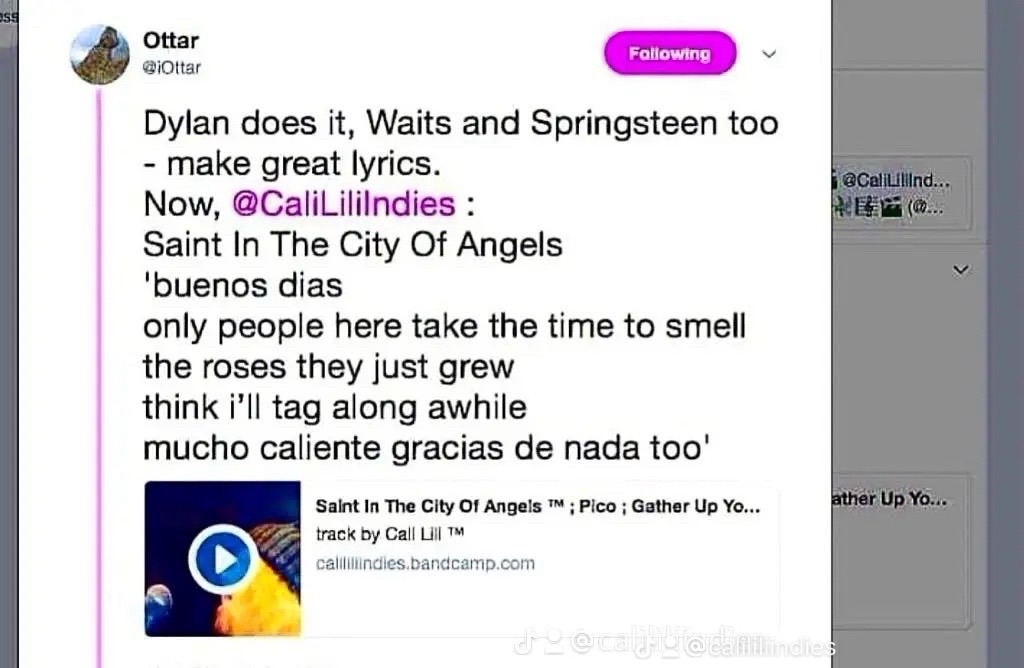
My cinema is heavily influenced by my studies in experimental theater which relies on a somatic connection between the actor’s mind and body. This has been heavily explored and as a dancer, it was a natural ingredient in my cinematic recipes. I’ll be exploring that in an upcoming book, which will include this essay as a chapter, but for now I’d like to lift this thread, which appears later on in this essay here’s a quote:
“theater experimentalist Jerzy Grotowski was “interested in the actor because he is a human being” (Grotowski 1968). Grotowski employs the “give and take” of muscles in our bodies as a theoretical principle. His actor training involves the constant “give and take” between one part of the body and another part, the mind and the body, one performer and another performer, director and performer, performer and text, and performer and audience. The body functioning in harmony with mind as a result of struggle, like the Japanese Zen ideal, is Grotowski’s “method” …” (continued below)
JD Salinger Is My Tap Water (but I still love a Hollywood ending) ;
From Ramrod To Eve N’ God This Female Is Not Yet Rated ;
The Ironies & Ecstasies of Escalating Risk in Film, Art, Life or How I Spent International Women’s Day 2024 while John Robert’s So Called Supreme Court Revoked Democracy “
During Memorial Day Weekend 2024 as we approach pride month I’m thinking about a specific type of war veteran and war crime. I’m thinking about victims of gender violence, rape and violence against LGBTQIA communities, all of which are war crimes.
This kind of violence occurs not only during times officially designated as “wartime” but we might forget that wartime is every day for women and LGBTQ+ communities in too many parts of the planet.
For my sisters & brothers with memory & honor, I humbly contribute some excerpts :
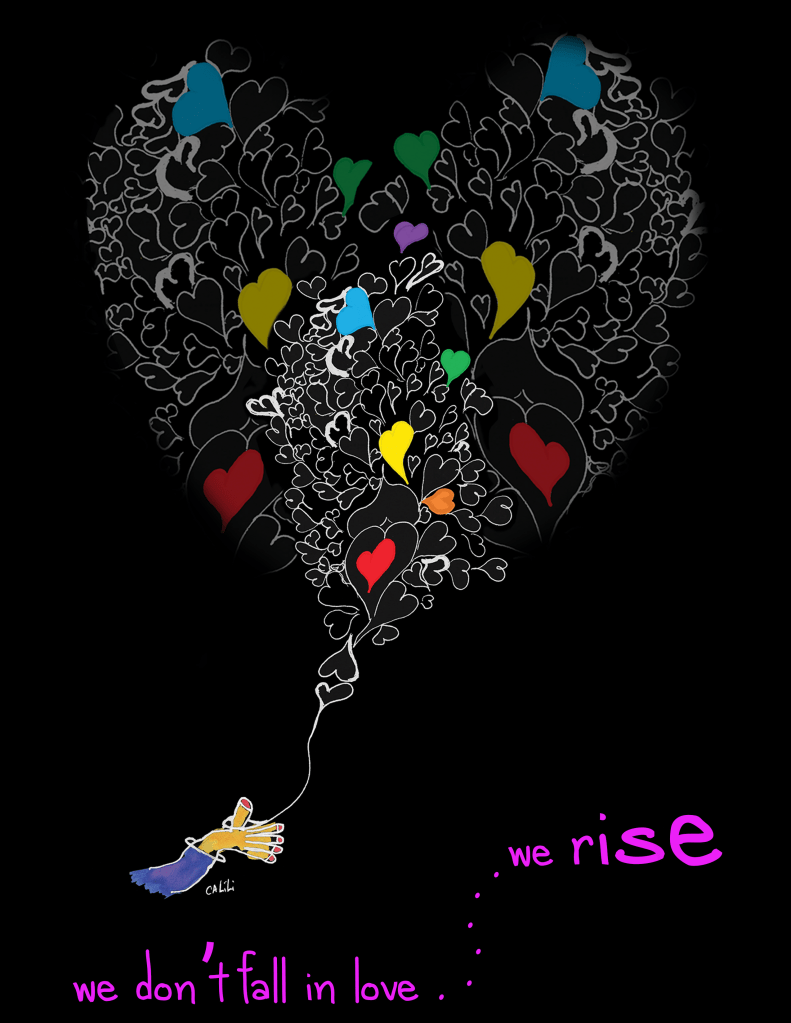
What you are about to read began as a simple practical exercise to clarify my thoughts before speaking to a sold out live audience & my first live stream event.
And then it happened again. I felt a “meditation” coming on. Some might call it an essay but my mind is a collage, so poetry & lyrics are my jam.
I swear I was minding my own business, putting together a plan for our impending appearance at a screening of the cult movie classic “Vice Squad” (1982) co-starring my awesome partner movie icon Wings Hauser and top Actors’ Studio Coach Gary Swanson.
The producers of the upcoming documentary “Wings Hauser Working Class Actor, “ Matt Verbois, Dan Mckeon & Cyrus Voris asked me to join the guys at the Egyptian Theatre in Hollywood for a post- screening Q&A in front of a sold out standing room only, live audience. This event was sponsored by American Cinematheque and La-La Land Records.
My role that night was to discuss my partnership with Wings Hauser, my own work as a 21st century actress, director and singer-songwriter and founder of my hand-built up-cycled “sustainable studio” floating in the Venice Beach Canals where we make signature movies, music & books that we describe with mottos & logos relating to either hydroponic farming / aquaculture / organic cuisine or other inspirations from sister arts such as “sustainable fashion” or visual arts.
As we are authentically indie, it’s difficult to pigeonhole my projects, which is part of the purpose for our existence. That’s why we often include terms like “organics,” “sustainable,” “farm to table films” “small batch” and “single source” such as :
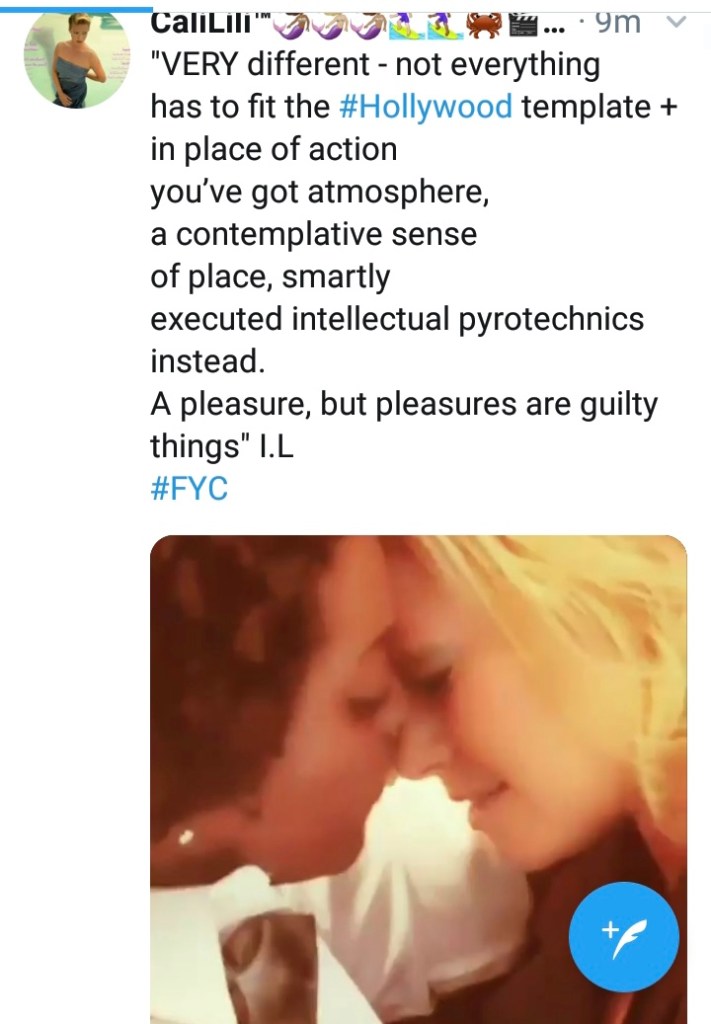
March 8 2024 happened to be International Women’s Day during women’s history month at this particular moment in HERstory and as the film Vice Squad depicts scenes of unusually graphic violence against women my goal was to prepare some ideas in this vein.
Film Clip : Wings Hauser & Cali Lili in a scene from “ Eve N’ God This Female is Not Yet Rated “
On Memorial Day Weekend 2024, I was invited to participate in a similar Q & A live stream broadcast to the audience at The Plaza Theater in Atlanta sponsored by Videodrome Atlanta (“the last video store”).
For the memorial day weekend event, I began my comments by quoting Matt Owensby, (of Videodrome Atlanta) who described my movie “Eve N God This Female Is Not Yet Rated” as :
“subverting, traditional narrative expectations,” an apt description on many levels!
For example my film evolves towards a love scene at the very end of the film, instead of the middle, which is due to the fact that the structure was intended to mirror a female orgasm.
Also, I cast movie icon Wings Hauser, as my flawed but redeemable “Dr God.” My film’s meditation on the complexities of “good versus evil” was heightened by the fact that in 1982 Wings Hauser’s acting performance immortalized a character named “Ramrod,” a vicious sado-misogynistic pimp whose violence way surpasses the power of the also iconic Edward G. Robinson in the original “Vice Squad,” and the loathsome bestial braying of Marlon Brando’s Stanley Kowalski (in Tennessee Williams’ A Streetcar Named Desire”) whose misogyny tears down the “beautiful dream” of the beautiful Blanche Dubois, a character representing our romance with liberal democracy, an educated civilization, and our endeavors “toward a more perfect union,” stunningly portrayed by Vivien Leigh.
As both live discussions Q & A took place after the screening of a film, which depicts unusually graphic misogynistic scenes of violence against women, what you are about to read, stems from the notes I took before my participation in these discussions and of course, reflects my perspective on all these issues.
At first I planned to illustrate the ironies and ecstasies of casting as my metaphorical “God” (Doctor Goddard) in my Oscars 2020 Contender “Eve N’ God This Female is Not Yet Rated,” the legendary actor, Wings Hauser, who immortalized one of the most evil cinema villains in history, a vicious white pimp named Ramrod.
Of course Wings Hauser is also known for a variety of eclectic powerful and even comedic roles in films & television over the course of his legendary 50 plus year career, including roles in films advocating for diversity in Hollywood. He’s known for his role as “Lieutenant Byrd” in the Oscar nominated movie “A Soldier’s Story,” as well roles in movies by two important African American artists, “Jo Jo Dancer, Your Life is Calling” by the genius, Richard Pryor and “Tales From The Hood” by innovative actor/writer/ director Rusty Cundieff, who, in my opinion started his own genre.
I’m SO honored that my feminist interracial LGBTQIA musical fantasy “love is love story,” “Eve N’ God This Female Is Not Yet Rated” was featured in a panel next to those amazing films.
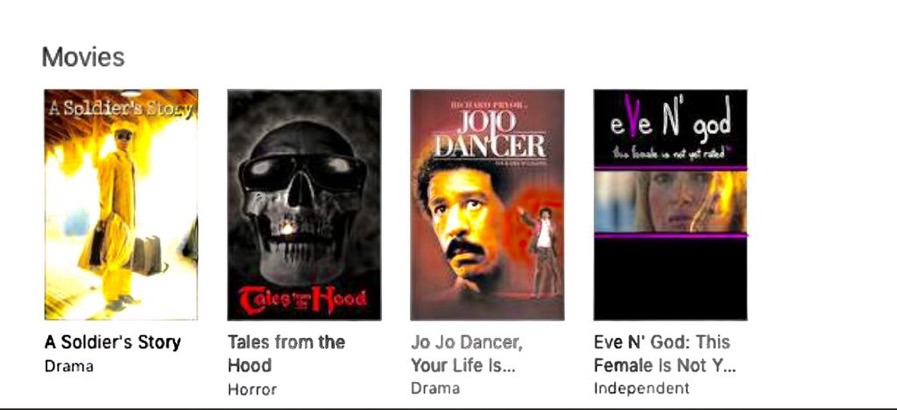
Official Movie Trailer Cali Lili ‘s Eve N’ God This Female is Not Yet Rated starring Wings Hauser Cali Lili Candace Burney Isriya McFillin
“Dr. God” is my metaphorical portrait of a status quo white-male-god-figure – with flaws. A “god” figure who eventually redeems himself by going toe to toe with a contemporary “Eve” character who’s dialogue was patterned after the filibuster scene in “Mr. Smith goes to Washington” where Jimmy Stewart pleads for the saving of our democracy.
My “Eve” speaks in filibusters as she petitions “Dr. God” for our freedoms. Her voice echoes Blanche Dubois (and other dismissed female cultural personas). Her voice is a cry, pleading for justice from the flawed deity she describes as :
“the most ‘supreme’ court.”
As I address fellow movie & music lovers, poetry lovers, book lovers & news nerds, it occurs to me that whether we consider ourselves highbrow or no brow, whether we love, horror genre movies, thrillers, romantic, comedies, dramas, animated , fantasies, or documentaries, whether we jam to Rap, or Bach, Doom or Classic rock, Blues, Ska, Smooth Jazz or Americana, what we have in common is not only the desire for a good story told well, but we also don’t want to be told “what to like. “
Our bond, in my humble opinion, lies in our desire for freedom (yeah democracy) our admiration & inspiration for independent thinking, our demand that individuals DO MATTER (in spite of the corporate-mind-pablum we are over fed) and we are genuine supporters of that oft-imitated, more often appropriated, rarely achieved “indie” status of the truly “independent” artist.
We bond over our disdain for injustice. We don’t want to be told what to read, what to watch, what to see, what to hear, what to think. Our “suspension of disbelief” allows us to engage no matter how briefly in a childlike innocence where we can redeem our hopes for freedom.
What is a child if a child is not free?
What is freedom without kindness, understanding and compassion?
What is freedom without cooperation as we work together toward common goals in spite of our differences? In fact working together in celebration of our differences.
I have written elsewhere that I believe the 21st-century is a time of useful consciousness where we must examine and quit our addictions to the speed of supremacy and dominance. We tell each other to “crush it” when we reach for excellence. We describe our sports teams as “dominating” each other when they win a game. Even when the game is an excellent match, both teams perform gracefully, graciously yet we still describe one team as “dominating” the other.
Please everyone, let’s quit this addiction to supremacy because by definition we are incubating ever more efficient “dominators,” “crushers” of the human soul.
Let us please, redefine success.
At my studio even though my projects did break a few glass ceilings and sound barriers to give voice to my independent art, we prefer to “weave slow, heal things” instead of succumbing to the status quo command to “move fast, break things.”
I keep returning to the disturbing fact that distribution of cultural products such as movies, music and publishing remain in the so-called “supreme” hands of corporations, which is, by definition, a supremacist distribution model. I think we must demand better of our cultural distribution ecosystem.
I’m inspired by Senator John Tester of Montana who recently passed a bill disallowing monopolization in the distribution of beef in Montana and I wrote to the 117th Congress and executive branch, requesting that we adapt that beef bill for independent movies and music to protect the independent artist and the audience members that love independent art.
My comments are always focused on the idea that as independent human beings, independent artists and audiences who appreciate the ritual gathering of our “village” for the celebration of authentic independent art, together we take part in a tradition of taking risks for the good of our culture. Risks that are similar to what the great Congressman John Lewis described as “good trouble.”
I am positing that the reason we take risks is because we cherish freedoms and we bond, no matter what our tastes demand, whether we like “junk” food or fine dining, our bond is our craving for freedom.
As an independent actress / director / singer songwriter, who happens to be a female member of the LGBTQIA community, I’m asking my fellow movie and music lovers to join my movement which supports independent artists in an increasingly corporate ecosystem of art “markets.” My team and I ask you to please :
“SupporTheARTSustainTheARTiST ™️ ”
Independent art cannot continue in the face of corporations without your help. Of course the independent artist will always strive to survive to create because we have no choice, we were born this way and our work springs from within. But your support means the world to us. It means a chance for us to, not only survive but to modestly thrive. It might also literally “mean the world” to the very existence of human culture & civilization because if we attempt to nourish ourselves purely on empty calories the corporations feed us, I sincerely believe we can never find nourishment without a thriving ecosystem of independent artists.
In my film, our protagonist, Eve rediscovers her long lost lover, Lilith. Eve decides she must leave “Eden “ in order to join Lilith on Earth for a taste of paradise. In doing so, she saves not only herself, and Lilith, but she also saves “God” by redeeming Doctor God’s innocence. We all know he’s capable of veering off into devilish Ramrod territory on occasion.
My Eve seeks to restore our innocence by reminding us that misogyny, defined as :
“hatred for all things feminine, vulnerable, wild, and free,”
is in fact the original, “original sin.”
I am in pre-preproduction on my next film and album so I REALLY couldn’t justify lending time to write anything other than the next draft of my current new screenplay. Nevertheless “she,” this chapter, persisted and when a simple bout of note taking, snowballs into a longer group of sentences and then paragraphs, on rare occasions like this one, I reluctantly give in, consenting to explore the meditation into unknown territory.
So it was, the following paragraphs wrote themselves into a chapter and the chapter barged in and wrote herself into my book. Like all good meditations, this became a journey toward an unanticipated destination.
Whether unwittingly or consciously, artists often explore recurring themes in our work. This trip unexpectedly returned me, toward the destination of my constant worry that cultures must find ways to redefine success away from our current violent supremacy / dominance model so we can relocate the coordinates to our humanity. The perfectionisms we worship, to the detriment of our work/life balance are a symptom of our supremacist bias and that perfectionist model can often erode the spirits of our better angels and lead us, to exactly where we are now. My worry is not just that as a culture, many of our citizens (and citizens of many other democracies) have not only lost the location of our humanity, they, we, have also lost the compass. When many of our fellow citizens see violence as a viable option for the illusion of problem solving, the entire culture suffers and thereby, the world, the very earth & water & sky suffer, as do all living beings. Of course violence never solves problems, it only creates more problems.
But even here, the conclusion is not really the point, it’s all about the journey (as the protagonist “Eve” in my indie film says).
Even here I remind myself again that at my sustainable studio, we strive to manifest one of our many mottos : “weave slow, heal things” instead of following along in the status quo command to “move fast break things.“
For me, poetry & lyrics spill more easily than prose, so besides the Pacific Ocean, the following “stream of consciousness” is the way I surf.
Grab a board.
Here we go.
Part 2
JD Salinger is My Tap Water
These questions are necessarily suspended in a precarious area of risk between matters of life and death for artists – and all fellow humans.
So, it’s way too late on a school night and I’m way too young to be riding the New York City subway alone when some guy decides to make some stand against his own demons by opening up a zippo lighter very close to my face. He screams in that spine altering guttural octave, that I should “GET OFF HIS TRAIN.”
I don’t budge. I just give him the “green eyed burn” staring right back at him with the kind of steely resolve I should not possess at the tender age of 12. But I’m a New Yorker, JD Salinger is my tap water and Holden Caulfield could’ve been my brother.
Subway guy brings the lighter even closer to my face. I am a little blonde girl with a little mermaid backpack full of books tucked under my dance shoes and he is a wounded middle aged black man. Little did we both know, I’m not quite “white,” I’m just a rose gold shade of multiracial multi-continental coral-pink. And I’m already nursing a few wounds myself.
If I get off “his” subway car now I will be at a lonely subway station not even close to my final Jackson Heights destination in the middle of the night. There are very few people in the subway car and I’m the only girl.
But the violence I have been navigating in my childhood home has taught me to stand my ground. I’ve seen a man bully and beat a woman, I’ve stood in between them as an unfortunate referee only to fail in my efforts as he throws her out of her own home. I’ve helplessly seen her sleep in the park downstairs. I’ve tiptoed to the apartment door to let her back in when he’s asleep. I’ve even called the police to intervene between my parents. So no motherfucker on a train is gonna tell me what to do.
Little Little did I know, subway guy probably saw the movie “Vice Squad” on DVD and wanted to play out a Wings Hauser zippo scene with me. Something about me, triggered him into that retro zippo moodand something about me, triggered him into that retro zippo mood tonight. When I stared him down, he backed off. The look in his eye was a combination of shock, disbelief, determination, pain, and acquiescence. Finally another man on the train ushers the zippo wielding man away from me. But zippo man never takes his eyes off my eyes staring him back into his territory, telling him I know the jungle too. I would experience several other encounters like that in the big apple, but this was my first bite.
Part 3
But I Still Love A Hollywood Ending
Just a few years after the NYC subway incident, I’m in Los Angeles, sharing the anecdote with my partner, Wings Hauser who is amazed. He tells me about the zippo lighter scene in “Vice Squad” when Ramrod the pimp confronts a woman on the street in exactly the same manner, suddenly holding up a zippo lighter to her face. Most on screen pimps were portrayed as black men and Wings was told black audiences appreciated seeing a ruthless white pimp on the screen. Subway zippo guy might have been emulating Ramrod years later when he encountered a vulnerable blonde kid with whom he could play out the scene.
My formative years were characterized by such hauntings, echoes in the NYC air not unlike that of almost any urban playground complete with sprinklers in the park and a lonely sandbox for those of us who wished we could go to the beach in summer like the “happy” kids do.
At NYU I studied the works of many master artists, including “master of suspense,” Alfred Hitchcock, who was once asked:
“what is your idea of happiness?”
His answer:
“a clear horizon, no clouds, no shadows.”
In a filmed interview, by Richard Schickel (“Film on Film” 1973), Alfred Hitchcock relates a childhood story in which his father, a green-grocer, sent young Alfred to the local jail with a note for the chief of police, who promptly led the boy down a long corridor, locked him in jail, returned ten minutes later, and released him saying “that’s what we do to naughty boys.”
Hitchcock remembers the “clang (and) solidity of that cell door” (“Film on Film” 1973).
Without warning, an unsuspecting victim is wrongly punished or accused of some wrongdoing. The accuser reveals a previously hidden intention of evil which has now risen to the surface. The victim screams innocence on the wind to the world, but “life goes heedlessly on and we hurry to join it” (Film On Film, 1973 ).
As the audience, we, the “other witnesses” in the scene can “enjoy the suspense” literally “suspended” in time, no matter how disturbing the story, as long as we are assured the movie will end, then, we’ll go to dinner or drinks or traffic, or just go to sleep in a “hurry to join” life going “heedlessly on.”
Hitchcock’s recurring themes include victim-protagonists who consider themselves innocent, but the director says:
“our evil and our good are getting closer together… In today’s sophisticated era you can barely tell one from the other ; evil can intrude anywhere” and one “can’t hide from the world” (“Film on Film” 1973).
Hitchcock confides:
“I’m afraid of everything” and explains his intentions toward his audience:
“they must be provided with the knowledge that death may appear at any moment” (“Film on Film” 1973).
In “The Birds” Hitchcock’s lead character pleads
“innocent of crimes against nature. Nature is disordered … in revolt…
In Hitchcock’s universe, no-one is innocent of something like original sin” (Film On Film, 1973).
So what does all this have to do with movie icon Wings Hauser, who played the sado-misogynistic, coat-hanger wielding , castrating devil spawn character named “Ramrod” in the 1982 movie “Vice Squad,” along with an excellent cast, including the powerful Gary Swanson and beautiful Season Hubley ?
What does it have to do with me, casting Wings Hauser as my version of a flawed but ultimately redeemable metaphorical “God” in my sustainable, green, all female crew production of the 2020 Oscars Contender “Eve N’ God This Female is Not Yet Rated” an interracial feminist fantasy, LGBTQ love is love story & rock n’ roll epiphany?
Glad you asked.
Part 4
From Ramrod
to
“ Eve N’ God ; This Female Is Not Yet Rated “
At first it was just a great casting choice that also felt like a fun bit of future cinema trivia. But the idea bloomed upon examination through my particular set of lenses. Whether we movie lovers consider ourselves “high brow” or “no-brow,” whether we love horror, genre movies , authentic art house cinema, documentaries, Hollywood classics and beyond, whether we music lovers crave death metal, rap du jour, global rhythms or any era, any culture, any iteration of singer songwriters, our common bond, in my humble opinion, lies in our desire for freedom (yeah democracy) our admiration & inspiration from independent thinking, our demand that individuals DO MATTER (in spite of the corporate-mind-pablum we are over fed) and we are genuine supporters of that oft-imitated, more often appropriated, rarely achieved “indie” status of the truly “independent” artist. We bond over our disdain for injustice. We don’t want to be told what to read what to watch or what to “like .”
My educational background was so eclectic & interdisciplinary spanning from pre-law & anthropology to physical disciplines like multicultural dance & other movement methodologies, I often feel like I am purposefully bridging a variety of intercultural disciplines.
In this case, my thoughts were riffing on connections between sci fi fantasies, thrillers, horror movies, theatrical adaptations for film, nerdy performance art methodologies and political science scenarios in which the yin/yang balance of power between males and females becomes the central focus. Oh, and I was also thinking about the current insanity marking the John Roberts’ So Called Supreme Court’s dalliance with dictatorship.
One key theme in my film is an exploration of a line of dialogue spoken by “Eve,” our protagonist. In the middle of her 21st Century “epiphany” she contemplates :
“the original –
original sin”
In “Eve N’ God, This Female Is Not Yet Rated,” as in Hitchcock’s cinematic universe, even god , like Hitchcock’s characters, “is not innocent of something like original sin,“ to paraphrase the previous quote from Richard Schickel.
Meanwhile in the 1982 world of “Vice Squad,” we have Gary Swanson’s gritty portrayal of a cop named “Walsh,” representing for us, the forces of “good against evil” as a good cop. We also have Season Hubley’s powerful portrayal of “Princess” the classic “hooker with a heart of gold” who is also a young single mom.
While wildly different from Vice Squad, my film also happens to grapple with the “Yin-Yang” balance, the “Tao of Eve,” the “Tao” of good versus evil. My story also happens to center on a triangular structure of central characters inhabiting a 21st Century post industrial, post modern, post Edenic world of riddles, illustrated by triangles, spirals, formulas on the walls & metaphysical codes found in nature and art. I could not shy away from allowing our allegorical protagonist, “Eve,” (Cali Lili) to illustrate a “Girl Gone Wild” PHD style.
When I wrote and shot my film, I hadn’t seen the other movies exploring “Eve.” Each of the other “Eve” themed films illustrates uncanny similarities, much to my surprise.
That subject deserves its own essay which I feel obligated to write, but for now, suffices to point out that each of the “Eve” movies addresses this theme :
“girl gone wild ”
Well, of course we gone wild. The making of my film is in itself, an example of a 21st Century “girl gone wild,” and a risk.
My version of a counterculture indie is riskier than most because it does not rely on the normally bankable genre of horror, gratuitous sex & violence. A risk because while I do include love scenes and some violent imagery, my counter culture project relies, mostly on my own auteur style, dialogue, acting, and the intellectual curiosity of the intelligent audience. A risk because the protagonist is not only a woman, she talks a lot. In fact, she “breaks the sound barrier,” as over 51% of the movie dialogue is spoken by a girl.
That’s a risky film.
Our “Eve” is a contemporary version of “a stripper with a heart of gold“ who multitasks as a surfer chick in Venice Beach, putting herself through school, earning a PhD in gender studies and supporting her no good husband named “Adam.”
In a nutshell, my story can be described as :
“One day
in the epiphany
of a 21st Century Girl,
Who Kissed A Girl.”
The movie takes place in one day, “today.” Today is the day “she” finally has “the talk” with our version of a metaphorical, flawed “Dr. God” / “Doc” (Wings Hauser).
Doc is Eve’s PhD advisor and head of the gender studies department.
During that long overdue conversation, Eve demands accountability & answers from “God .“
She needs answers to many of the questions women and girls (and those who love us) have debated in our own minds, hearts & souls for centuries, including , biblical restrictions to the nature of female sexuality, girls’ reproductive & healthcare rights – oh – and also – whatever happened to “Lilith,” the original “Eve,” our “Mitochondrial Eve,” originating in Africa, but conveniently erased from our collective memory? My Eve asks “Dr. God” to answer for that long lost sisterhood.
Here I feel obligated to detour for a brief mention about the 1956 classic “Eve themed” movie I just saw a few weeks ago for the first time. Directed by Roger Vadim starring Brigitte Bardot, the title is : “And God Created Woman” ( “Et Dieu … crea la femme “). I was struck by some of the shocking similarities between some aspects of that production and mine, but I was even more gobsmacked by the differences in how we ended our films.
While my allegorical fable ends with Eve setting herself free (like many of the other Eve themed films) thereby also setting our metaphorical Dr. God, free too, the 1956 Vadim movie ends in a vastly different manner. After the Bardot version of a character named “Juliette” who’s persona screams of “Eve,” performs her “wild dance” for freedom to the rhythm of African bongo drums, she is “tamed” by her white “Adam,” who SLAPS her back into “her place” as “his woman.” The Vadim movie portrays Juliette/Eve feeling “relieved” and sexually aroused by that slap. Her “Adam” then, leads “Juliette /Eve” back “home” (Eden?) by the hand, happily into her future humble domicile.
For those of us looking closely, we think we see a twinkle in Juliette/Eve‘s eye, indicating that no walls can hold her to this home with Romeo/Adam. But who knows, maybe she wants the security of a cage while also enjoying the makeup sex? That’s what this 1956 movie appears to say. I’ve always believed every relationship crafts its own vocabulary. While I was personally disappointed in how the Vadim movie ends, I must admit that it’s none of my business how this couple, or more to the point, this female, gets her “kicks.” Of course it’s far more questionable when couples choose to raise children in patriarchal environments where the female is chronically dominated. Sound familiar?
Bardot’s complex portrayal of “Juliette/Eve” is a powerful display of self-knowledge & determination along with moments of fragile vulnerability & compassion. Like my version of “Eve,” “this female” too, is an authentic rebel. In my movie our patriarchal “God” figure asks Eve, “so, you got a cause Lady Rebel ?” To which Eve responds “Don’t need one, but yeah, I got cause.” Similarly, I saw the Bardot version of the Eve archetype as the 1956 female version of James Dean’s 1955 Rebel. For any rebel, the “cause” “lies so deep in the cultural fabric, “ it is, as my Eve states “in the stitches.”
For our 21st Century rebellious fable, our Eve is a burlesque dancer / stripper who performs her own version of eVe’s liberation “dance” where she rips her stripper pole off its base, revealing wispy branches connected to the “tree of life.” Our Eve dances with a stripper pole that is actually the “tree of life.” As evidenced by the May 2024 cross examination of a sex worker named “Stormy Daniels,” who very bravely “takes the stand,” bearing witness under oath to stand up for herself, and for our democracy, yet our contemporary backwards culture, continues to slut shame women, blaming every “Eve” for her own victimization at the hands of a misogynistic supremacist culture.
For my Eve movie I felt that casting the actor who immortalized “Ramrod “ as my flawed but redeemable “God Figure” at this time in herstory was both poignant and irreverently funny. I shared this with Wings when I nervously asked him to read the script and more nervously asked him to consider playing the role (he doesn’t do favors and I don’t want favors). He loved it & did an awesome job as always. His best ever, in my humble opinion. Until our next one.
Flashback to Hitchcock , who himself was a sort of “God” figure, with a preference for the “Bardot” type, also known as “The Hitchcock Blondes” :
“The world today is full of brutality but it’s developed into brutality with a smile … We live in a chance universe, we are victimized by accident, saved by accident (and) the artist has to make the invisible a little hard” (Hitchcock 1973). The man who longed for a “clear horizon, no shadows,” the man who could be viewed as a self-proclaimed paranoid, employed the shadows of cinema to bring evil hidden clouds to the surface and project them, in a collision course, onto the screens of our emotional minds, now full of unprecedented doubt and fear as we navigate the 21st century on our interplanetary swimming pool.
Here we are 2024. The 21st Century. “Age of Aquarius,” yet we find ourselves saddled, still, on the edge of our seats & sanity, brought there by those who wish to return us all to the dark ages.
Now THAT’S – suspense.
It would be one thing, if such individuals or groups preferred to live in their own darkness. But they prescribe it, demand it for others. We are living through an unprecedented time when AMERICA, yeah, the country with the Statue Of Liberty holding up that torch, is approaching an election with one of two major parties, espousing a platform advocating an agenda for authoritarian dictatorship.
Not just ”Orwellian,”
positively “Hitchcockian” – ain’t it?
In the semi-edenic mindscape of my movie “Eve” points out to Dr. God, that he is “the MOST SUPREME Court. “ Then she goes on to ask “Where’s the female version of you?”
As we ride through 2024, this question about the “Supremacy” of the current iteration of John Roberts’ So Called Supreme Court and others who place themselves above the law, rings especially loudly because it originates in the “origin story” many of us rely upon for our notions and behaviors related to “faith“ and “justice.”
The book of “Genesis” is one particular biblical “origin story,” (many cultures retell their own origin stories) forms the basis for a cultural fabric held together by “the stitches” (referring again to another bit of dialogue from my film) of our legal & political institutions which have their own set of origin stories like “The Code of Hammurabi.“ Once again, contemplating “the original, original sin“ seems to me, a worthy theme that keeps on giving.
Alfred Hitchcock thought HE was living in precarious times. Oh boy, do we have a movie to show him. Imagine good old “Hitch” watching any segment of news today?
Then imagine him comparing it to the media of “alternative facts,“ where he would recognize our contemporary version of innocence sacrificed on the altar of evil.
Jump cut – forward to “Vice Squad.”
It was Wings’s brother, Erich Hauser (Rest in Power) who reminded us there had been an earlier movie entitled “Vice Squad” circa 1953 starring Edward G Robinson (full disclosure while I’ve been told I am possibly distantly related to Edward G. I have no idea if it’s true. Erich thought it was an amazing coincidence and so did we). Both Vice Squad movies brought the audience into a world not unlike that of Hitchcock’s characters. Both Vice Squad movies challenge our expectations, both warn us that even the good guys and girls might bend rules and both movies highlight the exploitation of women.
It’s likely the Edward G. Robinson version had a similar effect on the audience of his day but in the case of Wings Hauser’s now iconic free form portrayal of actual mayhem in one living specimen, “Ramrod,” there is a far more disturbing aspect to the suspense we experience when faced with Ramrod’s “brutality with a snarl.“
Wings Hauser’s performance of a malignant narcissistic sociopath in action – not only brings us to the edge of our seats, it DRAGS us to the edge of sanity. Drags us into a world of such chaos that we might forget our future ability to walk away from the theater and join the flow of “life ongoing heedlessly” as prescribed by the “master of suspense “ himself.
The tone of Hauser’s performance takes us – beyond the scope of mere suspense, it matches the tone of increasingly risky circumstances we all find ourselves in these days. Of course, abuse is far more difficult to confront in “real life.”
Ramrod in your house is a whole other animal.
That’s why the sacred art of acting, the Holy Spirit of drama, might continue to foster our healing through catharsis, “if we can keep it” as Ben Franklin famously said about our young Democratic Republic.
Cathartic Drama is an older goddess than Democracy but they inform each other well in the process of civilization.
Another good example is the play “A Streetcar Named Desire” by Tennessee Williams who co-adapted it for the screen with director Elia Kazan.
Uncomfortably, “we” (the audience) watch Brando throw down Stanley Kowalski’s brand of misogyny, yet our culture venerated the “STELLA” moment as though it were a monument to “bull in a china shop passion,” instead of a revolting, infantile cry from a homophobic wife-beater, reeling his lusty willing victim, Stella (in a very difficult role played beautifully by Kim Hunter) back into his dirty grasp, before raping & institutionalizing her sister Blanche Dubois (played by the genius Vivien Leigh, who is herself a miracle, performing miracles on screen with every role she breathed life into) the only kind and refined soul to fly accidentally into the light of the voracious furnace we laughingly call “society,” eventually to be burnt at its stake.
Stanley is likely suffering not just from the ptsd he suffered in the war but also his own homoerotic impulses, yet none of that is the driving force for his “deliberate cruelty.” Blanche says :
“some things are not forgivable. Deliberate cruelty is not forgivable! It is the one unforgivable thing, in my opinion, and the one thing of which I have never, never been guilty.”
Stanley’s need for superiority, absolute power as “the rightful king” of his domain, is his “why.”
Was our culture AS uncomfortable watching Wings Hauser’s Ramrod perform far more sadistic acts of cruelty than Stanley Kowalski?
Or were we gradually desensitized by a culture increasingly tolerant of the “deliberate cruelty” Blanche Dubois called out on behalf of Tennessee Williams, whom no doubt, was mourning our loss of the American “Belle Reve,” the lost “beautiful dream,”drained of innocence by ever increasing levels of tolerance for the “deliberate cruelties” of authoritarian violence, abuse, misogyny, homophobia, racism & environmental abuse, like so many famous experiments exposing human capacity for inflicting torture on command?
At least some progress was made when the screen version of the Tennessee Williams play showed us a “Stella” who, (perhaps against the will of the author?) unlike the theatrical version, refused to go back to her abuser at the end of the film. On screen, Stella finally rejects the abuse she was willing to tolerate on stage.
Luckily, we also get to see the brilliant Karl Malden, and other excellent actors who play Stanley’s army & poker buddies, transform from their blind obedience to Stanley, into a Greek chorus, eyes open for the first time, recognizing Stanley’s corruption. We recognize it on Blanche’s behalf, and ours. Blanche, of course, is the symbol of liberal democracy. She hangs in there advocating for poetry, flattering lighting, romance, love, justice, beauty, acceptance and the “kindness of strangers.” Blanche is even kind to Stanley, who neither deserves nor “desires” her kindness. Stanley has no time for the humanity of streetcars, he’s a freight train with a “napoleonic code.” Having buffed up his physique toward an authoritarian ideal for so long, the “bread lines” for desire & democracy no longer hold power over his behavior. This makes Stanley a danger to anyone & everything he touches. He is fueled by the goal of supremacy, fueled by cruelty, the only thing in the world Blanche rejects, the only thing she can never forgive.
Good for her.
Blanche is a Shero. She may look like she’s going away to some loony bin, but I say she escapes the loony bin for a better place, leaving the lunatics like Stanley and his enablers in their bin. Like our contemporary Eve, she hasn’t been kicked out of Eden, she walks out.
You Go Blanche.
You Go Eve.
Fast forward to the “Vice Squad” universe, Ramrod, like Stanley, seems to “get away with everything” for most of the movie & many viewers seem to “love to hate him.” An apt metaphor for our times. But it’s not just that cliche at work here, you know, the one about how “we love to hate “any given character.
The staying power of Hauser’s performance, like Brando’s, lies in our civilizations’ nervous adolescent worship of male-flavored superiority and dominance. I have written elsewhere that I believe we must quit our addictions to superiority and dominance or risk incubating smarter and more effective wannabe dictators.
Our culture and many others also seem to worship ever violent (often misogynistic) films that are referred to as cult counterculture “edgy” films when they are young movies (often directed by males) and then referred to as cult classics when the films grow up. But these movies are the furthest thing from counterculture because they are the closest thing to our cultural biased norms.
That’s why I decided to take the risk of making what I felt could be a truly counterculture film. A movie in which 51% of the dialogue was spoken by a woman. In researching gender studies & women in STEM, I found scientific studies proving evidence that most males and some females find it very challenging to listen to the voice of a woman for any significant length of time and retain what she says. I don’t think that’s nature. I call that “socialization” of the most destructive kind.
My project was made with an all female production crew at a time when this was rare. I tried to create an all female music crew, but it was not to be. By the time we completed the soundtrack though, I was beyond happy that the sound crew was authentically “integrated” with regard to gender, cultural backgrounds and sexual orientation.
I must take an extra moment for a BTS Note. My project would prove to be an authentic counterculture product from the moment I put an advert out, inviting female – and LGBTQ identified crewmembers – to submit resumes, explaining in the advert that we would be hiring with an aim toward diversity. The hate mail flowed in immediately and it was vicious from the start. We are now all , unfortunately accustomed to some of the rancor we see in society these days, purposely normalized by those who seek to harm democracy and civilization by dividing us from within but as recently as just a few short years ago we were truly shocked by that level of misogynistic homophobic poison. Some of the infantile comments left where my movie is playing on demand on various platforms also illustrate how counterculture this project truly is. We sure seem to have “disturbed the comfortable” while making a project intended to “comfort the disturbed.” I’m glad. That was a real risk worthy of a contemporary “rebel” with a cause so deep, it’s “in the stitches.” Mission accomplished.
I’ve written elsewhere, I believe we need a new definition for success. Our shy admiration for characters like Stanley & Ramrod, who will stop at nothing to assert their dominance, speaks volumes for who we are as a culture. Considering that our culture is currently toying with the idea of authoritarianism and that our legal system, our political system, and our economy could use some improvements in delivering our ideals of “equal justice under law” along with rights to pursue happiness for our most vulnerable citizens, by the people, for the people, it seems to me that the archetype of pure evil embodied in such characters can serve as teachable moments for our times.
This is one of the reasons I was so interested in portraying a “flawed deity,” played by the actor who immortalized Ramrod.
It’s one thing to watch a character go balls out to achieve his goals in a work of fiction but of course it’s quite another to live with or endure such an abusive character in your own home, your own workplace, in your own country or online where cyber bullies or self-appointed critics and “reviewers” living in mommy’s basement (or in the lap of our culture’s luxury class) can wield sociopathic amounts of influence over other people’s thoughts, minds, hearts and lives.
Perhaps many of us have not experienced abuse directly, but I can assure you it ain’t no movie. If Republicans get their way and manage to destroy American Democracy, more of us will join the unfortunate club of unfortunate people who’ve directly experienced abuse.
These days, in light of current events, the terror of Hitchcock’s description of the jail door slamming, is now fully felt by the audience at a time in history / her-story when our precious democracy is threatened by some people’s twisted fantasies of success for the few.
The sheer unbridled rampage of evil claiming supremacy above any “Rule Of Law” as “ Ramrod “ eludes “ Walsh “ and claims his spot as an “archetype of abuse” is a useful “story-lesson in fear.” A story illustrating the horrors of abuse of power, way too uncomfortably mirrored on the nightly news. When it comes to a character as thoroughly evil as Ramrod (imitated by other actors after that performance), an examination of his popularity with audiences is worth a second and third consideration in light of our times.
Supremacy is in fact, completely unsustainable, without violence, which is why it is an unworthy, dehumanizing goal.
Unlike the bank robbers (sometime murderers) portrayed in the movie “Bonnie & Clyde,“ the character of Ramrod in “Vice Squad” is uncompromisingly cruel, whether indifferent or enjoying his crimes, he’s always “efficient” at delivering human suffering, like the dead eyed ruthless efficiency of a shark swallowing limbs whole, never deterred except for an occasional pod of angelic dolphins. Ramrod doesn’t even bother to get angry like Stanley did in “Streetcar.” He doesn’t waste energy with emotion. Like a corporation, he swallows up the territory & spits out the bones as an afterthought, another acting choice by Hauser (often imitated by actors who took their cues from Hauser’s performances of Ramrod and a few other similar iconic roles he’s played.)
Ruthless efficiency at all costs is a familiar cultural aspiration. Sports teams are touted as having “dominated” their opponents. We tell each other to “crush it” as we approach a challenge at work or play. As swathes of our culture contemplate voting for an authoritarian in 2024, we must finally admit it, we do worship superiority, and dominance. The current state of affairs of state, is the reaping of that worship. That Frankenstein we incubated.
May I please, humbly suggest (as my protagonist “Eve” suggests) we need a recovery program for this addiction or it will swallow us whole.
The rules of logic lead us to an uncomfortable truth. When a culture worships dominance and superiority, it must, logically, incubate and give birth to superior dominators. “Move Fast Break Things” was the early motto of Facebook. Personally, I always admired & now mourn the loss of Google’s early motto “don’t be evil.” Growing up these past few years I’ve often thought if people who worshiped dominance were exposed to abuse on a personal level, they would favor “don’t be evil” over “move fast break things.“
Our admiration for dominance (which we’ve unfortunately exported) surely incorporates our appreciation of characters who display 100+ percent commitment to a goal. We are an economy and culture based on results. As I write this, I realize the concept of “taking risks” is often associated with “commitment to goals,” the ultimate American aphrodisiac. Touchdowns, home-runs, 401 K’s, Teslas.
I’m suggesting we consider taking “cathartic risks for the power of good causes” – AS POWERFULLY – as those who take such risks for the sake of power.
Ramrod’s sado-misogynistic cruelty is also tinged with a hint of his own possible latent homo erotic tendencies. He is the embodiment of unbridled evil and abuse of power but Ramrod, like other abusers, like Stanley, who derive enjoyment from inflicting pain on women – might just need a boyfriend?
If it wasn’t so terrifying it could be funny, like “SNL,” or poignant, like “Brokeback Mountain.”
As I’ve written elsewhere, survivors of abuse share an unfortunate lesson in wisdom that is worth heeding as a culture. Any abuse, whether it be domestic , child abuse, animal , environmental abuse, or civil rights, human rights abuse, all abuse is an abuse of power.
Power is the abusers’ desired objective. Without absolute power, the abuser cannot survive.
Like the shark who must keep moving and devouring to stay alive, Ramrod, the quintessential portrayal of cinema villain archetype is both, abuser and dictator. He will never submit to “ Walsh “ or to any law or “rule” except his own. He makes the rules and no other rules exist for him. That’s the “real trick” to “staying alive” on the streets, to paraphrase the “Vice Squad” poster.
Ramrod is almost omnipotent. He will never concede, admit or even recognize his own vulnerability, eluding capture & death for as long as possible. He’s a never ending high speed chase and the audience is suspended in that liminal space, “enjoying” the hating of the character as long as they know the movie will end and they can “join life heedlessly ongoing.“
But in “real life,” we, the people, we the audience, witness, digest & become desensitized to abuses of power on the nightly news, becoming “addicted,” dependent upon, the outcome. Some of us hope for a “Hollywood ending,” others rooting for “the bad guy.” We, the people, the democracy, the republic, the nation need the good guys to prevail.
Don’t we ?
I felt reality show Survivor, was grooming us to accept increasing levels of cruelty & injustice & now SCOTUS considers green lighting an immunity idol for less than 1% of us while allegedly “supreme judges” already claim that very immunity for themselves, as they refuse to recuse for the sake of Equal Justice under law.
Throughout the history of storytelling, we have always shared scary stories, fables, fairytales and fantasies, including sci-fi, which provide our cultures with a form of “healing through fear. “
As an actress, the most satisfying acting moments involve some form of improvised, imaginative playing with “danger” and risk-taking on the word “action” within the “safe” context of “the play” & “the rules” of a profession, the craft of acting where the consequences of any action are unexpected and spontaneous, if we are doing our job.
Of course I don’t mean actual or “real” danger. But as Hitchcock mentioned years ago, our imagined danger, and our real dangers are drawing dangerously near each other (including on-set safety). I don’t believe it is a good sign, but I do believe we can learn some lessons as we navigate the toxic “reality show culture“ currently endangering every aspect of civilization from education to arts, politics, of course, rule of law, decency, democracy, and Mother Earth. When I saw the reality show “Survivor” for the first time (years after its inception) it scared me. I felt that this show was grooming our nation to normalize cruelty and betrayal while glorifying one notion of success above all : “supremacy.”
What could be scarier than losing the freedoms of democracy? And thereby losing hope for the wellness of the planet? Whether it be actual prison or psychological, legal, societal imprisonment under authoritarian rule – or massive earthly devastation, the road to freedom is determined by our willingness to stand up for our rights.
In Vice Squad , detective Walsh must be wondering to himself throughout the movie, “what the fuck does it take, to take this Ramrod thing down?”
And then when he gets the chance to nail him, he utters an iconic line most of us associate with Clint Eastwood : “go ahead, make my day.”
Way before the Eastwood line, came the origins of that famous quote. The first iteration uttered by Gary Swanson as “Walsh” who said it to Wings Hauser as “Ramrod,” when Ramrod’s rampage finally ends.
Walsh To Ramrod :
“C’mon scumbag, make your move and make my day.“
Although Walsh represents the “good” part of good v. evil, this line of dialogue, that cinematic moment , indicate to us, that always looming in the context of any human story is the borderline between the two. Certainly this is not an exhaustive list of examples but both the 1973 film “Serpico,” starring Al Pacino directed by Sidney Lumet and the 1991 movie adaptation directed by Lili Fini Zanuck based on Kim Wozencraft’s novel “RUSH,” clearly illustrate the limitations of officers working in “Vice,” which is why their duties are often limited to specified periods of time, lest they become too cozy with the ways and means on the “bad” side of town.
Part 5
THE IRONIES
and
ECSTASIES
of
Escalating Risk in Film, Art, Life.
As our 21st century culture witnesses one unacceptably unaccountable atrocity after another, throughout the world, including our own United States Supreme Court, we are desperately in need of “the good guys” and girls.
Posted :
“WANTED :
Heroes & Sheroes.
Now Hiring.
Must be bold
non-violent
risk-takers
for ‘good trouble’ (to paraphrase the great hero congressman John Lewis“ )
My version of “Eve,” stands up to an omnipotent “Doctor God,” performed with the same ruthlessness and commitment by the actor who portrayed the seemingly omnipotent “Ramrod.”
Both “God” & “Ramrod” assert what they believe to be their absolute right to absolute power.
Those who believe it is their right to remove the rights of women in this country, in the name of a “God,” they pretend to speak for, are far more devilish than Ramrod.
Eve, who has been shamed & slandered by Adam, forced to forget her soulmate, Lilith, finds herself vulnerable and alone on a planet “where everything eats everything else,” summons up the courage to challenge “God,” to “become a better man.”
My allegorical fable about a contemporary Eve, the interracial love story between Eve and Lilith as two women of color, and the long overdue conversation between “Eve” and “God,“ is a response to our cultural and judicial solipsism. A dreamscape that seeks to awaken us from nightmares and challenge us to heal our very real opportunity for a kind of “paradise” on Mother Earth, where air might be safe enough to breathe and water, safe enough to drink, and endangered species, including democracy, might once again, dare to thrive in harmony as we spin forward splashing through space.
A cultural space where an independent filmmaker might thrive while taking creative risks for the sake of a healthier culture. An entertainment eco-system that nourishes and supports the independent artist and the audience, with nourishing “food for thought,” instead of appropriating and then attempting to diminish genius as disposable corporate collateral damage.
A cultural , legal and legislative landscape, even a tax structure that rewards the independent artist for taking intellectual risks and making art based in our democratic ideals as much as it rewards Wall Street box-office smash hits dominating corporate theaters – and as much as it might reward her for making babies.
My background in yoga & wellness, inspired me to create a sustainable studio that could “farm & harvest” what I consider to be “aqua-culture” to “nourish” culture.
My background in pre-law, is what I relied upon to understand the evil performed by the 21st century iteration of the so called “Supreme” Court. The John Robert’s Years.
My background in anthropology & performance studies led me to explore the physicality of metaphors like “standing up “ for a principle.
In considering moments of risk in performance in relation to moments of risk in everyday life, the common denominator is the human being, the actor, equipped with a vulnerability of mind and body.
In this era of contemplating the permutations of artificial intelligence, as a human artist, an actress, dancer, as a singer and also a practitioner of the ancient ancient art of yoga, I find it helpful to turn towards the interplay between our very human, mind-body mechanism and the performance, the art we render.
The mere act of “standing up” as in “standing up for ourselves “ involves a struggle:
“When we are merely standing still, a great deal of coordinated muscular activity is being carried out invisibly. We have to fight against the force of gravity, and this requires energy” (Atlas of the Mind and Body).
Existence is a continuous struggle and this lesson can be learned, as many lessons are, from the elementary example of the human body:
“Much of the body’s muscle movement is involuntary. Our hearts, digestive tracts, the walls of our arteries, lungs, eyes, skin, and bladder, operate on a kind of dual control system where dilation alternates with constriction”
(Atlas of Mind and Body).
This alternation is a struggle of two opposing forces , a yin – yang, in service to the same function.
“The interplay of muscle groups is initiated by brain activity but is not necessarily always ordained by conscious will. The passenger standing in a train for example, swaying but remaining upright does not have to think about the muscle actions needed to keep him on his feet” (Atlas of Mind and Body) and yet “although the activities of involuntary muscles are largely beyond our conscious control, in some cases we can override the instruction of the autonomic nervous system…” (Atlas of Mind and Body).
In this case we have another form of struggle, the “involuntary,” or unconscious workings of the body with the conscious will. The “content” of the brain’s conscious and unconscious struggle depends on various permutations of “chance” genetic and environmental factors in this “chance universe” ( “Film on Film” 1973) where good and evil may sometimes wear the same mask.
Unlike mainstream culture, where obvious delineations between “good“ characters & “evil” ones are clearly defined, “counter culture” projects offer the artist new options. Empowerment of girl power, social & environmental justice and the questioning of societal norms including faith & marriage, women’s & lgbtq rights and democratic as well as environmental freedoms is the foundation for my sustainable movies and music.
Although “Eve N’ God ; This Female Is Not Yet Rated” was shot before Covid, two of the three main characters speak to each other via zoom and many of our themes are now, in 2024 – topics of intense conversation and daily debate in every form of media.
My “Eve” character seeks to “give voice” to women everywhere, to “the global girl” and to characters like “Princess” in “Vice Squad” along with the many other cinematic “sex workers with hearts of gold.”
Currently our culture is navigating an old “minefield” where decency squares off against notions of superiority elevating some living beings above others.
Superiority is not sustainable.
Neither is a culture that refuses to cooperate with its own best interests. Just consider the fact that a portion of our citizenry willingly enable threats to fellow citizens like Ruby Freeman & her daughter Shaye Moss who volunteered their time to the sacred work of our guaranteeing our fair elections or E Jean Carroll, Stormy Daniels, and others who stood up for themselves against bullies. Consider too, that instead of condemning the bully, those who enable the bullying, call the bully “a god” and gleefully participate in assaults on democracy, endangering the nation and the planet, for what ? For their own benefit. For power. For supremacy. The “gentrification of culture” has caused us to vote against our own best interests.
The great screenwriter Paddy Chayefsky showed us to ourselves in his genius film “Network,” which illustrates what happens to a culture that conflates news with entertainment. The ironic genius of Chayefsky showed us our reality culture before we got here. He warned us.
Chayefsky and other artists of his generation employed irony to bring us to our senses. Irony is like that strong cup of coffee in the morning or that early morning workout, clearing your head, out of the fog into the light. Irony, because it leads to ecstasy. I know it’s not dead. This is probably an excellent time for the Renaissance of irony. And please don’t confuse my idea of “Renaissance” I’ve been mulling over since I mentioned the expression “ 21st renaissance in the works“ in a previous essay, with the current appropriated use of the word “Renaissance”
in corporate “pop” culture. Nor should my humble sustainable studio be confused with the equally appropriated “humble beginnings” stories offered by corporate stars in order to obfuscate the obscene money hoarded by the 1%.
I’m saying we get back to using our brains when we experience art. One way we can use our brains is by embracing the ecstasies of “irony” as illustrated by so many of our brilliant predecessors. Yes they would be very OLD if they were alive and active today. Old and wise, even though not very old person is a wise one, we could use a little Paddy Chayefsky. Chayefsky was very close with director Bob Fosse, who directed the film “Lenny,” about the late comedian, Lenny Bruce. Fosse looked up to Chayefsky and considered him his best friend. If you take a quart of jazz, blend it with some post modern irony and then shake it up with 21st Century political dirty tricks, what have you got ? You got that OLD thing called “the blues.”
The origin story of the “blues” is the origin of the human cry. Add an American twist and that’s how we got a Langston Hughes’ poem :
“ I wish the rent
was heaven sent”
The blues has always been a cultural coping mechanism. The African American experience was a sisterhood & brotherhood to the Jewish immigrant experience, the Irish American , the Mexican American experience and that of many other immigrants. There is a wry sad smile everywhere and lucky for American culture, some of our immigrants were capable of capturing the feeling.
A feeling called “the blues.”
Chayefsky said “the worst kind of censorship is the kind that begins in your mind before you sit down at the typewriter.” That’s what happens when authoritarians rule but it’s also what happens when an artist tailors her own thoughts, to suit “the suits” and the alleged “marketplace.” In fact, nobody knows what the audience will love, but corporations decide what to “feed”
the culture. They decide it from the prix-fix “menu” on “the A List.”
Who writes the “A List” menu ?
“Status quo” industry practices with built in biases “train” our minds on “what to expect” when we “expect” the plot or style of any movie, the “sound” of any song, the “vocabulary” and structure of any article, essay, or book. It’s not so much racist or misogynistic or homophobic, though it is, but it’s FAR MORE about “the art, of the deal,” so to speak.
And THAT is how we got here. This moment in history & herstory, is a corporate-Hollywood moment.
But we don’t have to abdicate our story. We can write our own happy ending.
When my project was in preproduction, we put out an advert asking for female & lgbtq crewmembers to send in their resumes, making it clear that our hiring practices are based in diversity. We received so much hate mail, intended to force us to curtail our innovative hiring and “put us back in our place.” But we knew it was not purely racist, misogynistic and homophobic. We knew that we were being called out for being free. We were being called out for being independent, for being individuals, for being humans who chose to make a human film with humans (not corporations) 100% at the helm.
My “why” for building my studio was all about “being the change I wished to see.”
We are “handmade to make a difference” ™️ and my studio logo is designed in the form of an “ingredient list,” a menu of sorts.
I’m dedicated to creating projects that “nourish” a healthier culture. At my studio we “weave slow, heal things” instead of “move fast, break things.”
Now like an avalanche, parts of our culture hurtle away from humanity toward some unknown destination teeming with artificial intelligence, all too disrespectful of human intelligence.
Caution:
Nerdy Performance Studies Detour Ahead
I debated whether or not to include the section below about performance theory and its ensuing network of ideas. Ultimately, I decided, hey, I’m talking about taking risks so what’s wrong with taking a few intellectual risks too? So, please exercise caution as you navigate the next section of this winding road. You might enjoy it? It might bore you? But unless you are a true performance art, performance studies nerd, I don’t think you’ll be reading about this anywhere else. Give it a shot.
I wonder if Chayefsky, or Tennessee Williams, or Marlon Brando , or Elia Kazan, were aware of theater experimentalist Jerzy Grotowski who was “interested in the actor because he is a human being” (Grotowski 1968). Grotowski employs the “give and take” of muscles in our bodies as a theoretical principle. His actor training involves the constant “give and take” between one part of the body and another part, the mind and the body, one performer and another performer, director and performer, performer and text, and performer and audience. The body functioning in harmony with mind as a result of struggle, like the Japanese Zen ideal, is Grotowski’s “method” :
“When I tell you not to think, I mean with the head. Of Course you must think, but with the body, logically and with precision and responsibility. You must think with the whole body, by means of actions” (Grotowski 1968).
Grotowski expects human actors to push themselves to the limits of their potential, “bypassing the half measures of daily life” (Grotowski 1968).
Grotowski says: “It is far less risky to be Mr. Smith all one’s life than to be Van Gogh.”
This is partly true, provided that Mr. Smith does not, in his own way, spend his life consciously asking “why” and placing his mind and body in risky situations in order to approach answers to fundamental questions of existence – in Grotowski’s terms “struggling with one’s own truth” (Grotowski 1968).
Intentionally placing oneself in the midst of the ongoing struggle, either physically or psychologically, is an act of admitting the “yin-yang,” the “Tao” of the human condition. Our vulnerability is our power as human beings.
The “difficult” road, rather than the contented or apathetic one, is open to all humans (including Mr. Smith) and it can be understood in terms of the Japanese Zen journey to “satori,” or enlightenment:
“What is truly difficult is to become conscious of what you have in yourself and be able to use it as your own” (Suzuki 1965).
“Action” in Zen, which is using “what you have in yourself,” is to be taken with “no mind,” like Grotowski’s logic of the body. The practice of swordsmanship was very closely linked to Zen philosophy and this art is an extremely risky one, in which “the problem of death (is involved) in the most immediately threatening manner” (Suzuki 1965). The swordsman in action “must come right out of his inner mechanism.” He must act instinctively and not intellectually” (Suzuki 1965).
Grotowski’s interpretation of Antonin Artaud’s notion of “cruelty” is this : “cruelty is rigour” (Grotowski 1968). The artist who is “cruel” to himself has examined his art and his mind/body with rigor.
Grotowski, the theater artist, has “cruelly” defined the domain of theatrical art. The risks taken on stage are analogous to those taken in life.
In a theater, both performers and audience “acknowledge a risk that things might not go well” (Macaloon 1984). Here, Macaloon describes an area of risk when what occurs on stage and how it occurs may not correspond exactly to the “pre-formed program of activity (Macaloon 1984). “
Macaloon also mentions risk in performance in relation to behavior in daily life:
“This element of open risk incorporated into the dialogue between the ‘what’ and the ‘how’ is universally present in cultural performances and it separates performance from most of everyday behavior…. This is scripted action and therefore, it…is different from everyday behavior” (Macaloon 1984) .
Performers struggle against the “pre-formed” form of theatrical action each time they engage in the act of performing. However, the intensity of the struggle, the “how” – very much like the intensity with which one engages everyday behavior, varies greatly from individual to individual. The higher the intensity, the greater the risk, and the greater the possibility for intense satisfaction or intense failure.
Grotowski comments on risk:
“Part of the creative ethic is taking risks. In order to create one must, each time, take all the risks of failure” (Grotowski 1968) return for the risk involved in stripping the self physically (in body technique ) and psychologically in the “poor theater” and the seemingly histic “shock” technique, both the actor and audience can “experience human truth” (Grotowski 1968).
The “ethical” actor, in the “poor” theater according to Grotowski, achieves “great satisfaction:
“After self-sacrifice beyond all normally acceptable limits, (he) attains a kind of inner harmony and peace of mind. He literally becomes much sounder in mind and body and his way of life is more normal than that of an actor in the rich theater” (Grotowski 1968)
What does Grotowski expect of his “ethical” (or “holy”) actors?
“If the situation is brutal, if we strip ourselves and touch an extraordinarily intimate layer, exposing it, the life mask cracks and falls away….” (Grotowski 1968)
“It is much more difficult to elicit the sort of shock needed to get at those psychical layers behind the life mask” (Grotowski 1968).
The “life mask” of Macaloon’s “everyday behavior” is not safe in Grotowski’s theater.
Similar to the ritual sacrifice described in Richard Schechner’s
Ritual and Performance (1986) where “a victim is selected, a surrogate, scapegoat,” Grotowski’s actor sacrifices him/herself as a kind of “homeopathic” cure (Schechner 1986).
Grotowski speaks of sacrifice:
“If he does not exhibit his body but annihilates , burns it, frees it from every resistance to any psychic impulse, then he does not sell his body but sacrifices it” (Grotowski 1968).
In place of the “courtesan actor” (Grotowski 1968) who “exhibits” and “sells” the self, Grotowski trains a “holy” actor who sacrifices the self for the community. This actor trains himself to endure past the point of fatigue and then provokes the community, requesting their participation in the ritual.
Macaloon’s “acknowledgement of risk,” where something may not proceed according to script, is no longer in focus. The relationship of actor to audience is more “difficult” and the nature of risk is also more “difficult.”
A new kind of liminal sphere is opened up for both actor and audience when endurance for a creative ethic becomes the focus.
In my projects, I explore this territory, especially minimalism which informs my signature style, along with the “poor theater” & particular forms of Japanese aesthetic practices which I have studied so deeply, but for now, I will focus on a few simple examples.
Grotowski’s aesthetic choice is “poor theater.” For many performers “poor theater” is usually a necessity as well as somewhat of a choice.
In “ Choices: Making an Art of Everyday Life (1986), “ Marcia Tucker describes performances which “challenge and upset (her) preconceived notions of art….” (Tucker 1986).
The “performance art” described in “Choices” involved artists who took physical and emotional risks in the name of their creative ethic and according to Tucker, “much of the work … was seen by the public as masochistic” (Tucker 1986).
An example of the work discussed in “Choices” is that of Chris Burden’s performances.
Tucker lists some of these: “(He) locked himself in a 2’x2’x3′ locker for five days (1971), crawled through fifty feet of broken glass with hands held behind his back (19/3), had himself crucified on the hood of a volkswagon
(1974)…, (Performed) Shoot (1971) in which a marksman accidentally shot Burden in the arm and Prelude to 220, in which he was strapped to the floor by copper bands next to two buckets of water containing live 110 lines… (These) were…public pieces which specifically incorporated a very real danger to himself despite the fact that the odds were against his actually being injured….” (Tucker 1986)
Burden comments: “I don’t think I am trying to commit suicide. I think my art is an inquiry, which is what art is all about” (Tucker 1986).
Like Grotowski’s experiments with the mind/body of the human actor, many
“auto-performers,” who are often classed as “performance artists” and work in galleries conduct
experiments which raise the stakes of inquiry to an extraordinarily high level.
Performance artists can project their hidden violence to the audience in the form of images or in the form of theatrical reality, which is action in the “here and now.”
Given the “reality show horror” projected onto our nightly news (I’m told by my elders, that it’s not all that different from the nightly news of yesteryear), theatrical reality in performance is becoming closer to “everyday reality” (as in Performance artist’s “making an art of everyday life” Tucker 1986) and consequently, the risks taken in theatrical reality are also closer to potential risks of everyday life.
Aside from horrific accidents taking place on movie sets, that are then reported on the news, the tension of risk lies in the extension of a theatrical violence, born of the violent material in the artist’s (or con artist’s) conscious and subconscious mind – inching its way back into the “everyday” world and testing how far out into the world it can go.
The continuum of risk factors to the human being either in performance or in daily life now includes climate related risks to life, permanent and/or temporary physical/psychological damage, physical/psychological discomfort, embarrassment, or pain, to unsatisfactory fulfillment of a personal goal.
The common factors of risk in life and in performance are the human mind and the human body. Each factor of the risk continuum must also be seen alongside a continuum of perception and/or action/behavior on the part of the risk-taker.
The human being in life and in performance can be either a “risk-seeker” or one who shuns risk.
According to psychological studies on the subject of risk-taking,
“thrill-seeking often produces the best achievers, but it can also create the worst criminals…. For some, the thrills are mainly mental, for others physical, and for still others they are a mix of both” (Farley 1986).
According to researcher Frank Farley, the level of “thrills” that each individual seeks is closely related to levels of arousal in the reticular activating system which “controls our body’s level of arousal” (Atlas of Mind and Body).
Farley explains: “We all seek unconsciously to maintain optimal level of ‘arousal’ or activity in the central nervous system, particularly in the… reticular activating system….If arousal is too high or too low, we try to adjust it to some middle ground” (Farley 1986)
The middle ground is sought by “average” individuals who seek “soothing environments ” (Farley 1986) when arousal is too high and “stimulating environments” when it is too low.
However, some individuals have unusually low or unusually high arousability. Farley names people with unusually low arousability “big T’s” as opposed to the high arousability “little t’s.”
Big T’s tend to be more creative and extroverted, but they also tend to be more delinquent, hyperactive, and reckless drivers (Farley 1986). In the action/behavior area of the risk spectrum these individuals are sensation seekers and perceive the risk factor, but their attitude toward the known or unknown source of possible consequences, such as death or breaking the law (which could result in physical/emotional damage and/or discomfort and/or failure to achieve personal goals), is one of disregard, reverence, or increased pleasure at the high stakes of the risk.
In a study focusing on anxious and reckless drivers, psychological researchers found that the reckless driver, the low arousability sensation seeker, has “difficulty internalizing norms” (Shoham, et. al. 1984).
The anxious driver, on the other hand, “(deeply) internalizes traffic norms (and is)… less willing to take risks” (Shoham, et. al. 1984). The reckless driver will view the prospect of punishment as a source of pleasure since “punishment will raise their desired feeling of tension” (Shoham, et. al. 1984) .
Reckless drivers, and psychopaths, are described as having “low ability for avoidance learning (Shoham, et. al. 1984), while the anxious driver is said to have a “high learning and conditioning ability and low impulsivity level ” (Shoham, et. al. 1984).
It is interesting to note that much of the most recent actor training “methods” since Stanislavsky have stressed the qualities of the “impulsive” reckless driver and psychopath, who do not internalize norms but seek their own road.
Examples of such texts are Viola Spolin’s “Improvisations for the Theater” and Grotowski’s “Towards a Poor Theater. “ These texts downplay the “learning,” “conditioning,” and “internalizing” aspects of the “anxious” driver who resemble a
Stanislavsyesque (since we can’t compare the actors who worked with the man to those who work with his texts) “method” actor trained in “emotion-memory.”
An example of risks involved for an unaware victim of risk who behaves normally in everyday activities is the potential victim of a natural, weather or nuclear reactor hazard victim. In this case, the government and media function as the director of a suspense film (“thriller”).
Hitchcock says: “the essential factor to get suspense is giving them information” (“Film on Film” 1973). He offers an example of the increased effectiveness of suspense in a scene where the audience, in possession of knowledge that a bomb will soon explode, watches two men discuss baseball, over the same scene of the conversation when a bomb suddenly explodes without the audience’s prior knowledge.
In the case of a potential climate catastrophe or nuclear hazard:
“If an individual has formed strong initial impressions about a hazard results from cognitive social psychology suggest that those beliefs may structure the way that subsequent evidence is interpreted…. The people lack strong prior opinions about a hazard…they are at the mercy of the way the information is presented” (Slovic, et. al.
1984)
In the case of any risk, including risk from weather events or disease, the study Behavioral Decision Theory by Slovic, et. al., stresses interpretation and perception:
“(the fact that) differences in how risks are presented can have such marked effects suggests that those responsible for information programs have considerable ability to manipulate perceptions and behavior” (Slovic, et. al. 1984)
The director, like the government or media program, has the power to organize information in such a way that the actor is unaware of the various possibilities of risk to his mind/body. However, in examples of performance where risk is, in itself, a major theme to be explored in the act of performance, the actors are individuals willingly devoted to an ethic or ideal and willingly subjecting themselves to varying levels of risk.
Guerrilla and Radical/Political theater in the U.S. during the 60’s, and other forms of “outlawed” and “revolutionary” (in the broad sense of the term) performance have occurred all over the world.
The stakes have become increasingly higher to match the increasingly risky nature of our “post-modern” / post millennial world in which the ultimate disaster – annihilation of the human race and most forms of life on planet earth, is no longer a hidden evil.
Our capacity for enduring the concept and visualization of violence becomes higher as society becomes addicted to its portrayal.
The “thrillers” of today are not as tame as Hitchcock’s “thrillers.” The raging characters described back in the 80’s on the cusp of a new century when instagram & AI were just a twinkle in the corporate eye, are the majority of the stories civilization is now hooked to, the stories future generations grow up on, the global language of video.
The high level of tolerance and enjoyment of violent images is a perfect match for the actual and potential violence which is a factor in the existence of every human being on earth.
This information is available to us in our everyday lives through all forms of media.
Long ago and far away (it seems much longer than it really has been) Constantin Stanislavsky stressed the actor’s work of probing the psyche for genuine emotions which would allow the play’s text to come alive.
Stanislavsky provided actors with a much beloved safe “circle of light” with which the actor could surround him/herself and forget the audience in order to do the job.
It was later on in life that Stanislavsky paid more attention to “physical actions,” but the region of the psyche remains the territory of Stanislavsky’s texts.
As if in reaction to Stanislavsky text, Grotowski (who claims Stanislavsky as a “teacher”) developed a “psycho-technique” which stressed the body as the most honest (genuine) form of human expression.
Although the element of improvisation, present in various forms in both Western actor training and in the work of a master of Asian performance (Schechner 1985) and the element of possible failure have always presented a risk to the performer and entire performance, the element of risk is quite a different matter for avant-garde performers. Realization of Grotowski’s “sacrifice” of the body by many avant-garde artists (not necessarily directly influenced by Grotowski’s work) heightens the performer’s potential risk.
Similar to Hitchcock’s conception of the slow merging of good and evil is the increasing approach of a risky “action” in performance to a risky “action” in daily life. There are no more magic circles to hide in.
As Hitchcock presciently put it, “you can’t hide from the world.”
While the corporate artist (or the non-corporate individual con-artist-thief) shamelessly steals fresh ideas plucked from social media where “the poor artists” share ideas, today’s 21st century authentic artist is almost forced to be “ethical” in this time of extreme uncertainty.
Painfully aware of what Richard Schechner calls “the end of humanism “ ( Schechner, 1982) and far from retreating from the risks of an artist, in a necessarily poor theater functioning, in the underfed outskirts of a hugely, materialistic and overfed, (mostly, Western) society, the post-modern / post millennial artist commits him/herself to the task of asking the relevant questions of the time. And with nurturing from an informed caring audience, together, the individuals that create the culture might nurture the culture so she can heal herself.
I’ve written elsewhere that I believe we are participating in a “Time of Useful Consciousness.”
It so happens that our time in history / herstory involves very high risk to humanity as a whole and the questions formulated by artists match their society, social atmosphere, and cultural ecosystem.
In Japanese culture, for a samurai warrior, a swordsman, a Zen priest, a kamikaze pilot an action should ideally be performed without the accompaniment of conceptual thought.
Intuition is the catalyst of action and Zen philosophy urges action to be carried out immediately after intuition is perceived. Zen philosophy has also produced seemingly paradoxical performances in which subtle poems in praise of beauty are composed by Samurai warriors who then, lay down their ink brush in favor of the sword to perform the violent ritual of suicide, Harakiri. The actor divides his body from the belly upward and his companion completes the act by cutting off the head.
Devotion to an ethic or ideal is the element that drove many Japanese men to perform according to intuition.
“I am indifferent to the cold of winter,
It is the frozen hearts of men that frighten me.
I know that my end is approaching ;
What joy to die like the shining leaves that fall in Tatsuta, Before becoming tarnished by the rains of autumn.”
Written by Saigo, 19th Century leader of a peasant revolt, before committing Harakiri (Yourcenar 1983).
This intensity of dedication and realization in action of innermost intuition is identical in quality to many of the “riskiest”performances that sometimes occurred in the Western world.
“Carbone 14,” a Canadian theater group, refer to their acting and training method (which becomes their “method” of everyday behavior) as “Kamikaze acting.”
Mr. Brass, one of the founding members of the company, says in an unpublished interview:
“ I think theater is there to ask questions….We relate ourselves to Kamikaze pilots…. (The work) is very physical, sometimes it’s very rough, sometimes very violent, and it takes total committment from each of the actors…. Our whole lives revolve around the theatrical act and that’s what I mean by Kamikaze” (Babcock 1986).
These actors have performed “suspended fifty feet in the air from a net attached to two silos in En Toute Securite …, balanced precariously on chairs fifteen feet off the ground in Le Titanic…, (and) setting themselves on fire in Le Rail….” (Babcock 1986).
The way in which these actors use the word “improvisation” and “risk” is very different from an older form of tension between scripted action and realization of action in the “here and now” when death was not present at any moment.
The performers, as if in a race for time, have pushed both the scripted and realized action toward the very limit of danger to human existence.
My protagonist, Eve, in “Eve N’ God This Female Is Not Yet Rated” defends her PHD thesis by stating :
“ there are no conclusions, we’re in the beginning”
But why take risks with performers’ lives ?
Mr. Brass says:
“For us it is a necessity…I go through periods of sheer conviction and moments of…total doubt…all at once” (Babcock 1986)
These performers need to exist in a difficult atmosphere because, in terms of Grotowski’s “via-negativa” (Grotowski 1968), they resign from not doing so. Their intuition demands that these human beings violently reject contentment or apathy. They do it, for the culture. They do it for the good trouble.”
I have attempted to formulate the questions of performers who have devoted their mind/bodies wholly to performing.
Performers who sacrifice the notion of personal “quality of life” in terms of family, home, and security, in Grotowski terms:
“the poor theater does not offer the actor the possibility of overnight success. It defies the bourgeois concept of a standard of living (Grotowski 1968 ).
Such performers feel compelled to ask the most difficult questions of our age, “the end of humanism,” employing most dangerous means.
For some of these performers, the long lost comfort of the “magic circle“ of theater is inaccessible to any theatrical artist using human body as a sacrificial “hostage “while he/she asks us to leave our own comfort zones in order to consider basic questions of humanity.
The artist seeks a community willing to participate in the ceremony and join in the rejection of apathy, acceptance of humility, respect for intuition, and join the artist in a resignation from inactivity.
Today’s risk as filmmakers, artists, but also as movie, music & art lovers – are no less visceral. But perhaps they are not as noticeable?
All day long our eyes and ears are bombarded with messages from those whose jobs are literally to “capture eyeballs and eardrums” through marketing campaigns in every flavor, on every level of society.
The messages used to “sell,” will stop at nothing, including plagiarism, in order to sell, for the few, who are already in power.
As I’ve written elsewhere, I believe we’ve strapped ourselves to the ticking time bomb of so-called success as if we were riding it rodeo style like actor “Slim Pickens” in Kubrick’s
”Dr. Strangelove Or How I Learned To Stop Worrying and Love The Bomb.” He rides it downward toward mutually assured doom.
And we’ve defined success, using the status quo vocabulary of supremacy and dominance. That’s why we are facing a reckoning with the rise of authoritarianism, the bastard child of supremacy and dominance, whose right brain functions as abuse, and whose left brain demands submission from every living being, every eco-system landing vulnerable in its path, subject to its will.
All authoritarian systems rely on submission.
Personally, whenever I am asked to “submit” my self as an artist or “submit” my work of art, I get physically nauseous.
Everywhere we look, we are ordered to “submit.” We have allowed our cultural minds, hearts & souls to be moulded by the corporate idols.
We “submit.”
Like my “ Eve, “ I say NO.
I won’t submit.
Because I agree with the genius of that “OLD GUY” author, screenwriter, thinker Paddy Chayefsky:
“The worst kind of censorship is the kind that takes place in your own mind before you sit down to a typewriter” (or keyboard or microphone or camera).
Most of us have experienced rejection at one time or another. Many of us have experienced or witnessed the toxic haters, bullies & nasty jokesters hiding behind fake avatars online who take pleasure in denigrating the work of an artist or the life of a vulnerable soul they happen to encounter.
Wealthy corporate mind-moulders and non-wealthy toxic grievance-holding hater bullies alike, share a world view which has unfortunately saturated global culture. They both subscribe to the cultural mental illness that worships superiority-dominance models of success. Whether violence is invoked or hinted at, it’s inherent to the supremacy-dominance model. And it’s killing civilization, draining the innocence & life out of our arts, cultures, societies, just as sure as the hands of a stone cold killer would drain out the life from his victim.
Daily we witness a real life horror movie with a “moral,” a teachable moment worth heeding.
It’s an addiction worth quitting.
How far will the human “race” advance in the era of technology if we lose all value for the existence of all life forms?
How much longer will the forgotten living beings, whole populations of people and species of wildlife, including artists, endure the real role of sacrificial victim before the real blood already spilled on corporate altars makes a difference, to you?
Does the artist who may not qualify as a commercial commodity have a strong role in advanced technological society?
Is her existence deemed necessary ?
Or is she disposable, like you?
And who is the deemer?
Who
Writes
The
“A-List” ?
Cui Bono ?
Who benefits from the list?
It’s not you.
Who will decide whose “freedom of speech” is honored & protected?
Same people who write “ The A Lists “?
Is there an “A List” for “speech” ?
For “rule of law?”
We too, run these risks “by choice and or, by chance” as Hitchcock warned.
In my film, our protagonist, Eve rediscovers her long lost lover, Lilith. Eve decides she must leave “Eden “ in order to join Lilith on Earth for a taste of paradise. In doing so, she saves not only herself, and Lilith, but she also saves “God” by redeeming Doctor Godard’s innocence.
We all know he’s capable of veering off into devilish Ramrod territory on occasion.
My Eve seeks to restore our innocence by reminding us that misogyny, defined as :
“hatred for all things feminine, vulnerable, wild, and free,”
is in fact the original, “original sin.”
In choosing to unite in the healing of true “original sin” and restoring our innocence by embracing our feminine, our endangered vulnerabilities, our wildness and our freedoms, we too, can save ourselves by cherishing our siblings, including every species of wildlife and sealife life roaming, swimming, flying on our beautiful, blue planet, our sacred Eden , our paradise, our mother, Earth, spinning into infinity, swirling and surfing the multiverse on our interplanetary swimming pool.
I have written to congress & the executive branch on behalf of independent artists and I will continue my efforts to secure human artist rights in an increasingly corporate monopolistic ecosystem.
I believe this effort to speak up for the independent human artist, yields dividends for the survival of every living being threatened by the indifference of corporate conglomerates & the greedy few who have hoarded humanity & comfort for themselves alone, to the detriment of the people and the planet.
My team and I make these projects with individuals, by individuals, for individuals and we make these projects for – you – because we love you.
I hope, my team hopes, you will consider supporting my efforts to bring awareness for independent artists by purchasing the movies, music & books we release direct from the Cali Lili Indies ™️ and by sharing them widely, adding more positive ratings & reviews wherever you see us speaking up for every one of a kind individual (you) with our handmade single source, sustainable indies.
Thank You from the heart, for all the support you have already shown us !
You must be logged in to post a comment.